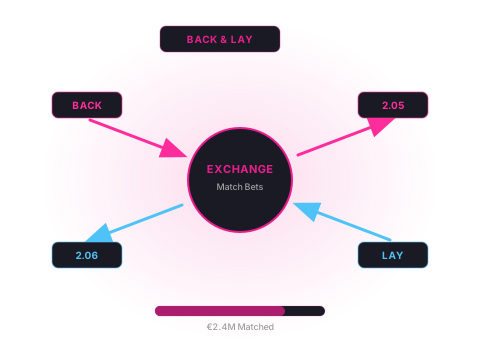
The Betfair Exchange launched back in 2000 and, by a wide margin, is still the world's largest peer-to-peer betting marketplace. It introduced something that hadn't really existed before in mainstream betting: instead of betting against a bookmaker, customers bet against each other, with Betfair running the marketplace and taking a commission on net winnings.
That structural difference matters a lot in practice, more than people give it credit for. The Exchange doesn't restrict profitable accounts the way soft bookmakers do. It offers lay betting (betting against outcomes), which a conventional bookmaker simply can't give you. And on the bigger markets, there's enough liquidity to place serious stakes without moving the price around. Get your head around how an Exchange account works, and where the limits actually are, and you're most of the way to using it well.
How the Betfair Exchange Model Works
On the Exchange, every bet involves two customers: a backer (who bets that an outcome will happen) and a layer (who bets it won't). The backer gets whatever odds are listed; the layer accepts the risk of paying out at those odds if the outcome does happen. Betfair matches the two opposing bets and charges the winning side a commission on the profit.
Here's the key thing for anyone used to conventional bookmakers: Betfair's commercial interest is in volume, not in who wins. A customer who wins consistently generates exactly the same commission revenue as one who loses consistently, because Betfair takes its cut from winnings either way. That's precisely why the Exchange doesn't restrict accounts on profitability grounds. There's simply no commercial reason to bother.
Prices are set by customers posting bets, not by Betfair traders sitting somewhere setting a line. The odds you see at any given moment just reflect the aggregate of customer money sitting at various prices. Pre-match, this tends to produce prices that are competitive with, or better than, what you'd get at a conventional bookmaker. In-play, the Exchange is often the deepest market going for major events.
| Feature | Betfair Exchange | Conventional Bookmaker |
|---|---|---|
| Who you bet against | Other customers | The bookmaker |
| How prices are set | By customer supply and demand | By bookmaker traders |
| Effective margin | ~2–4% (via commission) | 7–12% on major markets |
| Account restrictions | Rare | Common for profitable bettors |
| Lay betting available | Yes (core feature) | No |
| Maximum stake | Limited by market liquidity | Fixed by the bookmaker |
| In-play trading | Full: prices move in real time | Limited: prices set by traders |
Betfair Commission Structure
The standard Betfair Exchange commission rate is 5% on net winnings per market. "Net winnings" just means your total profit across every bet you placed in that specific market for that specific event. Back Manchester United at 2.0 with €100 and they win, your market profit is €100, your commission charge is €5, and you walk away with €95 net.
Worth flagging: commission is charged per market, not per event. So if you place multiple bets in the same market (backing, then trading out of the position, say) the commission applies to the net result of all those bets combined, not to each transaction separately.
Lose on a market and you pay no commission at all. That's the Exchange's "netting" system in a nutshell: you only ever pay when you're actually up.
The Exchange's effective margin (comparing back and lay prices on the same selection) usually sits around 2–4% on liquid markets, well under the 7–12% you'd typically see at a European soft bookmaker. Doesn't sound like much on a single bet, but over thousands of bets that gap adds up to a real difference in expected returns.
Account Restrictions and the Premium Charge
The Exchange just doesn't use the same account restriction playbook as a conventional bookmaker. Profitable bettors aren't stake-limited or shut out of markets as a punishment for winning; Betfair's commission model makes that kind of response unnecessary in the first place.
The thing that actually bites highly successful long-term traders is the Premium Charge (PC). It applies to accounts where lifetime net winnings top £250,000 and lifetime commission paid comes in under 20% of lifetime gross winnings. In those cases, Betfair tacks on a top-up fee to bring the effective commission to somewhere between 20% and 60% of gross winnings, depending on the tier.
For the vast majority of Exchange users, including plenty of serious regulars, the Premium Charge just doesn't come up. It's aimed at a small group of highly profitable professional traders running extreme volume over long periods. If that's you, it becomes a real factor in how you think about the platform. If it's not you (and statistically, it probably isn't), file it away as a problem for a future version of yourself.
For serious bettors after volume betting with zero commission and zero restriction, the Asian bookmaker ecosystem accessed via a licensed betting broker is worth a look. Platforms like Pinnacle charge no commission at all and run margins of 2–3%, roughly on par with the Exchange on the bigger markets.
Liquidity and Effective Limits on the Exchange
There's no fixed maximum bet on the Exchange. What actually limits your stake is market liquidity: the total money other customers have posted at the price you want. On the most liquid markets, major European football pre-match, major horse racing, available liquidity can run into the tens of thousands of euros per selection at competitive prices.
That varies a lot by market, though. In-play liquidity on major events can be about as deep as it gets anywhere. Lower-division football, niche sports, and early prices before serious betting interest has built up can be thin, especially for bigger stakes. Price impact, taking all the money sitting at one price and forcing yourself onto the next, worse price, is a genuine consideration once you're betting big on the Exchange.
For events where Exchange liquidity is thin but Asian books have strong coverage, running both the Exchange and the Asian market through a broker gets you the best overall depth.
Accessing Betfair from Ireland
Betfair takes customers from Ireland directly, under its Malta Gaming Authority licence. Irish customers can open accounts, deposit, and use both the Exchange and the Sportsbook without any location-based restriction.
Account opening follows the same process as for other European customers: registration details, a deposit, and KYC verification (photo ID plus proof of address). Irish bank accounts and cards work fine for deposits and withdrawals, and standard processing times and minimum amounts apply, nothing Ireland-specific to worry about.
If you're already on Betfair Exchange and want to add access to Asian bookmaker markets (Pinnacle, SBOBet, MaxBet), a licensed betting broker like AsianConnect or BetInAsia gets you there from Ireland through a single account. Exchange for in-play and lay strategies, Asian bookmakers for pre-match value: that combination is basically the standard toolkit for professional bettors working out of Ireland.
Frequently Asked Questions
- Does Betfair Exchange restrict winning accounts?
- Not really, no. Betfair Exchange does not operate the same account restriction system as a conventional bookmaker. The Exchange is a peer-to-peer market, and Betfair charges commission on net winnings regardless of outcome, so whether you win or lose does not directly affect Betfair's revenue. Restrictions of the sort you get on soft bookmakers, stake limits, market exclusions, account closure for being too profitable, are rare here. The real constraint is market liquidity: the max you can bet is set by what other customers are willing to take, not by a Betfair risk decision.
- What is the Betfair Premium Charge?
- It is a fee, essentially, applied to highly profitable Exchange accounts that have generated significant net winnings while paying relatively low commission over their lifetime. It kicks in on accounts where lifetime net winnings exceed £250,000 and lifetime commission paid is under 20% of lifetime gross winnings. Betfair charges the difference to bring the effective commission up to 20 to 60% of gross winnings. It affects a small minority of professional traders and long-term profitable users, not recreational bettors or new accounts.
- Can I open a Betfair Exchange account from Ireland?
- Yes, straightforwardly so. Betfair holds a Malta Gaming Authority licence and accepts customers from Ireland, and both the Exchange and the Sportsbook are accessible. Standard account opening and verification requirements apply: photo ID and proof of address to complete KYC before withdrawals get processed.
- What commission does Betfair charge on the Exchange?
- It is 5% on net winnings per market, standard rate. Betfair takes 5% of the profit on markets you finish net positive on; markets where you finish net negative generate no commission at all. New accounts sometimes qualify for promotional reduced rates, and over time very active accounts may qualify for reduced commission through Betfair's loyalty discount system.
- What is the maximum bet on Betfair Exchange?
- There isn't one, not in the way a bookmaker imposes one. The effective ceiling is set by market liquidity: how much money other customers have posted at or near the price you want. On major football (Champions League, Premier League) and major horse racing, liquidity can run to tens of thousands of euros per selection. On lower-profile events, it might be limited to a few hundred euros at competitive prices.
- What is the difference between backing and laying on Betfair?
- Backing means betting that an outcome will happen, same as a standard bookmaker bet. Laying means betting it won't happen, effectively putting you in the bookmaker's seat. When you lay a selection you're taking the other side of someone else's back bet, which brings a liability into play (the potential payout to the backer if the outcome does happen), calculated off the lay price and stake. Both are available on every Exchange market.