Betdaq has been a Betfair competitor since 2000, a year before Betfair itself even launched. That longevity says something. In a space where most Betfair challengers got absorbed or just quietly shut down, Betdaq survived independently for over a decade before Ladbrokes Coral bought it in 2013. It's still one of the few genuine alternatives to Betfair operating at any real scale, which honestly deserves a bit more credit than it usually gets.
The core proposition will feel familiar if you've looked at Smarkets or Orbit: peer-to-peer exchange mechanics, 2% commission, no Premium Charge. What sets Betdaq apart is its Irish regulatory footprint. It holds a licence from the Irish Revenue Commissioners, which has historically translated into deeper Irish horse racing markets than you'll find on Smarkets or Orbit, and makes it a natural one to consider if you're betting from Ireland.
The honest assessment, and there's no point dressing it up, is that Betdaq trails Betfair on raw liquidity across most sports and most markets. But the real question isn't whether it matches Betfair globally. It's whether it has enough depth in the specific markets you actually care about, at a commission rate that's meaningfully lower. For Irish racing bettors, and for anyone building a proper multi-venue setup, the answer is usually yes.
What a Betdaq Account Gives You
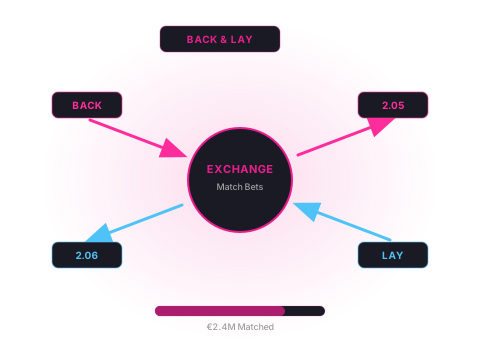
Betdaq operates as a peer-to-peer exchange: all bets are matched between customers, not against a house bookmaker. You can back selections to win or lay them to lose, which opens the standard exchange toolkit of position trading, hedging, and laying overpriced favourites that professional bettors use across all exchanges.
Commission: 2% on net market winnings, charged automatically on settlement. No Premium Charge, no profitability tier, no discount scheme complexity. The rate is the same whether you have been profitable for six months or six years.
Sports coverage: Horse racing (UK, Ireland, and international), football (major European leagues and international competitions), greyhounds, tennis, cricket, golf, and selected other sports. Irish horse racing is historically Betdaq's strongest market.
Irish racing advantage: Betdaq's Irish licence and historical focus on the Irish market has made it a credible venue for Irish National Hunt and Flat racing. Market depth in Irish meetings on Betdaq is often more competitive relative to Betfair than in other sports, worth checking specifically if Irish racing is a primary focus.
Interface and platform: Betdaq's platform is functional but generally considered less polished than Betfair or Smarkets. The core back and lay functionality is accessible; the design reflects a platform that has evolved incrementally rather than been rebuilt for modern user expectations. Desktop is more capable than mobile for complex strategies.
In-play: Available across major sports. In-play liquidity is limited compared to Betfair: adequate for modest stakes in top events, thin for smaller markets and lower-league football.
Betdaq and Irish Horse Racing: The Specific Case
If you bet primarily on Irish horse racing, Betdaq deserves a closer look than the general liquidity comparison with Betfair might suggest. Betdaq's Irish regulatory presence has historically attracted Irish racing market-makers and volume in a way that other Betfair alternatives have not managed. The available matched volume in certain Irish meetings (particularly prominent National Hunt fixtures) is meaningfully higher on Betdaq relative to Betfair than the overall platform size would predict.
To be clear, this doesn't mean Betdaq consistently beats Betfair on Irish racing liquidity. Betfair's scale is just too large for that to be universally true. What it means is that the gap is narrower here than elsewhere, and checking Betdaq's prices before committing to Betfair in Irish racing is a small habit that can genuinely pay off. In any individual race, Betdaq might have the better price for your stake size, especially once Betfair's market has already been picked over at the obvious prices and Betdaq still has volume sitting at a more favourable level.
For bettors whose racing focus is UK flat racing, jumps, or international fixtures, this Irish racing advantage is less relevant. The liquidity gap relative to Betfair is more pronounced in those markets, and Betdaq earns its place in the setup primarily through its commission rate rather than depth.
Commission on Betdaq: Simple, Predictable, Low
The commission arithmetic on Betdaq is identical to Smarkets and Orbit: 2% of net market profit, settled automatically. For a bettor generating €15,000 in gross exchange winnings over a year, the commission bill is €300 on Betdaq versus €750 on Betfair at the standard 5% rate. That difference (€450 per year per €15,000 in winnings) scales linearly and compounds over time.
The more significant comparison is with Betfair's Premium Charge, which applies to accounts that are both consistently profitable and whose lifetime winnings exceed lifetime commission paid. In the worst cases, highly profitable Betfair accounts face effective commission rates of 20%, 40%, or higher. Betdaq has no equivalent mechanism. A bettor in Betfair's highest Premium Charge tier pays 2% on Betdaq regardless of profitability history.
If you haven't run into the Betfair Premium Charge yet, this probably reads as abstract. Fair enough. But for anyone who has, Betdaq's flat rate isn't a marginal improvement, it's a structural difference in how the platform treats you once you start winning consistently. That distinction matters more than it sounds.
Bettors who need access to larger liquidity pools than any European exchange can provide, or who want sharp Asian bookmaker prices alongside exchange markets, may find that licensed betting brokers complement the exchange setup. Brokers route bets through Asian books with significantly higher limits, without the account restriction risks of traditional European bookmakers.
Where Betdaq Fits in a Multi-Exchange Setup
Most serious exchange bettors hold accounts on multiple platforms. The rationale is simple: prices and available volume vary across exchanges, and accessing each market at the best available combination of price and liquidity is a consistent performance advantage over time.
A practical multi-venue exchange setup for an Irish bettor might include: Betfair as primary for highest-volume markets (major football, UK racing); Betdaq as secondary for Irish racing and as a commission-saving venue where its liquidity is competitive; Orbit or Smarkets where specific sports or market structures favour those platforms. No single account covers everything at optimal conditions; the multi-account approach is the professional standard for this reason.
For bettors who have encountered stake restrictions from traditional bookmakers and have moved toward exchanges, maintaining multiple exchange accounts is the natural next step. Exchange accounts don't limit profitable customers; the practical constraint is liquidity, not policy. Building a diversified exchange portfolio addresses that constraint most effectively.
Frequently Asked Questions
- What is Betdaq and who owns it?
- Betdaq is a peer-to-peer betting exchange that matches customers against each other rather than acting as a traditional bookmaker. It was founded in 2000 and acquired by Ladbrokes Coral (now part of Entain) in 2013. Despite its corporate ownership, Betdaq operates as an exchange: you back and lay against other customers, not against the house. Commission is charged on net winnings rather than built into the prices, which is the structural advantage of the exchange model over traditional bookmaking.
- Can I open a Betdaq account from Ireland?
- Yes. Betdaq is licensed by the Irish Revenue Commissioners; it actually holds an Irish betting exchange licence, which is notable among exchange platforms. Irish residents can register, verify, deposit, and access markets in the same way as UK customers. The platform has historically had a particular focus on Irish horse racing, which remains one of its stronger markets relative to other non-Betfair exchanges.
- What commission does Betdaq charge?
- Betdaq charges 2% commission on net market winnings, the same headline rate as Smarkets and Orbit Exchange. Like those platforms, it does not operate a Premium Charge or profitability-based surcharge. The 2% applies uniformly to all account holders regardless of win rate or lifetime account performance. Commission is deducted automatically on market settlement; losing bets incur no commission charge.
- How does Betdaq liquidity compare to Betfair?
- Betdaq has lower overall liquidity than Betfair, particularly in high-volume markets like Premier League football and UK flat racing. The gap is meaningful for large-stake bettors who need consistent access to significant matched volume. Where Betdaq has performed better historically is in Irish horse racing, where its Irish licence has helped it attract market-making activity. For bettors primarily interested in Irish racing, Betdaq is worth assessing specifically in those markets before assuming Betfair has a blanket advantage.
- Does Betdaq have in-play betting?
- Yes. Betdaq offers in-play markets across football, horse racing, tennis, and other sports. In-play liquidity is limited compared to Betfair; for most sports, in-play volume on Betdaq is adequate only for modest stakes in major events. The platform has improved its in-play offering over time but has not closed the gap with Betfair for large-volume in-play trading.
- Is Betdaq a good alternative to Betfair?
- Betdaq earns a place in a multi-exchange setup primarily through its 2% commission rate (versus Betfair's standard 5%) and its Irish horse racing market depth. It is not a wholesale Betfair replacement; the liquidity difference is too large for most markets. The practical case for a Betdaq account is specific: Irish racing bettors who want to compare prices against Betfair, bettors affected by Betfair's Premium Charge who need lower-cost alternatives, and bettors building a comprehensive multi-venue setup to access the best available price in each market.