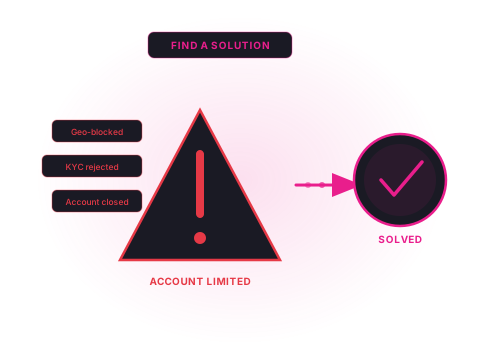
You've placed bets, accumulated winnings, and then tried to withdraw, only to find your account locked pending verification. Or perhaps you submitted documents on sign-up and they were rejected without a clear explanation. Honestly, the verification process at retail bookmakers is one of the most inconsistently applied parts of the entire betting account experience, and it doesn't get better with time.
Understanding how identity verification actually works (and why it sometimes doesn't) helps you navigate the process more effectively, and decide when it's worth pushing back versus when the situation calls for a different approach altogether.
Why Bookmaker Verification Fails
Most failed verifications have one of three causes: document quality issues, a mismatch between submitted information and account details, or a deliberate hold applied by the bookmaker's risk team. The first two are genuinely fixable. The third is a different situation.
On the technical side, automated document verification systems are sensitive to image quality. A passport photo taken in low light, with a reflection across the chip area, or with clipped edges will typically fail automated processing. Proof of address documents that are more than three months old, or which show a different address format than the one registered on the account, are frequent rejection triggers. Getting the format right (a clear, unedited scan or photo, in PDF or high-resolution JPEG, showing all four corners of the document) solves most of these cases.
The trickier scenario is when a bookmaker's risk or compliance team has applied a manual hold. This happens more often than most bettors realise, and it doesn't always mean anything has gone wrong with the document submission. Some bookmakers initiate enhanced due diligence checks on accounts that have triggered their internal profiling: winning history, unusual deposit patterns, large withdrawal requests, or simply accounts they've decided to keep an eye on. In these cases the verification request is a precursor to a broader account review, not a routine identity check.
Signs That the Verification Is More Than a Standard KYC Check
If your verification situation involves any of the following, it is likely a risk-driven review rather than a simple documentation issue:
- Requests for source of funds: Standard KYC does not require payslips or bank statements. If these are being requested alongside a standard ID check, you are in enhanced due diligence territory.
- Withdrawal hold with no withdrawal requested: If your account's verification status has changed without you initiating a withdrawal, it is likely a proactive review rather than a reactive check.
- Support responses that are vague or non-committal: "Your documents are under review" repeated over several days without a specific timeline is a sign of manual intervention.
- Account activity being paused: If you can log in but cannot place bets while verification is pending, this goes beyond standard KYC practice.
- Multiple resubmissions that keep failing: If you have resubmitted documents that clearly meet the stated requirements and they keep being rejected, the problem is not the documents.
What Most Bettors Do (and What Actually Works)
The natural response to a verification failure is to re-read the requirements and resubmit better documents. This is the right first step for genuine document quality issues, and it works. A cleaner scan, a fresher proof of address, or a document that exactly matches the account registration details will resolve the majority of standard KYC failures within 24–72 hours.
Where bettors get stuck is when this approach fails repeatedly. The tendency then is to keep resubmitting variations of the same documentation, hoping something will eventually be accepted. It rarely works past the third or fourth try. At that point, the most useful thing you can do is request written clarification of exactly what is missing, not a phone call, a written response via email or the bookmaker's support ticket system. A written response creates a record, and it forces the bookmaker to either provide a specific requirement or admit they can't.
For withdrawals that are being blocked by a pending verification, in regulated markets the regulatory authority has the power to compel the bookmaker to process your withdrawal regardless of the verification status if the delay exceeds what is considered reasonable. This is not a fast process, but it is an option that most bettors are unaware of.