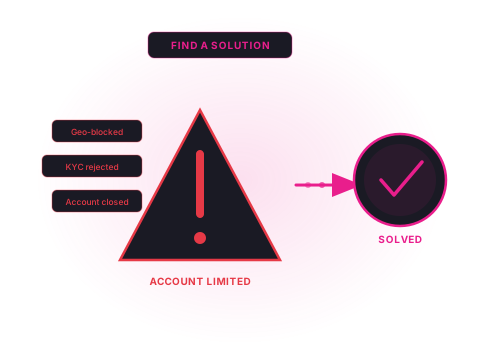
You've tried to open a betting account and been refused, or the application is stuck in some limbo state where it neither progresses nor fails cleanly. For bettors in Ireland and plenty of other markets, this isn't unusual at all; it's a structural consequence of how betting licensing works across different jurisdictions.
Understanding why accounts get refused helps you figure out whether the problem is fixable or whether a different approach is more appropriate. In many cases, direct sign-up at a particular bookmaker isn't available in your country, and the practical path forward involves a different structure entirely.
Why Bookmakers Refuse Account Applications
The most common reason for an account refusal, particularly for bettors in Ireland and the UK, is a country or market restriction. Some bookmakers (Pinnacle being the most notable example) do not hold a licence for the Irish or UK market and therefore cannot accept direct accounts from those countries. This isn't a judgement of the individual bettor; it's a licensing position. Pinnacle's restricted countries list includes Ireland because they don't have an Irish licence, not because Irish bettors are unwelcome as a category.
The second major cause is identity verification failure during the sign-up process. Most bookmakers now run automated ID checks as part of registration, matching the details you provide against public records and identity databases. If the automated check fails for any reason (name format, date of birth mismatch, address not found in the database), the account may be refused before you've even submitted any documentation. See our separate guide on bookmaker verification failures for the specifics of how to resolve these.
A less visible but common reason is an internal group-level flag. Many major bookmakers are owned by the same corporate groups. An account closure at Bet365, for example, can trigger a system flag that prevents new account applications at other brands within the same group. Bettors who have been closed at one brand are often surprised to find that apparently unrelated bookmakers under the same parent company also refuse their applications. This information is never communicated directly, but it is a real and widespread pattern.
The Geography Problem: When Your Country Is the Issue
For bettors in Ireland in particular, the country restriction issue affects access to some of the most interesting markets. Pinnacle (which offers sharp odds, high limits, and no account gubbing) does not accept direct sign-ups from Ireland. The same applies to many Asian bookmakers like SBOBet, MaxBet, and Singbet, which have their own market access restrictions based on licensing arrangements.
There's a kind of commercial irony here that experienced bettors notice pretty quickly. The bookmakers that are best for serious bettors, the ones that don't limit winning accounts, tend to be the ones with the most restricted direct access. The ones that are most freely accessible tend to be the ones that close or restrict winning accounts most aggressively. Funny how that works out.
It is important to be clear about one thing: attempting to circumvent these restrictions by using a VPN or providing false location information is a terms of service violation and can result in account closure and, in some cases, forfeiture of funds. It is not a recommended approach. The structured alternative (using a licensed betting broker) is the legal and sustainable solution.
Self-Exclusion and Cross-Operator Blocks
In some regulated markets, there are shared self-exclusion registers that apply across all licensed operators in that jurisdiction. If you have previously self-excluded (whether as a precautionary measure or due to a gambling concern), that exclusion may be shared across operators, and new account applications may be blocked. The processes for reversing a self-exclusion vary by jurisdiction and operator, and some exclusions have minimum cooling-off periods that cannot be waived.
If this is the cause of your account refusal, resolving it requires contacting the relevant gambling authority for your jurisdiction to understand the exclusion status and the procedure to lift it. This is not a process that individual bookmakers can override: it's a regulatory function.