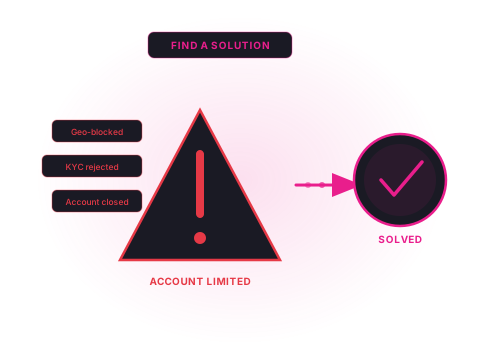
Common Bettor Problem

Your Bookmaker Just Limited Your Account. Here's What's Actually Happening.

Account limits are the bookmaker's way of telling you they don't want your action. Most bettors get no explanation — this guide gives you the real one.

Jump to Solutions →
Bookmaker account limits — causes and solutions

You log in to place a bet you've been sitting on, type in your stake, and the system won't accept it. Or a market loads with a maximum stake of €0.50 where last week there was no restriction at all. No email, no explanation — just a silent, sudden cap on what you can do. That's what a bookmaker limit feels like, and for most bettors it arrives without warning.

This page explains what actually triggers a limit, what the warning signs look like before one arrives, and what your realistic options are once it has. We'll cover the wrong moves most bettors make first — and the approach that professional bettors use to stay in action long-term.

Why Bookmakers Limit Winning Players

The corporate explanation is "risk management." The real explanation is simpler: soft bookmakers operate as market-makers with a built-in margin. When a bettor consistently finds value above that margin, they become unprofitable to accept. Limits are not a punishment — they're a business decision, made by algorithm.

Most major bookmakers use automated profiling that tracks your closing line value (CLV) — how the odds you got compare to where the market closes. A bettor who consistently gets odds that are better than the final price is demonstrating the ability to find value. That triggers a flag. The system also tracks stake patterns, market selection (are you always on sharp markets?), timing (do you bet just after line movements?), and win rate over rolling windows of 30, 60 and 90 days.

The uncomfortable truth is that you don't have to win at an unusual rate to be limited. Being a net winner at all, over a sufficient sample, is enough. Bookmakers aren't required to take bets from anyone — and their margin is built on the assumption that most customers lose. Anyone who doesn't becomes a liability.

Warning Signs Most Bettors Miss

Most bettors only realise their account was flagged after the limit appears. By that point, the risk team's decision is already made. But there are usually signals beforehand — you just have to know what you're looking at.

What Most Bettors Try (And Why It Rarely Works)

The first reaction is usually customer support — a message asking why the limit appeared and whether it can be reviewed. In almost every case, the reply is a templated response referencing "commercial decisions" with no further explanation. Escalating to a complaints process rarely changes the outcome: the risk assessment is made by a system, not a representative, and support agents have no authority to override it.

The second instinct is to open a new account — under a partner's name, a different email address, or a separate household member. This violates bookmaker terms of service in every case and, if discovered, typically results in voided bets and account closure across the entire platform group. It's also increasingly detectable through device fingerprinting and IP pattern matching.

Some bettors try routing through a VPN to appear from a different location. This carries its own risks — most bookmakers can detect common VPN providers, and any account associated with a VPN is typically flagged for additional review. See our guide on VPNs and betting accounts if you're considering this route.

What Professional Bettors Do Instead

Professional bettors don't fight restrictions — they route around them. The fundamental shift in mindset is treating bookmaker access as a logistics problem to be managed, not a personal injustice to argue about. There are three structural moves that serious bettors make, usually in combination.

1. Using Sharp Books From the Start

Pinnacle is the most well-known example of a bookmaker that explicitly welcomes winning bettors. Their model is built on high volume and tight margins rather than profiling and restricting individual customers. If you haven't explored opening a Pinnacle account, it's the first practical step for any bettor who wants longevity. SBOBet and other Asian books operate on similar principles.

2. Moving Action to Betting Exchanges

Exchanges like Betfair operate on a peer-to-peer model — you're betting against other customers, not the house. There is no structural reason for an exchange to limit a winning bettor because the exchange earns commission on all matched bets regardless of outcome. Liquidity is the main constraint on exchanges, not profitability profiling. See our exchange platform guides for more on how they work.

3. Using a Licensed Betting Broker

A licensed betting broker places bets on your behalf through professional-grade corporate accounts. The bookmaker interacts with the broker — not with you as an individual — which means your personal betting patterns are never visible to the bookmaker's risk system. Services like AsianConnect and BetInAsia give clients access to Pinnacle, SBO, and Asian markets through this model. It's how most serious bettors in Ireland and across Europe eventually structure their action.

Practical Steps to Take Right Now

  1. Document the limit immediately. Screenshot the maximum stake shown, note the date and which markets are affected. You'll need this if you formally appeal or pursue a complaint.
  2. Test whether the limit is market-specific or account-wide. Try placing a small bet on a very popular, liquid market (like a major football match outright). If that also has a cap, the account is fully flagged. If only certain markets are affected, the flag may be narrower.
  3. Open an account with Pinnacle or a betting exchange. Do this now, not later. Verification processes take time, and having an alternative already in place means you're not locked out when the next restriction arrives.
  4. Research betting broker options. Compare AsianConnect, BetInAsia, and alternatives. Consider which books you need access to and what commission structure makes sense for your volume.
  5. Adjust your behaviour on remaining unrestricted accounts. Diversify stake sizes, avoid always betting at the same time relative to line movements, and reduce the signals that trigger algorithmic flagging. Our guide on avoiding bookmaker restrictions covers this in detail.

Professional Solutions — Recommended Betting Brokers

These brokers give professional bettors access to Pinnacle, SBO, and other sharp bookmakers without account limits or restrictions.

  1. #2
    BetInAsia

    Sharp odds, fast execution, low commission

  2. #3
    MadMarket

    Exchanges & Asian books via one account

  3. #4
    SportMarket

    European-regulated broker with wide market access

Frequently Asked Questions

Can I get my bookmaker limit reversed?

Rarely. Once a bookmaker's risk team flags your account as sharp, the limit is almost never lifted through customer support. Appeals occasionally result in a temporary increase, but the account stays flagged. The more effective approach is to move your action to platforms that don't limit — such as Pinnacle, betting exchanges, or a licensed betting broker.

Do bookmakers share data about limited accounts?

There is no confirmed industry-wide database, but many bookmakers share a corporate parent or use the same third-party risk management providers. In practice, being limited at one major UK or Irish bookmaker often leads to tighter scrutiny — or faster limits — at their sister brands. Betfair, Paddy Power, BoyleSports and others use shared fraud and risk infrastructure.

Will I get limited if I only bet on favourites?

Betting on favourites alone doesn't protect you. What triggers limits is sustained profitability — particularly if you consistently beat the closing line (the odds available just before kick-off). A bettor who consistently gets better odds than the market closes at will be flagged regardless of which selections they bet on.

Is there a bookmaker that doesn't limit winners?

Yes. Pinnacle is the most well-known sharp bookmaker that explicitly does not restrict winning bettors. Betting exchanges (Betfair, Orbit Exchange) also don't limit accounts by nature — you're betting against other customers, not the house. Professional bettors often access both types through licensed betting brokers.

How do betting brokers help avoid limits?

A betting broker places bets on your behalf through corporate-grade accounts. The bookmaker deals with the broker — not you individually — so no pattern profiling of your personal account occurs. Brokers like AsianConnect and BetInAsia give clients access to Pinnacle, SBO, and Asian markets through this model.