When bettors look for alternatives to Betfair, the conversation usually starts and ends with Orbit Exchange. Matchbook gets talked about less, which is a little unfair, because it occupies a genuinely distinct position in the exchange landscape, particularly if American sports are anywhere on your radar.
Where Orbit has invested in cricket and top-tier football, Matchbook went a different direction and deliberately targeted NFL, NBA, and MLB markets. That's not a trivial difference if American sports are your main thing. Matchbook's US market depth is meaningful in a way Betfair's US sports section, frankly, just isn't, and the lower commission rate compounds the advantage for anyone betting at volume in those markets.
For European sports, the picture gets more nuanced. Matchbook's football and horse racing markets exist, sure, but they don't replicate Betfair's depth (not even close, in most cases). Figuring out where Matchbook fits, and where it doesn't, comes down to the same question you'd ask of any exchange: what does the liquidity actually look like in the specific markets you want to bet in?
What a Matchbook Account Gives You
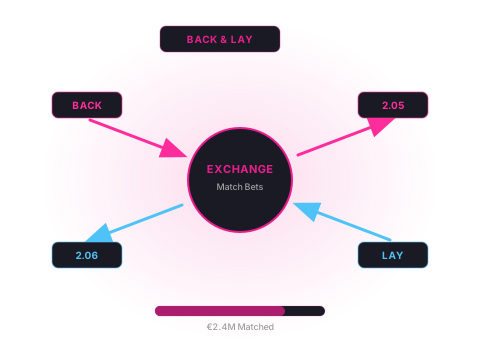
Matchbook operates on the peer-to-peer exchange model: you back and lay against other customers, not against a house bookmaker. The platform matches orders at agreed prices, settles markets on official results, and charges commission on net winnings. The structural advantages of this model (no account limits based on profitability, no margin built into prices by a counter-party bookmaker, the ability to act as layer as well as backer) are the same as any other exchange.
Commission: Matchbook's commission rate is lower than Betfair's standard 5%. The exact current rate should be verified on Matchbook's website, as the structure has evolved over time. The absence of a Premium Charge-style mechanism means the headline rate is the actual effective rate for any level of profitability.
Sports coverage: Football, horse racing, tennis, cricket, golf, and a strong selection of American sports: NFL, NBA, MLB, NHL, and college sports. The US sports focus is the differentiating factor.
In-play betting: Available on major sports. US sports in-play markets have reasonable depth for the platform's scale; European horse racing in-play is thinner than Betfair.
Trading: Back and lay functionality for position trading is available. Third-party trading software integration is more limited than Betfair's mature API ecosystem, which matters if you're a systematic trader relying on automation. Worth knowing before you build a workflow around it.
Matchbook's Strongest Markets: American Sports
The case for a Matchbook account is strongest if American sports are part of your betting portfolio. NFL game markets, NBA moneylines, and MLB lines have genuine exchange depth on Matchbook in a way that Betfair (whose US sports books are thin by European standards) does not replicate.
For a European or Irish bettor with interest in US sports, the typical setup is: Betfair for European racing and mainstream football, Matchbook for NFL/NBA/MLB where it offers the better exchange. The accounts complement each other rather than compete. Each earns its place.
Cricket bettors, do yourselves a favour and compare Matchbook to Orbit Exchange directly before committing to either. Orbit has specifically invested in cricket liquidity and in many match types will provide the deeper market. Checking both platforms pre-match takes two minutes and it's worth the step.
Account Restrictions: What Exchange Bettors Need to Know
Exchange accounts (on any platform, including Matchbook) do not restrict winning customers the way traditional bookmakers do. A bookmaker that identifies you as profitable can limit your stakes, restrict the markets you can bet in, or close your account entirely. An exchange cannot do this in the same way: your bets are matched against other customers, and as long as someone on the platform is willing to take the other side of your bet at your price, it will be matched.
The practical limit on exchange betting is liquidity, not policy, and that distinction matters more than it sounds. If Matchbook's NFL book carries €50,000 in available match odds volume, you cannot place €200,000 pre-match without moving the market significantly or being left holding unmatched portions. The constraint is structural, not adversarial. Nobody's out to get you here; there's just not enough money on the other side of the trade.
For professional bettors who have encountered bookmaker stake restrictions or account closures, exchanges provide meaningful relief from this problem. For those who need consistent access to very large stakes across multiple bookmakers, a licensed betting broker accessing Asian books offers depth that no European exchange can match.
Where Matchbook Fits in a Professional Setup
Most professional bettors who use exchanges maintain multiple accounts. The reasoning is simple: prices and available volume differ across platforms, and routing each bet to the best available venue improves execution over thousands of bets.
The practical stack for a serious exchange bettor typically looks something like: Betfair as the primary account for European racing, football, and tennis; Orbit as a secondary account for cricket and as a commission-saving venue for football where liquidity is comparable; Matchbook if US sports are part of the portfolio or as an additional price comparison point.
Each additional account adds some administrative overhead: separate verification, separate funding, separate platform logins. Whether that's justified depends entirely on the specific markets you bet in and the volume at which you operate. For US sports bettors, the Matchbook account is a fairly easy call. For bettors focused entirely on European horse racing? It adds little, and I wouldn't bother.
Frequently Asked Questions
- What is Matchbook and how does it differ from Betfair?
- Matchbook is a peer-to-peer betting exchange: it matches customers against each other rather than acting as the bookmaker. The core difference from Betfair is commission: Matchbook charges lower rates (typically around 2% or less depending on sport and account tier) compared to Betfair's standard 5%. Betfair has significantly more liquidity overall, but Matchbook has carved out a position in specific markets (particularly US sports) where it has invested in market depth.
- Can I open a Matchbook account from Ireland?
- Yes. Matchbook accepts customers from Ireland. It holds a gambling licence and follows standard regulatory requirements. Irish residents can open an account, verify their identity, deposit, and access all available markets. There are no specific geographic restrictions affecting Ireland.
- What commission does Matchbook charge?
- Matchbook's commission structure offers rates below Betfair's standard 5%. The exact rate has varied over time and may differ by sport or account tier. Checking the current commission schedule on Matchbook's website is advisable before comparing it to Betfair or Orbit. As with all exchanges, commission is charged on net market winnings; losing bets attract no commission charge.
- What sports can I bet on with a Matchbook account?
- Matchbook covers football, horse racing, tennis, American football, baseball, basketball, cricket, golf, and other sports. Its strongest market position is in US sports: American football (NFL) and basketball (NBA) in particular have attracted genuine liquidity on Matchbook, making it a credible venue for bettors specifically focused on those markets. For European horse racing and general football, Betfair retains the liquidity advantage.
- Does Matchbook have a Premium Charge like Betfair?
- Matchbook does not have a mechanism equivalent to Betfair's Premium Charge. Like Orbit Exchange, Matchbook's commission structure is a flat rate without profitability-based surcharges. This makes it commercially friendlier for consistently profitable bettors who have been affected by Betfair's tiered penalty system.
- Is Matchbook safe and regulated?
- Matchbook is a licensed operator and follows standard regulatory requirements including identity verification, responsible gambling tools, and customer fund segregation. Check the current regulatory status in your jurisdiction before depositing. As with any exchange, accounts are not subject to restriction based on profitability in the way traditional bookmaker accounts can be limited or closed.