Most bettors have placed a bet with a bookmaker at some point without ever really asking what a bookmaker is, or how it makes its money. Worth understanding, actually, because it explains both why traditional bookmakers behave the way they do (limiting accounts, adjusting odds, closing winning customers, the whole playbook) and why exchanges run on fundamentally different incentives.
A traditional bookmaker sets prices, takes bets against its own book, and profits from the margin baked into those prices over time. Your win is, quite literally, their loss. An exchange does neither of those things. It's a marketplace, nothing more: a platform connecting customers who want to bet with customers who want the other side of that bet. The exchange never takes a position of its own. It charges a small commission on net winnings. That's the whole business model, and it's honestly kind of elegant once it clicks.
This structural difference ripples through every part of the betting experience: the prices you see, the limits you face, how the platform treats profitable customers, what strategies are even open to you. None of this is academic. It's directly relevant to how you should bet.
The Core Mechanic: Backing and Laying
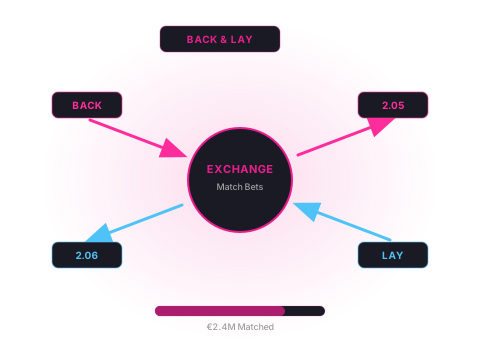
Every exchange transaction has two sides: a backer and a layer. Place a standard bet, money on a team to win, a horse to finish first, and you're backing. Whoever's on the other side is laying: effectively playing the bookmaker, taking your bet and paying out if you win.
On an exchange you can do either. Back a selection like you would with any bookmaker, or lay one, meaning you're betting it won't win. Lay a horse at 5.0 for €10 and you're effectively offering another customer a bet: they put up €10, you put up €40 (the potential payout minus the stake), and you pocket their €10 if the horse loses.
Being able to act as the layer opens up strategies a traditional bookmaker just can't offer. You can:
- Lay overpriced favourites when you believe the market has underestimated the chances of other outcomes
- Back a selection pre-event and lay it in-play if the price shortens, locking in a profit regardless of the outcome
- Build complex trading positions across multiple runners in the same market
- Hedge existing positions from bookmaker bets by laying on an exchange
None of it requires special permission or account approval. It's all just there, part of the standard product, for any exchange customer to use.
The Order Book: How Prices Are Formed on an Exchange
Unlike a bookmaker, where a trader sets the prices and you either accept or walk away, exchange prices come from the market itself. Open a market on Betfair or any other exchange and you're looking at an order book: a live feed of every outstanding back and lay order at each price point, plus the volume sitting there.
Want to back a football team at 2.40? The exchange matches you against customers who've placed lay orders at 2.40 or better. Enough volume at your price, and you're matched instantly. Not enough, and your order just sits in the book until a matching lay order shows up, or you cancel it.
What this produces is prices that reflect actual market consensus rather than one firm's pricing decision. On heavily traded markets, major football matches, popular horse races, the exchange price is typically a more accurate read on true probability than any single bookmaker's line. Bookmakers shade their prices to build in margin; the exchange price just converges toward the real probability as volume builds up.
The upshot: exchange odds tend to beat bookmaker odds for the same selection in the same market. Not dramatically, the gap varies by sport and event, but consistently. Over hundreds of bets, that consistent edge in price compounds into a real gap in long-run returns.
Commission Instead of Margin: The Exchange's Business Model
Bookmakers make money by building margin into their prices. The sum of implied probabilities across all outcomes exceeds 100%, and that excess is their expected profit. A bookmaker offering 1.90 on both sides of a coin flip expects to profit because those odds only imply 52.6% probability on each side, 105.2% total.
Exchanges charge no margin at all. Prices in the order book reflect what customers are willing to accept from each other, not what some firm decided to offer. Instead of margin, exchanges charge commission, a percentage of net market winnings. Betfair's standard rate is 5%. Smarkets, Orbit, and Betdaq charge 2%.
Here's the important bit: commission only ever applies to net winnings. Back a horse, it wins, you pay commission on the profit. It loses, you pay nothing. Across a session with wins and losses mixed in, commission gets calculated on your net position in each market, independently.
There's a slightly counterintuitive implication here: on exchanges, losing bets cost you nothing in platform fees. The platform only earns when you win. In a sense that aligns its interests with yours, they want you to win, because your wins generate their revenue. In practice, though, the commission structure just means the exchange is genuinely indifferent to who wins any given bet; it only cares that money keeps flowing through the platform.
Liquidity: Why It Matters and How to Assess It
Liquidity is probably the single most important practical variable on any exchange. It's just the volume of money available to be matched at a given price. In a highly liquid market, a Premier League match on Betfair say, millions of euros' worth of bets can be sitting at each price point. In a thin market, a few hundred euros might be all that's matched anywhere.
Why does it matter? Because the exchange can only match you against someone else willing to take the other side. Want to back a selection for €5,000 but only €1,000 is available at your price? €4,000 of your order just sits there, unmatched. Wait and hope more volume shows up, accept a worse price where volume exists, or take a partial match, those are your options.
Checking liquidity before you bet is, honestly, the one habit that separates disciplined exchange bettors from frustrated ones. Before committing a stake, look at order book depth at your target price and the two or three prices either side. If the available volume there is less than what you want to bet, adjust your expectations, not the market.
Liquidity varies by exchange, sport, event type, and how close you are to the event. Betfair has the most overall, no contest. Pre-event, the major markets carry the most volume. In-play, it spikes around key moments and dries up in the quiet stretches. Minor leagues, niche sports, obscure markets: thin everywhere except Betfair, and often thin there too.
Exchange Accounts and Winning Customers: A Fundamental Difference
For serious bettors, the most commercially significant difference between exchanges and bookmakers is simply how each treats profitable customers.
A bookmaker that spots you as consistently profitable will typically limit your stakes, restrict which markets you can bet in, or just close your account. Rational, from their side of things: their profits come from margin on losing bets, and a consistent winner erodes that margin directly. Professional bettors are not welcome in that business model. Not really a secret, if you're honest about it.
An exchange cannot behave that way, and doesn't. Its revenue is commission on matched volume, earned regardless of who wins. A consistent winner generates just as much commission as a consistent loser, more, actually, since winning positions are exactly what commission applies to. There's no financial reason for an exchange to restrict or close a profitable account. The only real limit on how much a profitable exchange bettor can wager is market liquidity.
That's why exchanges have become the core venue for professional bettors. If you've hit stake restrictions from traditional bookmakers, which happens to nearly every consistently profitable bettor eventually, exchanges are a structural solution, not some clever workaround.
One exception worth flagging: Betfair's Premium Charge, which does penalise highly profitable accounts through a higher effective commission rate. But that's a Betfair-specific quirk; alternatives like Smarkets, Orbit Exchange, and Betdaq run without anything like it.
How Professional Bettors Use Exchanges
Professional bettors rarely rely on a single exchange; most keep accounts across several. Makes sense when you think about it: prices and available volume vary across platforms, and hitting each market at the best combination of price and liquidity improves your returns over time. Betfair for maximum liquidity in mainstream markets, Smarkets or Orbit where their 2% rate and decent depth make them the more efficient venue, Betdaq for Irish racing specifically.
Beyond exchanges, professional bettors who need very large stakes, more than European exchange liquidity can support, typically turn to licensed betting brokers. Brokers like AsianConnect and BetInAsia give access to Asian bookmakers such as Pinnacle and SBOBet, where matched limits run significantly higher than European exchanges in most markets. It's not exchanges versus brokers so much as exchanges and brokers, each covering a different part of the portfolio.
If you're exploring exchanges for the first time after running into bookmaker restrictions, a sensible sequence is: get the exchange model straight (which this guide covers), compare the major exchanges to see where each one is strongest, then open accounts on whichever platforms fit your target markets. And if your needs go beyond what European exchange liquidity can offer, it's worth asking whether a licensed betting broker belongs in your setup alongside those exchange accounts.