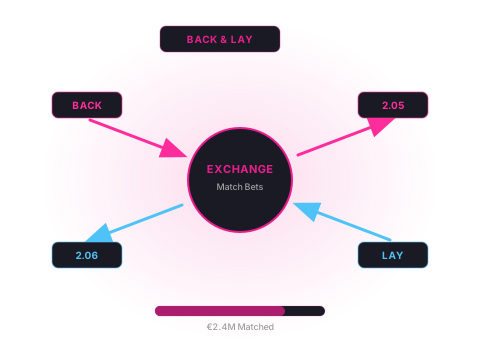
If you've ever placed a bet with a bookmaker, congratulations, you've placed a back bet. You picked a selection, put up a stake, and stood to collect if it won. The bookmaker took the other side: paid out if you won, kept your stake if you lost. They were laying your bet. You were backing it. Simple enough.
On an exchange, though, you can do either. Every market has a back side, for customers who want to bet on something winning, and a lay side, for customers willing to take the bookmaker's role for that one selection. The exchange just matches the two together and skims commission off the winnings.
This isn't just theory, and it's worth saying plainly: the ability to bet from either side changes what strategies are even open to you, how you manage risk, which situations create real edge. Skipping over the lay side because it feels unfamiliar is, honestly, leaving half the toolkit on the table.
Back Betting: The Familiar Side
A back bet on an exchange works identically to a bet with a bookmaker, except that you are matched against another exchange customer rather than the bookmaker itself.
You select a market, choose a selection, enter your stake, and confirm at the available back price. If the selection wins, you collect: stake × (back odds − 1). If it loses, you lose your stake.
The back odds on an exchange are typically better than those available at traditional bookmakers in the same market. The reason is structural: exchange prices reflect what customers are willing to accept from each other without a bookmaker's margin built in. After paying exchange commission, exchange bettors still generally net better returns than equivalent bookmaker bets at competitive prices.
The practical difference from a bookmaker back bet: on an exchange, your bet needs to be matched. In a liquid market, this happens instantly. In a thin market, your order may sit partially or fully unmatched until another customer is willing to take the lay side at your requested price. In the most liquid markets (major football pre-event, big racing, top tennis) this is rarely a constraint.
Lay Betting: Acting as the Bookmaker
A lay bet inverts the standard position. Instead of betting a selection will win, you are betting it will not. You offer to match another customer's back bet, accepting their stake in exchange for the obligation to pay out if the selection wins.
Here's the money flow, stripped down: if the selection loses, you collect the backer's stake (minus commission); if it wins, you pay out their winnings, which equals their stake × (odds − 1).
That second figure, what you pay if the selection wins, is your liability. The exchange freezes that amount from your balance before it'll even accept the bet. No funds to cover it, no lay bet. Simple as that.
Liability calculation: stake × (lay odds − 1)
Example: lay a horse at 4.0 for a backer's stake of €50.
- If the horse loses: you win €50 (minus 2% or 5% commission depending on exchange)
- If the horse wins: you pay €50 × (4.0 − 1) = €150
- Your liability before the race: €150 (frozen from your account balance)
The key asymmetry: your maximum win on a lay bet is the backer's stake. Your maximum loss scales with the odds. Laying at short odds (1.30, 1.50, 2.00) means your liability is manageable relative to your potential win. Laying at long odds (8.0, 15.0, 30.0) means your liability is a large multiple of what you stand to win. Understanding and respecting this asymmetry is the most important risk management lesson in exchange betting.
Back vs Lay: Direct Comparison
| Factor | Back Bet | Lay Bet |
|---|---|---|
| Your position | Betting the selection WINS | Betting the selection does NOT WIN |
| Your role | Customer / punter | Bookmaker for that transaction |
| If selection wins | You win: stake × (odds − 1) | You lose: backer's stake × (odds − 1) = liability |
| If selection loses | You lose: your stake | You win: backer's stake (minus commission) |
| Maximum win | Stake × (odds − 1) | Backer's stake |
| Maximum loss | Your stake | Liability = backer's stake × (odds − 1) |
| Commission applies | On net winning markets | On net winning markets |
| Available at bookmakers | Yes | No (exchanges only) |
Using Back and Lay Together: Position Trading
The real power of having access to both sides of a market is the ability to trade positions. Position trading means placing a back bet at one price and a lay bet on the same selection at a different price (either before the event or in-play) to create a guaranteed outcome regardless of the result.
The simplest form: back a selection at a long price pre-event (say 5.0), then lay it in-play if the odds shorten significantly (say to 2.0) after a positive development. The back bet wins if the selection wins; the lay bet wins if the selection loses. The exact profit on each outcome depends on the stakes and odds, but the difference in prices creates a "green book": both outcomes are profitable, or at minimum one is profit and the other is a small loss.
More sophisticated approaches get into scalping small price movements in liquid pre-event markets, trading football matches around goals (prices lurch hard the second the ball hits the net), or trading horse races in the volatile minutes before the off. None of this comes naturally at first. Each one takes practice, a fair bit of patience, and a real feel for how liquidity behaves in that specific corner of the market, something you mostly learn by losing small amounts of money until it clicks.
For bettors who are interested primarily in value betting rather than trading, back and lay still interact in useful ways, particularly in hedging. If you have backed a selection at a bookmaker and the price has shortened, laying at the shorter price on an exchange locks in a guaranteed return before the event. You convert a speculative position into a certain profit, trading some upside for certainty. This is position management, not just betting.
When to Back and When to Lay
The direction of a bet (back or lay) should follow where the value is, not a preference for one approach over the other. If you have identified a selection that is underpriced relative to its true probability of winning, back it. If you have identified a selection that is overpriced (the market has given it more credit than it deserves) lay it.
In practice, most value-betting strategies are back-side focused. The back side is where price discovery is most accessible: you compare bookmaker prices to exchange prices, identify gaps, and act. The lay side requires a different analytical approach: assessing whether the market consensus on a selection is too high, rather than too low.
Where lay betting genuinely shines is in markets where a selection's been pushed to a short price for reasons that have nothing to do with analysis: public sentiment, media hype, recency bias, that sort of thing. Popular short-priced favourites in high-profile races and matches are the classic hunting ground for this. And the question isn't "do I think this will lose?" It's "do I think the real probability here is lower than what the odds imply?" That's the whole test.
Bettors who want access to the broadest possible markets (including sharp Asian bookmakers alongside exchanges) use licensed betting brokers to complement their exchange accounts. Brokers provide access to books like Pinnacle where the pricing is tight and limits are high, while exchange accounts handle the back/lay positioning and trading that bookmakers cannot offer.
Frequently Asked Questions
- What is the difference between back betting and lay betting?
- Back betting means betting that a selection WILL win: the standard bet type familiar from bookmakers. Lay betting means betting that a selection will NOT win: you take the opposite position, acting as the bookmaker for that transaction. Both are available on betting exchanges. Traditional bookmakers only offer back betting; on an exchange, both positions are available to any registered customer.
- Which is more profitable: backing or laying?
- Neither is inherently more profitable. Both positions are profitable when the odds available are better than the true probability of the outcome. Back betting is profitable when you identify selections that are underpriced (the true probability of winning is higher than the odds imply). Lay betting is profitable when selections are overpriced (the odds imply a lower probability of winning than is realistic). The edge comes from finding mispriced markets, not from choosing a direction.
- Can you make guaranteed profit from back and lay betting together?
- A back bet and lay bet on the same selection at the same odds produces a near-guaranteed profit neutral outcome, the technique used in matched betting to extract bookmaker promotions. If the back odds and lay odds differ (due to market movement or different platforms), the result may create a small guaranteed profit (an arbitrage) or a small guaranteed loss. Commission on the lay bet affects the mathematics and must be factored in to understand the true outcome.
- What is in-play trading using back and lay bets?
- In-play trading involves placing a back bet before an event and a lay bet on the same selection during the event, or vice versa. If the price has moved in your favour between the two bets, you have a trading profit regardless of the final outcome. For example: back a team to win at 3.00 before kick-off; if they score first, lay them at 1.80 in-play. The combination locks in a profit on at least one outcome, often both, creating what traders call a "green book".
- Is lay betting higher risk than back betting?
- Not inherently, but the risk profile is different and requires attention. With a back bet, you can only lose your stake. With a lay bet, your potential loss is the liability (stake × (odds − 1)), which can be much larger than your potential win. Laying at long odds creates large liabilities relative to the potential return. This asymmetry does not make lay betting riskier in expected value terms, but it means position sizing must account for liability, not just stake.
- Do I need a special account to place lay bets?
- No. Lay betting is available to all customers on any betting exchange: Betfair, Orbit Exchange, Smarkets, Matchbook, and Betdaq. You do not need a separate account type or special approval. The only requirement is that your account holds sufficient funds to cover the liability of any lay bet before it is accepted.