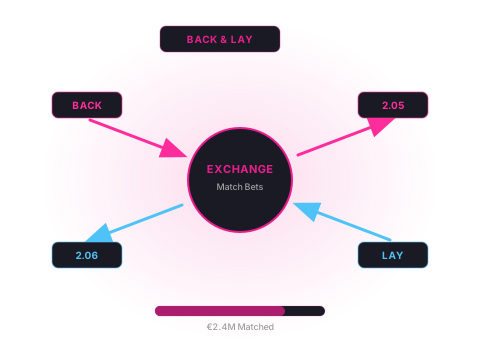
When bettors compare exchanges, the conversation almost always drifts to commission rates. 2% versus 5%, Premium Charge or no Premium Charge. Real differences, and they matter over time. But there's a more fundamental thing shaping whether you can even use an exchange effectively in the first place: liquidity.
Unlike a bookmaker, an exchange simply cannot accept your bet unless someone else is willing to take the other side at your price. No one on the other side, and your bet just sits there, unmatched. That's the exchange model's key structural difference from bookmaking, full stop, and it's what makes liquidity, the volume of money available to be matched in a market, the real limiting constraint on what you can do.
None of this is theoretical. Liquidity determines which exchange accounts are even worth maintaining, which markets you can realistically use at your stake size, and what strategies are practically open to you given the depth in whatever you're betting on.
What Exchange Liquidity Actually Means
Every price point in an exchange market has a queue of outstanding orders: bets placed by customers that have not yet been matched. The sum of money at all price points, on both the back and lay side, is the market's total liquidity. The amount available at any specific price is what you can transact at that price.
When you open a market on Betfair or any other exchange, you see the order book: three columns of back prices (in blue) showing the best available prices to back and how much money is available at each, and three columns of lay prices (in pink) showing the same for laying. The numbers beside each price are the amounts available.
In a highly liquid market, say a Premier League match on Betfair an hour before kick-off, the top prices on each side might show €50,000, €100,000, or more available. Your €200 back bet gets absorbed instantly without moving the market at all. Now take a thin market: a lower-league midweek fixture on a smaller exchange, where the top price might show just €500 available. Suddenly your €200 bet is eating 40% of the available volume at that price, and a €1,000 bet simply won't get fully matched.
The practical takeaway, and it's a simple one really: you can't decide your stake in isolation from market liquidity. Your effective maximum stake in any market is set by the available volume, not by what you'd like to bet.
Reading the Order Book: A Practical Skill
Before placing any meaningful stake, the first step is always to read the order book at your target price and the two or three prices either side. What you're looking for is how much is available at your own price (if your stake exceeds it, expect to be partially unmatched), how much sits at the adjacent prices (useful if you want to split a larger stake across price points), and the spread between best back and best lay. A tight spread means a competitive, liquid market. A wide one means thinness, and some genuine price uncertainty.
In a liquid market, the spread between best back and best lay is very narrow, often just one price increment. In a thin market it can be wide: the best back might sit at 3.20 while the best lay sits at 3.50, meaning no transaction is currently possible at a price both sides actually agree on. It stays illiquid until somebody moves their order closer to the middle.
Checking order book depth before you place a stake is, honestly, the single most important habit for a new exchange bettor to build. Open the market, look at the volume available at your target price, set your stake accordingly, and either accept a partial match in a thinner market or adjust: smaller stake, different price, different timing, or just a different market entirely.
Liquidity Across Different Exchanges
Betfair has, by a wide margin, the most liquidity of any exchange in the world, and this isn't some minor advantage worth a footnote. In many markets, particularly horse racing and mainstream football, its order book depth runs five to twenty times greater than the nearest alternative. For a large-stake bettor, Betfair is, in practical terms, irreplaceable as a primary venue.
That said, the alternative exchanges (Orbit Exchange, Smarkets, Betdaq, Matchbook) have each carved out genuine depth in specific corners:
- Orbit Exchange has the most competitive liquidity versus Betfair in cricket (particularly IPL and international fixtures) and top-tier European football. Its 2% commission makes routing here commercially worthwhile in these markets.
- Smarkets has built adequate depth in major football and tennis for moderate stakes. Its cleaner interface makes it accessible for bettors new to exchanges.
- Betdaq has stronger liquidity in Irish horse racing than most alternatives, reflecting its Irish regulatory focus. For Irish National Hunt and Flat racing, Betdaq warrants a specific check before defaulting to Betfair.
- Matchbook has the deepest liquidity in American sports (NFL, NBA, MLB) among European exchanges. Betfair's US sports books are comparatively thin.
What this means in practice: keeping accounts across multiple exchanges isn't primarily about chasing better odds, though sometimes it does help with that too, it's about getting the best available liquidity for the specific market you're in. Routing each bet to whichever exchange has the most relevant depth is just what professionals do.
How Liquidity Changes Over Time
Exchange liquidity in any market is never static. It builds as the event approaches, peaks around the start, and then behaves quite differently in-play depending on the sport in question.
Pre-event liquidity pattern: Markets often open days or weeks before an event with minimal volume. Liquidity builds steadily as the event approaches, with the largest single volume spike typically in the final 10–30 minutes before the start. For horse racing, this is very compressed: almost all of the pre-race volume arrives in the last few minutes before the off. For football, the build is more gradual over hours.
In-play liquidity: In football, in-play liquidity is highly dynamic around goals: markets are briefly suspended when a goal occurs, then reopen with new prices and a fresh wave of volume as bettors react to the changed context. In quiet periods of a match, in-play volume can be thin. In tennis, liquidity is event-driven, with the heaviest volume around breaks of serve, particularly in deciding sets.
Why timing matters: If you are placing a pre-event bet in a market with limited early liquidity, you may not get matched at your preferred price until closer to the event when volume builds. Setting your order at the price you want and leaving it to fill (rather than chasing the market by adjusting your price repeatedly) is usually the more efficient approach in these situations.
For bettors who need reliable access to very large stakes and simply can't be boxed in by exchange liquidity, licensed betting brokers open the door to Asian bookmakers, where matched limits in major markets significantly exceed anything European exchanges offer. Think of it as a parallel solution rather than a replacement; most professional bettors run exchange accounts and broker accounts side by side, each covering a different part of the portfolio.
Working Effectively in Thin Markets
Thin markets need a different playbook. Just placing a market-price order and expecting an instant match, the standard move in liquid markets, simply doesn't work when volume is limited. A few things help.
Stake sizing: scale your stake to what's actually available at your target price, not to whatever your usual stake happens to be. In a market with €800 available at the best price, a €500 bet is fine; a €2,000 bet is going to be heavily partially matched, no way around it.
Price setting: in a thin market with a wide spread, you can either accept it and transact at the best price on your side, or offer something more attractive to draw counter-orders. A lay slightly above the best available lay, or a back slightly below the best available back, can pull in a match, at some cost to your own margin.
Timing: if the market's going to get more liquid closer to the event, which most do, waiting until nearer the start can get you matched at better prices with less slippage. The trade-off, of course, is that prices can move against you too as the event nears and more information hits the market.
Market selection: repeatedly operating in thin markets with large stakes is just a structural inefficiency you're building into your own process. If a market never develops the liquidity to support your stake, it might not be the right venue at all, whatever edge you think you've found there. Sticking to markets where your stake is a small fraction of total available volume, not a significant chunk of it, cuts execution risk across everything you do.
Frequently Asked Questions
- What is liquidity in betting exchanges?
- Liquidity refers to the volume of money available to be matched at any given price in an exchange market. In a highly liquid market, millions of euros may be available across multiple price points; you can place large bets without moving the price or waiting for a match. In a thin market, only hundreds of euros may be available, meaning large bets cannot be fully matched at your desired price.
- Why does Betfair have more liquidity than other exchanges?
- Betfair launched in 2000 and spent over a decade as the only major betting exchange at scale. This first-mover advantage created a self-reinforcing dynamic: more customers meant more liquidity, which attracted more customers. Alternative exchanges (Orbit, Smarkets, Betdaq, Matchbook) have built competitive depth in specific markets but have not matched Betfair's overall volume. Betfair's liquidity advantage is most pronounced in horse racing and lower-league football; it narrows in cricket, US sports, and certain top football markets where alternatives have invested specifically.
- How do I check liquidity before placing a bet?
- Open the market on the exchange and look at the order book: the display showing available back and lay orders at each price point. The numbers shown next to each price indicate the available matched volume. For a back bet, check the amount available at your target price in the blue (back) column. For a lay bet, check the pink (lay) column. If the available volume at your price is less than your intended stake, you will be partially or fully unmatched.
- What happens if my bet is only partially matched?
- The matched portion of your bet proceeds as normal; you have a live position at the matched stake. The unmatched portion sits in the order book at your requested price until either another customer takes it or you cancel it. You can cancel unmatched portions at any time before they are matched. On market close (or at the off in horse racing), any unmatched orders are cancelled automatically and the funds returned to your balance.
- Is exchange liquidity better pre-event or in-play?
- It depends on the market. In most sports, peak pre-event liquidity builds in the final minutes before the start and then carries over into in-play. In horse racing, the largest matched volume often occurs in the final few minutes before the off. In football, in-play liquidity spikes around goals and other significant events. Some in-play markets in less popular sports can be extremely thin; large stakes may move the price significantly or simply not find a match.
- Can I improve my chances of getting matched?
- Yes. Offering your back or lay bet at the current best available price (rather than trying to beat it) maximises matching speed in liquid markets. In thinner markets, accepting that you may need to adjust your price to get matched (or split larger stakes into smaller portions placed at different price points) is a practical approach. Setting bets slightly ahead of the most likely price movement (for example, leaving a lay order at 1.80 if a team looks likely to score) can result in favourable matches when the market moves quickly.