When you place a bet with a traditional bookmaker, the bookmaker is your counterparty, end of story. The price is quoted, you accept it, the bet goes on. Liquidity simply isn't your problem; the bookmaker has near-unlimited capacity to take your bet at whatever price they've chosen to offer. That same unlimited capacity, worth saying plainly, is also why they limit winners. They have no mechanism to offload sharp bets they don't want, so instead they just stop letting you place them.
Betfair works differently. Your counterparty is another customer, and liquidity, the depth of the order book, determines what's actually possible rather than what a bookmaker feels like allowing. A market showing €10,000 available on the favourite at 2.00 means exactly that: you can back up to €10,000 at that price, no more. Want more? You wait, or you accept a worse price. There's no third option. Understanding this isn't optional for anyone using the Exchange seriously; it's the whole mechanism.
How Exchange Liquidity Works: The Order Book
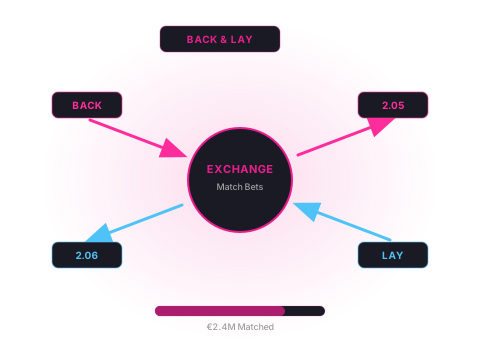
Every Betfair Exchange market operates as an order book, a real-time list of available back and lay bets sitting at different prices. Open any market and you'll see the three best available back prices (what you can accept to back a selection) alongside the three best available lay prices (what other customers are willing to take against you).
Each price level shows the volume sitting there, unmatched, waiting. If the favourite shows €5,000 available at a back price of 2.10 and you place a back bet of €1,000 at that same 2.10, your bet gets matched instantly against the lay orders already sitting there. The remaining €4,000 just stays put, available for whoever backs next.
Total liquidity in a market is the sum of all matched bets processed, and Betfair displays that figure on every market page. High-profile events show matched volumes running into the millions of euros. Small regional fixtures might show a few thousand, sometimes less. Either way, that matched volume number is the honest tell: it's what gives you a realistic sense of how much you can actually trade without moving the price against yourself.
Liquidity by Sport: Where Betfair Has Real Depth
Liquidity is not uniform across Betfair's catalogue, not even close. Some sports and competitions have extraordinary depth; others are, frankly, barely functional for any meaningful bet size. The distinction matters enormously if you're trying to place professional-level volume, and it's worth knowing before you go looking for it in the wrong market.
| Sport / Market type | Typical pre-match liquidity | In-play depth | Suited for serious bettors? |
|---|---|---|---|
| Horse racing (UK & Irish) | €50k–€500k per race | Very high, deepens significantly in-play | Yes (the Exchange's strongest sport) |
| Football: Champions League / PL | €1m–€5m per match | High, continues growing during match | Yes, very liquid pre-match and in-play |
| Football: lower divisions | €5k–€50k per match | Moderate, thins quickly in-play | Partial, limited volume at any price |
| Tennis: Grand Slams / ATP Masters | €200k–€1m per match | High, especially during play | Yes, particularly strong in-play |
| Cricket: international (Test, ODI) | €100k–€500k per match | Very high throughout match | Yes, growing rapidly, especially Test cricket |
| American sports (NFL, NBA) | €10k–€100k per game | Limited | Partial, better via Asian brokers for AH markets |
| Golf: majors | €50k–€200k per tournament | Moderate | Partial, outright markets have reasonable depth |
| Virtual / novelty markets | Very low | Minimal | Not recommended for volume |
The general rule holds up pretty well across the board: the bigger the audience, the more people willing to take both sides of a market, the deeper the order book gets. Betfair's strongest markets are the ones with a broad international following and genuine bettor interest, which is exactly why horse racing and top-tier football dominate its total matched volume year after year.
What Drives Liquidity: Timing, Market Type, and Competition
Liquidity isn't static. It builds as an event approaches, then, in most markets, surges again once in-play trading kicks in. Knowing roughly when it peaks is genuinely useful; it's the difference between getting a decent price and just taking whatever's on offer.
Pre-match liquidity builds steadily through the 24 hours before a major event, with a sharp acceleration in the final few hours. The most liquid pre-match window is usually the last 60 minutes, when the sharp money tends to arrive and the order book is at its deepest. Horse racing takes this further still. the final 5 minutes before a race can account for a huge chunk of the total matched volume, sometimes most of it.
In-play liquidity peaks on fast-moving, broadcast sports where a lot of people are watching at the same moment: live football, live tennis during service games, horse racing while the race is actually running. Sports without wide live broadcast, or ones that just move slowly, don't generate anywhere near the same in-play interest. Makes sense when you think about it, nobody's frantically trading a market nobody's watching.
Market type matters a lot too, arguably more than people give it credit for. The Match Odds market (1X2 for football, Win/Win for head-to-head sports) almost always carries far more liquidity than Asian Handicap, Correct Score, or Over/Under markets on the same event. And if Asian Handicap happens to be your preferred market, which is true for plenty of professional football bettors, Betfair's depth there is considerably shallower than what you'd find at a dedicated Asian bookmaker or a broker providing access to Pinnacle or SBO.
How Liquidity Affects the Prices You Get
The back-to-lay spread, the gap between the best available back price and the best available lay price on the same selection, is essentially the Exchange's effective margin. And it contracts as liquidity increases. On a very liquid market the spread might be as little as 1 or 2 ticks (the minimum price increment). On a thin market it can be, honestly, pretty ugly.
Take a Champions League match with €2m already matched and still climbing: the favourite might show a back price of 2.04 and a lay price of 2.06, a spread of 0.02. Back at 2.04, want to exit immediately by laying, and you're looking at a maximum spread cost of roughly 1%. Not nothing, but livable. Now put the same selection on a thin lower-division fixture, and you might see a back of 2.00 against a lay of 2.20. That's a 10% spread, which makes trading expensive at best and unviable at worst.
For straight backers holding to settlement, the spread matters less than the absolute price, fair enough. But even non-traders feel this: on thin markets the displayed best price is often only good for a small fraction of the stake you actually wanted to place. The rest either goes unmatched or gets filled at a worse price further down the order book.
When Betfair Liquidity Is Not Enough
There are, really, two main situations where Betfair's liquidity turns from an asset into a constraint for serious bettors.
Volume limits in thin markets. Try placing €5,000 on an Asian Handicap market for a mid-table Championship fixture and Betfair simply may not have the depth to match it at any price worth taking. The same bet at Pinnacle, a fixed-odds bookmaker built to take large pre-match Asian Handicap bets, would clear instantly at its published maximum stake. For bettors focused on lower-profile football with specific market needs, this isn't a minor inconvenience. It's a genuine structural problem, and no amount of patience fixes it.
Asian Handicap depth. Betfair does offer Asian Handicap markets, sure, but liquidity there is a fraction of what the main Match Odds market pulls in. The dedicated Asian bookmakers (Pinnacle, SBO, MaxBet, BetISN) treat Asian Handicap as their bread and butter, and they process multiples of what the Exchange manages on that same market type. So it's no surprise that professional bettors who lean on Asian Handicap as their main bet type generally split their activity: Asian books for AH, Betfair for Match Odds and racing.
For bettors in Ireland chasing Pinnacle's Asian Handicap depth specifically, the established route is a licensed betting broker such as AsianConnect, which gets you into Pinnacle and other Asian books through one regulated account, no need to juggle separate registrations across half a dozen Asian platforms.
Frequently Asked Questions
- How much liquidity does Betfair have on top football matches?
- On the biggest European club matches (Champions League knockout rounds, Premier League title-deciding games) the Match Odds market on Betfair regularly processes several million euros in matched bets before kick-off. In-play liquidity can be even higher on high-profile matches. On lower-division football or smaller leagues, pre-match liquidity might be measured in the low thousands or even hundreds of euros, which limits how much volume a serious bettor can place at competitive prices.
- What does "matched" and "unmatched" mean on Betfair?
- On Betfair, a bet is "matched" when the opposite side of the trade has been accepted by another customer. If you want to back a selection at 2.50 and another customer is willing to lay it at 2.50, the bet is matched immediately. If no counterpart is available at that price, your bet sits as "unmatched" in the market's order book until another customer accepts it or until you cancel it. Unmatched bets are not active; they carry no risk and will not result in winnings or losses until matched.
- Why is Betfair liquidity important for traders?
- Exchange traders need to enter and exit positions efficiently. Thin liquidity means you may not be able to get your full stake matched at the price displayed, or you may need to accept a worse price to exit a position in-play. High liquidity (especially in-play) means tighter back-to-lay spreads, faster order matching, and the ability to trade larger positions without moving the market price. Professional traders specifically seek the most liquid markets because efficient execution is part of the edge.
- Which sports have the best liquidity on Betfair?
- Horse racing (UK and Irish) historically accounts for the largest share of Betfair's total matched volume, particularly in-play. Football is the second largest, with Premier League, Champions League, and international tournaments generating the most depth. Tennis major tournaments and ATP/WTA events have strong in-play markets. Cricket, particularly major international matches, has grown significantly in recent years. American sports (NFL, NBA), golf, and most other sports have noticeably lower liquidity and may not suit traders who need depth for significant positions.
- Can I always get my bet matched at the displayed price on Betfair?
- Not always, particularly for larger stakes. The price displayed in the back or lay columns shows the best available price with the volume available at that price shown alongside it. If you want to bet more than the available volume at the best price, you either have to accept a worse price or wait. On very liquid markets like major horse races in-play, the order book refreshes rapidly, so this is usually only an issue for very large stakes. On thin markets, this is a frequent challenge even for modest bet sizes.
- Is Betfair liquidity available in Ireland?
- Yes. Betfair holds an MGA licence and is fully accessible to customers based in Ireland. Irish bettors have full access to all Betfair Exchange markets. Horse racing (including Irish domestic racing) is one of the best-served sports on Betfair in terms of liquidity, which is particularly relevant for Irish bettors who follow the domestic racing calendar closely.