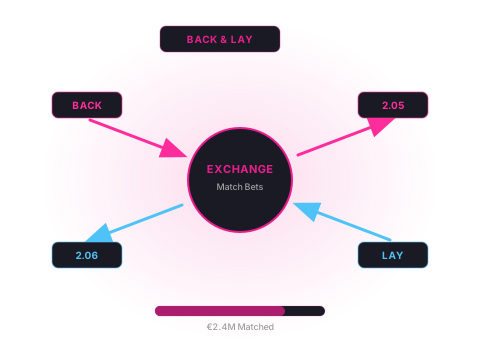
Most bettors who first encounter Betfair use it as a bookmaker replacement: backing selections at better prices, laying obviously over-priced favourites. That's a legitimate use of the Exchange, and often a profitable one. But trading (using the Exchange's liquidity to take and close positions on price movement) is a different discipline entirely. One that the Exchange's structure happens to enable in a way no bookmaker ever could.
A trader's goal isn't to predict the correct result of an event. It's to predict how the market price will move before or during that event, and to execute both sides of the trade at favourable prices. The outcome of the match, race, or game is, in a real sense, irrelevant to you; a successful trade produces the same profit whether the selection wins or loses. That takes some getting used to if you've spent years thinking in terms of "will this win."
How Back-and-Lay Trading Works
Exchange trading works by using the difference between back prices and lay prices, and the movement of those prices over time, to generate locked-in profit. Simple in concept. Less simple with real money on the table.
Backing first, laying later (price shortens): you believe a selection's price will shorten (the market will price it as more likely to win). You back at the current higher price. As the price shortens, you lay at the lower price. The difference between your back stake's potential winnings and your lay stake's liability locks in a profit. Example: back €100 at 3.00, potential winnings €200. Price shortens to 2.50. Lay €100 at 2.50, liability €150. Trade profit is roughly €33 whether the selection wins or loses.
Laying first, backing later (price drifts): you believe a price will drift (lengthen, meaning the market becomes less confident in the selection). You lay at the current lower price, taking on a capped liability. As the price drifts, you back at the higher price. The backing stake now covers your lay liability and generates a green book across outcomes. This one's riskier to get wrong, because a price that shortens further instead of drifting will increase your liability before you can close it.
The mathematics of trading, calculating what stake to use on the closing bet so the profit comes out equal regardless of outcome (a "greened book"), is straightforward on paper but demands precise execution in practice. Which is why most serious traders don't bother with the Betfair website interface at all and use dedicated trading software instead.
Key Betfair Trading Strategies
There's no single correct way to trade the Exchange, and be wary of anyone who claims there is. Different approaches suit different sports, different market conditions, and different levels of experience. Below are the frameworks you'll see most often, laid out side by side.
| Strategy | How it works | Best markets | Skill level |
|---|---|---|---|
| Pre-match momentum trading | Track price movement driven by early sharp money; enter in the direction of momentum | Football (pre-match), horse racing (morning markets) | Intermediate |
| News-driven scalping | React quickly to team news, injuries, or weather; take a position before the market fully adjusts | Football, cricket, horse racing | Intermediate to advanced |
| In-play lay trading | Lay a selection in-play when it is temporarily overpriced (e.g. after a goal, early leader in a race), close when price adjusts | Football in-play, horse racing in-play | Advanced (fast execution essential) |
| Pre-race horse racing | Trade horses in the 10–15 minutes before a race as price patterns form and stable money arrives | UK/Irish horse racing | Intermediate (knowledge of form helpful) |
| Scalping (tick trading) | Back and lay on the same selection for very small price differences, repeated at high frequency | Any very liquid market (horse racing, top football) | Advanced (requires API-speed execution) |
| Arbitrage & dutching | Back the same outcome at different prices across markets or use Exchange to lock in a guaranteed profit from a bookmaker-Exchange price discrepancy | Any market with simultaneous bookmaker and Exchange pricing | All levels (systematic approach) |
No single strategy wins out across the board, and honestly I'd be suspicious of a guide that told you otherwise. The traders who last tend to pick one or two sports, or one narrow market type, and get genuinely good at reading price patterns within that small world, rather than skimming across every market with a one-size-fits-all playbook.
Managing Positions: Cutting Losses and Protecting Profits
Position management is where most new traders come unstuck. The logic of a trade is easy enough to follow on a whiteboard; executing it consistently under the pressure of real money and a moving price ladder is a completely different skill, and nobody really tells you that until you've felt it.
The most common mistake is holding an open position too long once the price moves against you, hoping it turns back. On a bookmaker, you can't exit a bet; you're in until settlement, full stop. On the Exchange you always have the option to close, which sounds like an advantage (and is) but also means the decision to bail is entirely on you. Professional traders get around this by using pre-defined stop levels: if a position moves X ticks against them, they close, regardless of how convinced they still feel. The cost of exiting a losing trade small is always less than the cost of letting it ride to settlement.
In-play positions carry extra risk simply because price movement speeds up during live events. A horse racing position that's been sitting comfortably in the pre-race period can turn into a genuinely dramatic loss within seconds of the race starting, if it isn't closed in time. Many traders lean on conditional close orders (automated through trading software) so the position closes itself at a set price, taking the real-time panic-decision out of their hands entirely.
Bank management follows the same principles as any other form of betting, really. Risk no more than a small slice of the total bank on any one trade, and you preserve the ability to keep operating through a losing run instead of being wiped out by one. Trades compound; a bad run produces losses that take real discipline to recover from, and conservative staking is a mark of a trader who plans to still be around in a year, not a lack of confidence.
Trading Software and Tools
The standard Betfair website was built for casual betting, not professional trading, and it shows. It doesn't display the full order book depth, order placement is relatively slow, and there's no way to set up automated or conditional orders. For anyone trading seriously, third-party tools that connect to the Betfair API are pretty much essential at this point.
These platforms typically give you a ladder interface showing the full order book across every price level, one-click or single-key bet placement, automated greening (calculating and placing the closing bet so the profit comes out equal across outcomes), a running P&L per market, and the ability to set automated stop-loss and take-profit orders. There's a real learning curve to all this, worth being honest about, but the execution advantages for in-play and scalping strategies are substantial enough to make it worthwhile.
For bettors who are really just after straight back betting rather than trading, without the position-management complexity, Pinnacle and other Asian bookmakers accessed via a licensed broker often provide a simpler, cheaper route to the same goal: placing bets at market-competitive prices without account restrictions.
How Commission Interacts with Trading
Betfair's 5% commission on net winnings per market interacts with trading in a way that's actually more favourable than it looks at first glance. Because commission is charged on the net market result across all bets in a market, trades that produce a small profit on both sides of the book only get taxed on the net combined profit, not on each individual bet's winnings.
Worth walking through an example. A trade that produces €20 on the winning side and €15 on the losing side nets a market profit of €5. Commission on that is €0.25, nowhere near what 5% on the €20 winning side alone would suggest. The more a trader's positions offset within a market through greening, the lower the effective commission rate ends up being relative to gross winnings.
For a full explanation of the commission calculation and the Premium Charge that affects very high-volume profitable traders, see the dedicated Betfair Commission Explained and Betfair Premium Charge pages.
Frequently Asked Questions
- What is the difference between betting and trading on Betfair?
- Betting on Betfair means placing a back or lay bet and holding it through to settlement; the outcome determines your profit or loss. Trading means opening a position (backing or laying) and then closing it before or during the event by placing the opposite bet on the same selection. A successful trade locks in a profit regardless of the event outcome. The key distinction is that trading does not require predicting the final result; it requires predicting price movement.
- Can you lose money trading on Betfair?
- Yes, and it happens more than beginners expect. Trading involves real financial risk, and poorly executed trades or unexpected price movements can result in losses. A trade that is not closed before an event ends becomes a settled bet at the Exchange price at settlement. In-play positions can move very quickly (particularly in horse racing), and a delayed close can turn a winning trade into a significant loss in the space of a few seconds. New traders frequently underestimate execution risk and just how fast in-play prices move.
- What software do professional Betfair traders use?
- Many professional Betfair traders use third-party trading interfaces rather than the standard Betfair website. These tools (such as Bet Angel, Geeks Toy, or Cymatic Trader) connect to the Betfair API and offer faster order placement, one-click execution, ladder interfaces for tracking the order book in real time, and automation tools for systematic strategies. The standard Betfair website is adequate for casual Exchange betting but is generally too slow for in-play trading where execution speed matters significantly.
- Is pre-match or in-play trading better for beginners?
- Pre-match trading is generally more suitable for those learning. Prices move more slowly, there is time to think before placing orders, and positions can be closed without the urgency that in-play creates. In-play trading on sports like horse racing involves very fast price movement (particularly when a race starts) and a slow or missed close can result in a much larger loss than anticipated. Most traders start pre-match and move to in-play once they understand position management and execution speed requirements.
- Do you need a large bank to start Betfair trading?
- You can start trading with a small bank, but the practical minimum really depends on the markets you want to trade and the minimum bet sizes involved. Betfair's minimum bet is £2 (or equivalent), so you can practice with very small positions if you want to. That said, to trade pre-match football or horse racing at meaningful size, where a few ticks of movement actually produces real money, a starting bank of at least several hundred euros is more realistic for learning without risking stakes you can't afford to lose before your skills catch up.
- What is the best market to start trading on Betfair?
- Pre-match football Match Odds markets on top leagues (Premier League, Champions League) are often recommended for beginners because they move slowly pre-match, have deep liquidity, and the price patterns are somewhat predictable in relation to team news and market sentiment. Horse racing in-play is where the most volume occurs but is the most demanding technically and in terms of execution speed. Pre-match horse racing in the final 10–15 minutes before a race offers a middle ground: reasonable liquidity with faster movement than football but before the extreme volatility of the race itself.