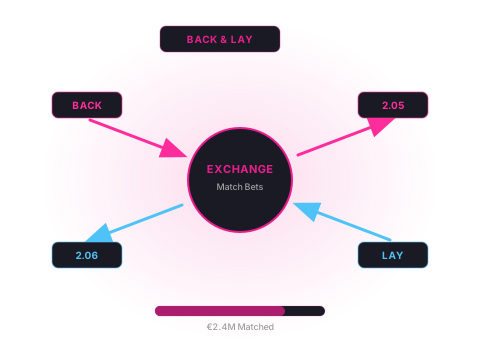
Traditional bookmakers only let you bet on something happening. A horse wins, a team scores first, a player reaches a final, you back these outcomes, and the bookmaker takes the other side. On a betting exchange that asymmetry just disappears. You can back outcomes, or you can lay them (bet that they will not happen). Both positions are open to any exchange customer, and honestly, once you get used to having both available, going back to a bookmaker-only mindset feels a bit limiting.
This opens up things a bookmaker simply can't offer. You can express a view that the market has overrated a favourite. You can lock in a profit by trading a position, backing a selection pre-event and laying it in-play once the odds have shortened. You can offset bookmaker bets with exchange lay bets to squeeze promotional value out of a sign-up offer with barely any outcome risk. Understanding lay betting opens up this entire space.
The mechanics aren't complicated. But there's one concept, liability, that every new layer needs to properly understand before placing their first lay bet. Get this wrong and the numbers turn ugly fast.
How Lay Betting Works: The Mechanics
When you place a lay bet, you are offering to take the position of a bookmaker in a single transaction. Another exchange customer wants to back a selection; you are willing to offer them that bet. You set the price (the lay odds) and the stake you want to match.
The terminology sorts itself out fast once you see both sides in action. The backer's stake is the amount the other customer puts up: if the selection wins, you pay them their winnings; if it loses, you collect their stake. Your liability is the amount you stand to pay if the selection wins, calculated as backer's stake × (lay odds − 1). Your potential profit, meanwhile, is just the backer's stake, collected whenever the selection loses.
A concrete example: you lay Arsenal to win a match at odds of 3.50, with a backer's stake of €20.
- If Arsenal lose or draw: you collect the €20 backer's stake (minus exchange commission)
- If Arsenal win: you pay out €20 × (3.50 − 1) = €20 × 2.50 = €50
- Your liability (the amount the exchange holds from your balance before the match) is €50
The asymmetry is the thing to really internalise here. Your maximum win on a lay bet is the backer's stake, full stop. Your maximum loss is the liability, and that scales with the odds, sometimes brutally. Laying a short-priced selection at 1.50 for €100 means a liability of just €50. Laying a long shot at 15.0 for €100 means a liability of €1,400. Same stake. Wildly different exposure.
Liability: Why This Number Matters More Than the Stake
New exchange bettors often anchor on the "stake" in a lay bet (the amount they want to match) and underestimate the liability. The stake you enter on the exchange interface is the backer's stake (the amount you stand to win), not what you are risking. What you are risking is the liability.
Before any lay bet is accepted, the exchange freezes your liability in your account balance. If you do not have sufficient funds to cover the liability, the bet will not be placed. This is a sensible protection mechanism, but it also means your available betting balance can be substantially reduced by unresolved lay positions, particularly if you are laying multiple selections at longer odds simultaneously.
| Lay Odds | Backer's Stake (your potential win) | Your Liability (your potential loss) |
|---|---|---|
| 1.50 | €100 | €50 |
| 2.00 | €100 | €100 |
| 3.00 | €100 | €200 |
| 5.00 | €100 | €400 |
| 10.00 | €100 | €900 |
| 20.00 | €100 | €1,900 |
The practical lesson, and it's worth saying plainly: lay odds matter enormously to risk exposure. Most experienced exchange bettors get more cautious about laying longer-priced selections, not because long shots never win (they do, more often than the odds might suggest they should), but because the liability ratio becomes disproportionate. A run of losing lay bets on 10.0 shots, even at a perfectly healthy strike rate, can wipe out a balance fast if sizing isn't managed against liability rather than stake.
How Serious Bettors Use Lay Betting
Lay betting isn't inherently a better strategy than back betting. It's a different tool for expressing a view, that's really all. The same edge-finding discipline applies: you're looking for selections where the current odds are shorter than the true probability of winning. The difference is that with lay betting, you profit when the market has overestimated a selection's chances rather than underestimated them.
Laying overrated favourites: Short-priced favourites in horse racing, football, and tennis are the most common lay targets. The market's tendency to overcorrect toward prominent selections, driven by public money, media attention, recency bias (people remember the last big win, not the base rate) can create consistent value on the lay side. A horse at 2.50 that the market has really assessed at 2.0 in probability terms is a positive-expectation lay, assuming the price is actually available.
Trading positions: Back a selection before an event at a long price, then lay the same selection in-play once the price shortens significantly. The back price and the lay price create an arbitrage. You've locked in a profit on at least one outcome, often both. This is position trading on an exchange, and it requires watching markets in-play and acting quickly when prices move, which is not for everyone, frankly.
Matched betting: A lay bet on the exchange offsets a back bet at a bookmaker at similar odds. If the lay odds closely match the back odds, the outcome is near-neutral regardless of result, and the net profit comes from the bookmaker's free bet or promotion. People use this to extract the cash equivalent of promotional offers, systematically. One caveat worth flagging: exchange commission affects the mathematics, so check your numbers carefully before assuming a matched bet is risk-free at a given set of odds.
Hedging existing positions: backed a selection at a bookmaker and the price has shortened significantly since? Laying at the new shorter price on an exchange locks in a guaranteed profit regardless of the outcome. Converts a speculative back bet into a guaranteed return. Useful when the original bet was placed at value and the market has since confirmed your assessment by moving the price.
Getting Your Lay Bets Matched
A lay bet only gets executed when another customer is willing to back at your offered price. In liquid markets (major football matches on Betfair, big racing events) matching tends to be fast, right at market price. In thinner markets, or at prices away from the current market, your order might just sit there. Or only partially match.
You can improve matching by setting your lay price at or near the current best available back price, since that's where the volume concentrates. Offering a lay at odds well below the current market means you're basically waiting for the market to move your way. That's a valid strategy, sometimes called "sitting an order," but it demands patience and a willingness to accept the bet might not fully match before the event starts.
Unmatched portions of a lay order return to your account balance, with the frozen liability released, if the market closes before matching occurs. You can also cancel unmatched bets manually at any point before they're matched. Partially matched bets are common in thinner markets: the matched portion proceeds, the unmatched portion comes back to you.
For consistent lay betting at meaningful stakes, Betfair's liquidity still makes it the primary venue, and I'd push back on anyone suggesting otherwise purely on commission grounds. That said, if you're laying selections in markets where Smarkets, Orbit, or Betdaq have competitive depth, routing there saves on commission. Matching reliability just has to come first.
Frequently Asked Questions
- What is lay betting?
- Lay betting means betting that a selection will NOT win, the opposite of a back bet. When you lay a horse at 6.0 for €10, you are offering that bet to another exchange customer. They stake €10; you stand to win €10 if the horse loses, but must pay out €50 (the €10 stake × the odds of 6.0, minus the original stake) if it wins. You are effectively acting as the bookmaker for that transaction.
- What is liability in lay betting?
- Liability is the maximum amount you stand to lose on a lay bet if the selection wins. It is calculated as: stake × (odds − 1). If you lay a selection at 5.0 for a €20 stake, your liability is €20 × (5.0 − 1) = €80. Your exchange account must hold sufficient funds to cover this liability before the bet is accepted. Liability increases significantly with longer odds; laying a 20.0 shot for €10 means a liability of €190.
- Can I lay any selection on an exchange?
- You can lay any selection for which there is a backer willing to take your offer. In liquid markets (major football matches, big races) you can usually get matched quickly at competitive prices. In thin markets, your lay offer may sit unmatched or only partially matched. You can set your own price; if the market does not move to your price before the event starts, the unmatched portion returns to your account.
- Is lay betting profitable?
- Lay betting is profitable when the lay odds are shorter than the true probability of the selection winning would imply. It is a tool for extracting value when the market has overpriced a selection, the mirror image of backing at value. Like back betting, profitability depends on consistently identifying mispriced markets. The mechanics of lay betting do not independently create an edge; they give you the ability to express a view from either side of a market.
- What is a lay bet in matched betting?
- In matched betting, a lay bet is placed on an exchange to offset a back bet placed at a bookmaker. The combination of a back bet (at the bookmaker) and a lay bet (on the exchange) at similar odds neutralises the outcome: you win approximately the same regardless of whether the selection wins or loses. This technique is used to extract free bet or bonus value from bookmaker promotions without risking significant funds on the outcome.
- What is the best exchange for lay betting?
- Betfair has the most liquidity for lay betting across the broadest range of markets, which means your lay orders are most likely to find a match at competitive prices. Orbit Exchange, Smarkets, and Betdaq offer lay betting at lower commission (2% versus Betfair's 5%), which is commercially relevant if you are laying frequently and profitably. For maximum liquidity, Betfair is the primary venue; for commission efficiency in markets where alternatives have competitive depth, Orbit and Smarkets earn their place.