Most bettors discover the exchange versus bookmaker distinction the hard way. They become consistently profitable, their bookmaker account gets limited or closed, and only then do they start looking for alternatives. At that point exchanges stop being some vague concept and become a practical necessity, fast, and the structural differences between the two models suddenly feel very real.
If you're earlier in that journey, whether you're just curious or actively weighing the switch, understanding the mechanics before you hit the restrictions is genuinely useful. Worth saying plainly: this comparison covers what actually matters. How prices are formed, how costs work, what limits you'll face, and who each model was really built to serve.
Exchange vs Bookmaker: Side-by-Side Comparison
| Factor | Traditional Bookmaker | Betting Exchange |
|---|---|---|
| How prices are set | By the bookmaker's traders, margin built in | By customers in the order book, no built-in margin |
| Odds quality | Systematically lower than true probability | Closer to true probability (generally better) |
| How the platform makes money | Margin on all bets, built into prices | Commission on net winnings only |
| Account limits for winning bettors | Very common (stake limits, market bans, closures) | None (limited only by available market liquidity) |
| Gubbing | Standard practice for profitable customers | Does not apply; exchanges don't restrict winners |
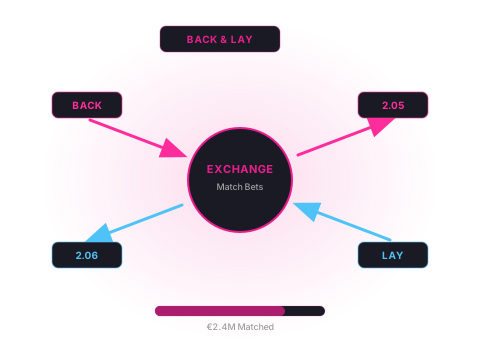
| Can you act as the bookmaker? | No | Yes (laying allows you to take the other side of bets) |
| In-play trading | Limited (accept/reject only, prices controlled by bookmaker) | Full order book: back, lay, and trade positions in-play |
| Best odds guarantee | Sometimes (promotional, often restricted) | Not applicable: prices reflect the market, not a firm offer |
| Transparency | Low (prices set by private traders) | High (full order book visible, market forms openly) |
| Minimum stake | Generally low or none | Minimum stake, but can also be limited by market liquidity |
| Markets available | Wide (bookmakers often offer more bet types) | Core markets well covered; exotic bet types more limited |
Odds: Why Exchange Prices Are Consistently Better
A bookmaker needs to profit from the bets it accepts, so it builds a margin (the overround) into every set of prices it offers. On a football match with three possible outcomes, home win, draw, away win, a bookmaker's prices will imply probabilities that sum to more than 100%, typically 105 to 110% in competitive markets and higher in less competitive ones. That excess percentage is the bookmaker's expected edge over the long run.
An exchange has no equivalent mechanism. Prices in the order book reflect what customers are willing to accept from each other, full stop; nobody is setting them with a margin target in mind. In a liquid market, the exchange price converges toward the true market consensus probability, and there's no systematic bookmaker edge lurking in what you see.
The practical upshot: exchange odds tend to be better than bookmaker odds for the same selection in the same market. Even after accounting for commission, which acts as a small effective reduction, exchange bettors are typically working from a better base than they would with equivalent bookmaker bets. Not a huge edge on any single wager. But for a bettor with any meaningful edge at all, that difference compounds over hundreds or thousands of bets into something that actually matters.
Account Limits: The Most Important Practical Difference
If you bet casually and inconsistently, bookmaker account limits may never touch you. You're not a target. The margin works in the bookmaker's favour over your aggregate bets, so there's no commercial reason to restrict you. The problem shows up when you start winning consistently.
Bookmakers spot profitable customers through betting patterns: sharp prices hit early, small edges extracted repeatedly, withdrawal habits, device and account history, all of it. Once flagged, the response tends to follow a predictable script. Stake limits introduced quietly. Market access restricted. Account eventually closed. I'd push back on calling this unfair, exactly; it's simply what the business model requires. Their profit comes from losing customers, and consistent winners are, to them, just a cost.
Exchanges have no equivalent incentive. Commission gets generated on matched volume regardless of which side wins, so a consistent winner on Betfair generates just as much commission as a consistent loser, sometimes more, because winning positions tend to be larger. There's no commercial reason for an exchange to restrict a profitable customer, and in practice they don't. The only real limit on how much a profitable exchange bettor can bet is available market liquidity.
This is the core reason exchanges are the default venue for professional bettors. If you've already run into bookmaker stake restrictions or account closures, exchanges aren't some workaround, they're a structurally different model that just doesn't produce the same problem. And if you haven't been restricted yet, understanding this now saves you the frustration of finding out the hard way.
Commission vs Margin: Understanding the Real Cost Difference
Bookmaker margin is invisible. It's embedded in the prices you see, and you pay it on every bet whether you win or lose. Back a team at 1.90 when the fair odds are 2.00, and that 0.10 difference is the bookmaker's margin, paid before the match even started, regardless of outcome.
Exchange commission, by contrast, is transparent and applied only to winnings. Betfair's standard rate is 5%. Smarkets, Orbit, and Betdaq charge 2%. Lose a bet on an exchange and you pay no commission at all. Win, and it's deducted from the profit.
For profitable bettors, meaning anyone who expects to win more than they lose over time, exchange commission beats bookmaker margin as a cost structure in most scenarios. The margin on every losing bet simply disappears; only net winning positions incur a fee. A bettor with a 5% edge placing €10,000 a month through a bookmaker charging 7% margin ends up paying more in effective costs than the same bettor paying 2% exchange commission on their winning months.
One complication worth flagging: Betfair's Premium Charge. It applies to accounts that are highly profitable relative to their commission history, and in extreme cases it can push effective commission rates to 20% or more. Alternative exchanges (Smarkets, Orbit, Betdaq) run nothing like it, which is exactly why they're attractive to bettors who feel that threshold creeping up.
When Bookmakers Still Have a Role
Exchanges don't replace bookmakers in every scenario, and it would be dishonest to pretend otherwise. There are genuine cases where bookmakers still earn their place, even for sophisticated bettors:
- Promotions and enhanced odds. Enhanced accumulators, price boosts, free bet promotions, all of it can produce positive expected value in the right circumstances. So-called "bonus hunters" or "matched bettors" use bookmaker accounts precisely for this. Yes, the accounts get limited eventually, but the promotional value can be extracted first.
- Exotic bet types. Accumulators, Yankees, complex each-way multiples: none of it exists on exchanges. If you specifically want these formats, a bookmaker is your only option.
- Pre-match liquidity in smaller markets. Exchange liquidity in very small leagues or niche events can be too thin to support even moderate stakes, while a bookmaker will happily take the bet.
- Ante-post markets. Long-term outright markets, season winners, tournament futures, often have deeper bookmaker liquidity than the exchange equivalent, which tends to stay thin.
The professional approach isn't either/or. It's knowing which venue suits which type of bet and routing accordingly: exchanges for the core day-to-day match betting where odds and account longevity matter most, bookmakers for the specific promotional or structural edges where they genuinely exist.
When You Need More Than Exchanges Can Offer
European betting exchanges have real limits on liquidity, particularly for large stakes in non-mainstream markets. A bettor operating at €5,000+ per bet in niche sports, or wanting access to major Asian bookmakers alongside exchange markets, will find exchanges alone don't cover the full professional toolkit.
Licensed betting brokers fill that gap. Brokers like AsianConnect and BetInAsia give access to Asian bookmakers, Pinnacle, SBOBet, and others, through a single brokered account, with significantly higher matched limits than European exchanges in most sports and none of the account restriction risk that traditional European bookmakers carry. Professional bettors typically run exchange accounts and broker accounts side by side, routing each bet to whichever venue offers the best combination of price, liquidity, and account access.
If exchanges solve the bookmaker restriction problem, brokers extend the available scale. Knowing all three, traditional bookmakers, exchanges, and betting brokers, gives you the full picture of what's actually available to a serious bettor.