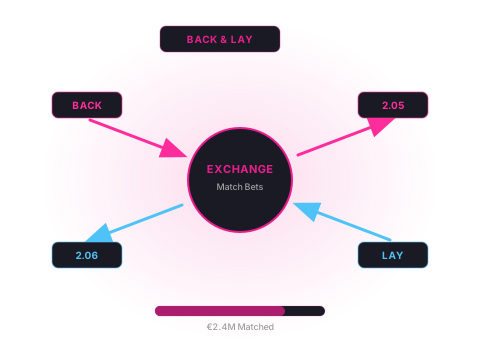
Betfair runs as a peer-to-peer exchange, which means prices come from the market itself, not from a trading room somewhere setting a line. That one fact changes almost everything about how it behaves under pressure. Order books are visible. Price discovery happens live, in front of you. And in a fast in-play market, being even half a second slower than the next person can genuinely cost real money.
Worth saying plainly: the standard Betfair website was never built with that in mind. It's built for accessibility, for the millions of people placing a bet or two on a Saturday, not for someone trying to read a full order book in real time. Third-party software exists to close that gap. Whether it's worth paying for, and which product actually earns its subscription fee rather than just looking impressive, is what the rest of this page tries to sort out.
What Trading Software Adds Over the Standard Interface
Laid out side by side, the gap isn't subtle.
| Feature | Standard Betfair interface | Trading software |
|---|---|---|
| Price display | Best back and lay prices only | Full order book depth via ladder interface |
| Execution speed | Click-and-confirm; website refresh rate applies | One-click execution; direct API connection; lower latency |
| Position management | Single market, manual tracking | Multiple markets simultaneously; automated P&L tracking |
| Automation | None | Rule-based bots, conditional triggers, strategy execution |
| Historical data | Limited | Price movement charts, volume history, market replay (some products) |
| In-play experience | Standard refresh (can be slow in fast markets) | Near-real-time feed; designed for in-play execution |
Main Betfair Trading Software Products
A handful of names keep coming up whenever this topic gets discussed, and for the most part that's earned rather than just marketing noise.
Bet Angel
Bet Angel is probably the name you've already heard, and there's a reason for that: it's been around longer than most of its competitors and built up a genuinely loyal following in the process. Full ladder interface, Guardian for keeping tabs on several markets at once, automation through both Basic and Professional-tier bots, and an Excel integration for anyone who wants to plug in their own model. There's a free trial before the subscription kicks in. If you want one platform that handles manual trading and automation without making you pick a side, this is probably it.
Geeks Toy
Geeks Toy is fast. That's really the whole pitch, and among traders working in-play it's earned a reputation as one of the lowest-latency options going. Ladder interface, one-click execution, a solid spread of automation tools. It's aimed at the crowd for whom milliseconds actually decide the trade (football and racing traders reacting to a goal or a stumble before the price has fully moved). Monthly subscription, though there's also a pay-per-session option for people who only need it now and then, a nice touch most competitors don't bother offering.
Gruss Betting Assistant
Gruss is the spreadsheet person's tool. Its Excel integration is genuinely strong, letting you build a model in a spreadsheet and have it talk to Betfair markets directly rather than forcing you into a full custom API build. It's noticeably plainer to look at than Bet Angel or Geeks Toy, but for someone running their own quantitative approach, that's beside the point entirely. Monthly subscription.
MarketFeeder Pro
MarketFeeder Pro isn't really built for manual trading at all. It's built for people who've already worked out their strategy and just want it to run: complex conditional logic, multi-market execution, scripts that fire without anyone watching the screen. This is the tool for systematic traders scaling something they've already tested, not for someone still learning how a ladder works.
The Ladder Interface: What It Shows and Why Traders Use It
The ladder interface is the core feature that distinguishes trading software from the standard Betfair website. It displays the full range of available prices as a vertical column (typically from 1.01 at the bottom to 1000 at the top) with matched volume and available-to-back and available-to-lay figures shown at each price point.
This full-depth view lets traders read the market in ways the standard interface simply can't support. Where liquidity is concentrated tells you something useful on its own: large volumes sitting at a specific price usually signal where the market expects things to settle. Watching which side of the book gets eaten faster gives you a read on price momentum, which way the pressure is actually running. Then there's what traders often call steam, a sudden pile of volume showing up at a price that had nothing on it moments earlier, generally a sign that new information is entering the market faster than the crowd can process it. And execution control is exactly what it sounds like: click a ladder cell and the bet goes in at that exact price, no confirmation box standing between you and the market. Cancelling works the same way. Instantly.
In-play trading, particularly on football and horse racing, is where all of this actually earns its keep. Price movements happen over seconds, not minutes, and the ability to see full market depth and execute in one click is often the difference between a strategy that works on paper and one that simply can't be executed fast enough to matter in practice.
Automation and Bot Strategies
Betfair permits automated betting through its API. There's no policy prohibition on running bots or automated strategies, provided the system stays within API call rate limits, and most established trading software builds in bot functionality at varying levels of sophistication, from something you could set up in an afternoon to systems people spend months tuning.
Simple conditional triggers
The most basic version: if price reaches X, place a back bet; if it reaches Y, place a lay. Useful for running a pre-planned strategy without babysitting the screen all day. Available in most trading software at standard subscription tiers.
Strategy-based automation
More complex rule sets that combine several conditions, market state, time, price momentum, position, into one coherent automated strategy. MarketFeeder Pro and Bet Angel Professional both support this level of complexity, but it takes real time to build and test the logic properly before you let it anywhere near live money.
Excel / model integration
Betfair API data fed into a spreadsheet or quantitative model, with the model's output driving execution. Gruss Betting Assistant and Bet Angel's Excel integration both support this, and it's a genuinely useful shortcut: statistical or machine learning models can interact with Betfair markets directly without anyone needing to write a custom API integration from scratch.
Important limitation: Betfair's API applies rate limits. There's a hard cap on calls per second, and automated systems that exceed it get throttled, no exceptions. Anything monitoring many markets at once, or placing bets rapidly, needs to be built with rate-limit management in mind from the start. Most trading software handles this quietly in the background; custom API builds have to account for it themselves, and it's easy to overlook until it isn't.
Who Benefits From Trading Software, and Who Doesn't
Trading software solves a specific problem. It's worth being honest with yourself about whether that problem is actually yours before you hand over a monthly subscription fee for it.
Likely to benefit
In-play traders on horse racing or football, anywhere execution speed decides the outcome of a trade. Systematic traders who want to automate a strategy they already run by hand. Anyone managing positions across several markets at once, since tracking that manually gets old fast. Model-driven bettors looking for a direct line from a quantitative output to Betfair execution. And, frankly, anyone trading enough volume that shaving a few seconds off each market actually adds up by the end of the month.
Less likely to benefit
If you're placing the odd pre-match bet, none of this changes much for you. Same goes for anyone using Betfair mainly for its liquidity rather than active trading, or someone just starting out with exchange betting, who's honestly better off learning on the standard interface before layering extra software on top. And if your strategy doesn't lean on speed, automation, or market depth data, there's no real reason to pay for tools built around exactly those things.
Frequently Asked Questions
What is Betfair trading software?
Betfair trading software refers to third-party applications that connect to Betfair's API to provide enhanced trading interfaces beyond the standard Betfair website. These tools offer features such as ladder interfaces showing full market depth, one-click bet placement and cancellation, automated strategy execution, in-play price feeds with lower latency, and position management across multiple markets simultaneously. The most widely used are Bet Angel, Geeks Toy, and Gruss Betting Assistant.
Is Betfair trading software free?
Most established Betfair trading software products are subscription-based, with monthly fees ranging from approximately £5 to £30 depending on the product and tier. Free tiers or limited trial periods are typically available for evaluation. Betfair does not charge for API access itself beyond the standard commission applied to all market activity; the software subscription is a separate cost paid to the software developer, not to Betfair.
Do I need trading software to trade on Betfair?
No. Betfair's standard web interface supports back and lay betting on all markets. Trading software is beneficial for bettors operating at higher frequency, using ladder-based interfaces, running automated strategies, or requiring lower latency price feeds than the website provides. Casual bettors and those placing a small number of bets typically find the standard interface sufficient. The software becomes valuable when execution speed, position management, or automation capability are operationally important.
What is a ladder interface in Betfair trading?
A ladder interface displays the full range of available prices in a Betfair market as a vertical column, with matched volume shown at each price point. Unlike the standard view which shows only the best available back and lay prices, the ladder shows all available liquidity in the order book, allowing traders to see where money is sitting, how it's moving, and where resistance or support exists in the market. One-click back and lay buttons are standard at each price level. The ladder interface is the primary tool used by in-play traders who need to read and act on price movement in real time.
Can Betfair trading software automate bets?
Yes. Most established trading software products include automation functionality. This ranges from simple triggers (place a back bet if the price reaches X, lay at Y) to complex conditional logic across multiple markets. Bot-style automation connects to the Betfair API and executes programmatic instructions without manual input. Betfair permits automated betting within the terms of its API usage policy; Betfair does not prohibit automation, but does apply API call limits and rate-cap rules that automated systems must operate within.
What is the Betfair API used for in trading software?
The Betfair API provides programmatic access to market data (prices, volumes, matched amounts) and order management (placing, modifying, and cancelling bets). Trading software uses the API to pull price feeds faster than the website refreshes, submit orders without going through the website interface, manage positions across multiple markets in real time, and trigger automated strategies based on market conditions. The API is how third-party software maintains a live connection to Betfair's markets.