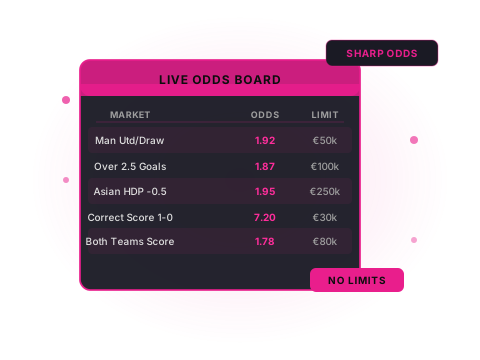
Most bettors have a moment where it clicks. Their Bet365 or Paddy Power account starts shrinking: smaller max stakes here, no more promotions there, then eventually limits so thin that serious betting just isn't possible anymore. And that's when the question most casual bettors never think to ask finally shows up: are there bookmakers that don't do this?
There are. Asian bookmakers. Not a marketing label, not some geographic quirk, but a genuinely different way of running a betting business, pricing markets, and treating the people who use them. Get the model itself first, and the rest, why it matters, who it's actually for, how you get to it from Ireland or anywhere else in Europe where you can't just sign up directly, follows from there.
The Asian Bookmaker Business Model
The essential difference between Asian bookmakers and European soft operators is how each type of business treats sharp bettors, those who consistently bet at prices that are better than the true probability of the outcome.
European soft bookmakers treat sharp bettors as a cost centre, plain and simple. A bettor who keeps winning is exploiting pricing errors, and from the bookmaker's side that's a direct threat to the profit model. The operator loses money on those bets. So the response is mechanical: cut the max stakes, block certain markets, eventually just close the account. The whole soft-book model leans on a customer base that, in aggregate, loses.
Asian bookmakers do the opposite, and Pinnacle's been running this model since 1998. A sharp bettor places a bet at 2.10 on something the market has at 2.00? That's information. It tells the bookmaker the true probability is likely higher than their line suggests. So instead of shutting that bettor down, the Asian bookmaker adjusts its line, essentially crowdsourcing pricing accuracy from thousands of sharp bettors worldwide. The edge comes from volume and tight margins, not from deciding who's allowed to keep betting.
What falls out of that is a genuinely different equilibrium: tighter margins (1 to 3% versus the soft book's 6 to 12%), higher limits set by market liquidity rather than someone's internal risk score, and, crucially, no real mechanism for individually restricting a winning account. The sharp bettor isn't tolerated here. They're actively welcomed, because they help the book run better markets.
The Key Asian Bookmakers and What They Offer
The Asian bookmaker landscape has several major names. Understanding each one's position helps bettors build the right multi-book setup.
| Bookmaker | Model | Core Strength | Typical Margin | Winner Policy |
|---|---|---|---|---|
| Pinnacle | Sharp (Curaçao) | Highest limits, best published margins, benchmark odds | 1–3% | No restrictions |
| SBOBet | Asian (IoM / PAGCOR) | Football Asian handicap depth, strong in-play | 2–5% | High tolerance |
| MaxBet | Asian (PAGCOR / IoM) | Line comparison value, mid-tier limits | 3–6% | Higher than soft books |
| BetISN | Asian (PAGCOR) | Southeast Asian football coverage, live markets | 3–6% | Higher than soft books |
| Singbet | Asian | Southeast Asian football, line comparison layer | 3–6% | Higher than soft books |
Professional bettors rarely stick to one Asian bookmaker. They run several through a broker, comparing lines before placing to squeeze out the sharpest price available. Pinnacle gets treated as the benchmark, more or less universally (if you can't beat Pinnacle's line, that bet's probably not value, full stop), while SBO and the rest add comparison depth and occasionally beat Pinnacle on a specific market.
Asian Handicap: The Defining Bet Type
Asian handicap is the bet type most associated with Asian bookmakers, and understanding it reveals why the Asian model is structurally more efficient for serious football bettors.
In a traditional 1X2 football bet you're picking one of three outcomes: home, draw, away. Margin gets spread across all three, and the combined overround typically lands somewhere around 106 to 112%. Take the draw out of the equation, which is exactly what an Asian handicap does, and margin only gets applied across two outcomes. Lower effective margin, every time. A 2-way market at even money with 3% overround gives each side 1.94; a comparable 3-way market might only offer 1.80 or worse on all three.
For a bettor with a genuine edge, that difference matters enormously, because more of the edge reaches your pocket instead of getting eaten by the bookmaker's cut. Which is basically the whole reason professional bettors gravitate toward Asian handicap markets, and why Pinnacle's handicap lines are treated as the global benchmark for football pricing.
Accessing Asian Bookmakers from Ireland
Direct registration isn't available to most Irish bettors, and no, emailing support won't change that. Asian bookmakers operate under licences covering Asian jurisdictions, and Ireland (along with the UK, Germany, France, most of Europe really) sits outside that scope. It's a licensing boundary. Not a technical one.
The professional route is a licensed betting broker. Brokers such as AsianConnect and BetInAsia hold their own regulatory licences and maintain commercial relationships with several Asian bookmakers at once. One broker account gets you Pinnacle, SBO, MaxBet, BetISN, and whatever else is on their panel, through a single funding process and a single point of contact. Commission runs 1 to 2% on net winnings, typically.
Here's the part that surprises people switching over from European soft books for the first time: the broker structure doesn't just get you in the door, it removes the whole individual-account-restriction dynamic. The broker's relationship with each bookmaker is institutional, so your betting activity doesn't trigger some internal review at the bookmaker level the way it would on a Bet365 account. You get the Asian pricing model and the operational stability, together.
Frequently Asked Questions
- What makes Asian bookmakers different from European ones?
- The fundamental difference is the business model. European soft bookmakers make their money partly from sharp bettors losing, but primarily by adjusting their offering to minimise the losses they incur from consistently profitable customers: through stake restrictions, gubbing, and account closures. Asian bookmakers like Pinnacle, SBOBet, and MaxBet operate on a volume model: they set tight margins, accept bets from sharp bettors because those bets improve their pricing information, and profit from the sheer volume of bets across thousands of markets. This means no individual account restrictions for winning bettors; profitability isn't a threat to the Asian model, it's part of how it works.
- Are Asian bookmakers legal?
- Yes, fully licensed and regulated: Pinnacle (Curaçao), SBOBet (Isle of Man / PAGCOR), MaxBet (PAGCOR / Isle of Man). Not accessible directly in Ireland or the UK isn't the same as illegal; it just means they haven't sought national licences there. Commercial decision, not a legal red flag.
- Why can't I open an Asian bookmaker account from Ireland?
- Most Asian bookmakers operate under licences that define permitted jurisdictions, primarily in Asia. Ireland, the UK, and most of Europe are not covered by those licences. Opening a direct account from these jurisdictions isn't possible because the bookmaker hasn't obtained (and generally hasn't sought) the relevant European regulatory authorisations. The professional solution is to access Asian bookmakers through a licensed betting broker, which holds its own regulatory licences and provides access to Asian book markets from European countries on a legal, institutional basis.
- What is Asian handicap betting?
- Asian handicap is a betting format originating in Asian sports betting markets that eliminates the draw as an outcome in football matches, creating a two-way market. A handicap is applied to the stronger team: for example, Liverpool -1 Asian handicap means Liverpool must win by 2 or more for the bet to win. Half-handicaps eliminate the possibility of a push (your stake returned). Quarter-handicaps split your stake across two adjacent handicap lines. The elimination of the three-way result significantly reduces the bookmaker's margin versus traditional 1X2 betting, making Asian handicap one of the most efficient bet types available.
- How do I access Asian bookmakers from Ireland?
- The established route is through a licensed betting broker. Brokers such as AsianConnect and BetInAsia hold their own regulatory licences and maintain commercial relationships with Asian bookmakers including Pinnacle, SBOBet, MaxBet, and BetISN. You open a single broker account, fund it, and use the broker's platform to access Asian book markets directly. The broker charges commission of typically 1–2% on net winnings. This is the professional route used by serious bettors who want multi-book line comparison access without the account restriction dynamics of direct soft bookmaker accounts.
- What is the margin difference between Asian and European bookmakers?
- Pinnacle operates with margins of approximately 1–3% on major football markets, among the lowest of any bookmaker globally. SBOBet and other Asian bookmakers typically range from 2–5% on core football markets. European soft bookmakers like Bet365, Ladbrokes, or Paddy Power typically operate on margins of 6–12% on the same markets. Over a significant volume of bets, this margin difference has a dramatic impact on long-term returns. A bettor placing 1,000 bets of €100 at a 55% win rate on even-money markets loses roughly €3,000 with a 10% margin bookmaker; the same bettor breaks approximately even with a 2% margin bookmaker.