Most bettors end up at Asian bookmakers for the same reason: they ran out of road at the European soft books. Limited, cut, closed. In that order, usually. The Asian model solves that particular problem, fine. But for professionals the real advantages sit well past just being allowed to place a bet.
Here's the thing though: professional use of Asian bookmakers looks almost nothing like casual use. Same platforms, completely different approach. And that operational gap, more than anything about the odds themselves, is what separates an operation that actually lasts from one that just buys itself a few extra months before hitting the same wall again.
This guide gets into the actual mechanics: the multi-book comparison workflow, the margin math, how professionals decide which book gets which bet.
Why the Asian Bookmaker Model Suits Professional Bettors
The core compatibility between Asian bookmakers and professional bettors comes down to a structural alignment of interests. European soft bookmakers are built for recreational customers; they profit from volume across a customer base that loses money over time, and sharp bettors are a problem to be eliminated. Asian bookmakers, particularly Pinnacle, operate on a different theory entirely: sharp betting activity is pricing information. A bet placed by a serious bettor signals that a market may be mispriced, and the bookmaker updates its model accordingly. The professional bettor is not a threat; they are a useful input into the pricing process.
This alignment produces the specific features that matter most to professionals: margins of 2–5% rather than 7–12%, limits set at the market level rather than the account level, no progressive account restriction, and a long-term operational environment where successful betting does not shorten your account lifespan.
The practical consequence is that a professional bettor can plan a long-term operation at Asian bookmakers. The operating environment is stable. The pricing is predictable. The infrastructure, once set up, does not deteriorate as performance improves.
The Multi-Book Line Comparison Workflow
One of the most important practical differences between casual and professional use of Asian bookmakers is the multi-book comparison workflow. Casual bettors pick a bookmaker and place bets at whatever price is available. Professional bettors compare prices across multiple books in real time before each bet is placed, and consistently select the best available price.
The operational setup typically involves access to at least three pricing sources simultaneously: Pinnacle (for the sharpest pre-match prices, particularly on Asian handicap and totals), SBOBet (for Asian handicap football depth and live markets), and a secondary book such as MaxBet or BetISN for additional comparison. Before placing any significant bet, the professional bettor checks the price at each source and routes the bet to whichever book is offering the best available odds at that moment.
This is where the broker model becomes practically valuable. Rather than maintaining separate accounts and separate funding at three or four Asian bookmakers, a licensed betting broker provides access to all of them through a single account and a single pool of funds. The multi-book comparison is handled through the broker interface, and the bet is routed to the optimal book automatically or on selection. This removes a significant operational overhead from the professional workflow.
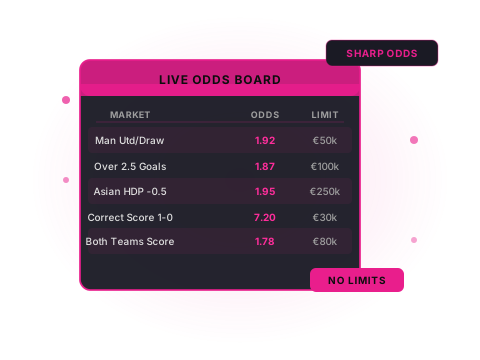
Break the panel down and it looks roughly like this. Pinnacle is the pre-match pricing benchmark, particularly on Asian handicap and totals, with margins around 2 to 3% and stakes running from €50,000 up into the €200,000+ range on the biggest markets; no account-level restriction, only market limits. SBOBet covers Asian handicap football and live betting at 3 to 5% margin, stakes typically €10,000 to €50,000, tolerant of winners at the market level. MaxBet sits a notch below as a secondary comparison layer, 4 to 6% margin, €5,000 to €30,000 stakes, mid-tier tolerance but still well above what any European soft book offers. BetISN plays a similar role with strong Southeast Asian coverage, similar margins and stakes, market-level adjustments rather than blanket bans.
Asian Handicap: Why It Matters for Professional Betting
For professional bettors, Asian handicap markets are not a novelty; they are the primary betting market. The structural reason is the elimination of the draw: Asian handicap lines use half-goal and quarter-goal increments to remove the possibility of the handicap exactly covering the margin of victory, producing a clean two-way market. With only two outcomes rather than three, the bookmaker cannot include a separate draw margin in the pricing structure.
The practical result is that Asian handicap markets at Asian bookmakers carry margins of 2–4% on major football, compared to 7–12% for equivalent 1X2 markets at European soft bookmakers. For a bettor placing significant volume, this difference compounds dramatically over time. It also means the market is priced more accurately; the reduced margin means the bookmaker has less cushion, and inefficiencies in the pricing are smaller and shorter-lived.
Asian bookmakers just cover far more Asian handicap ground than the European alternatives do. Bet365 and its peers will carry handicap lines on the big leagues, sure, but venture into lower-tier or Asian football and the coverage thins out fast. Pinnacle and SBOBet, by contrast, run comprehensive handicap coverage across hundreds of leagues, opening up markets for anyone with an edge outside the usual European suspects.
Margin and Closing Line Value: The Professional Metrics
Professional bettors evaluate their performance differently from recreational bettors. Rather than tracking P&L over a short window, professionals use closing line value (CLV) as the primary quality metric: did the price taken beat the closing price at the sharpest book available? Consistently beating the closing price at Pinnacle (which represents the most efficient pricing available) is the most reliable indicator of a long-term edge.
Using Asian bookmakers, and Pinnacle in particular, as the benchmark is central to this professional methodology. The Pinnacle closing line is used as the market-consensus reference point because the high limits and no-restriction policy mean that sharp money moves the line before close, making it the most accurate reflection of true probability. A bettor consistently beating this benchmark has a demonstrable edge.
The margin calculation also works in reverse when evaluating which book to use for execution. If a professional bettor has identified a value position, they want to execute at the highest available price across all accessible books. The multi-book comparison workflow, described above, extracts the maximum available edge on each bet. Over hundreds and thousands of bets, this consistent price optimisation is a measurable performance factor.
How Professional Bettors in Ireland Access Asian Bookmakers
For bettors based in Ireland, direct access is simply closed. Pinnacle, SBOBet, MaxBet, BetISN, Singbet, all of them operate under licences (PAGCOR mainly, plus the Isle of Man Gambling Supervision Commission) that don't extend to EU member states. There's no direct sign-up path here, and no amount of persistence changes that.
The route professionals actually use is a licensed betting broker. AsianConnect and BetInAsia are the two names that come up most, regulated intermediaries (AsianConnect holds a Malta Gaming Authority licence, for what it's worth) with commercial relationships across the Asian bookmaker panel, and both can onboard Irish customers. One broker account, and suddenly Pinnacle, SBOBet, MaxBet, and BetISN are all sitting behind the same login, with the multi-book comparison workflow described earlier built right in.
Commission on net winnings, usually 1 to 2%, is what that access costs. For anyone moving from European soft books at 8 to 12% margin to Asian books at 2 to 5% through a broker, the margin saving swamps the commission. Not close, really.
Frequently Asked Questions
- Which Asian bookmakers do professional bettors actually use?
- Usually Pinnacle for the sharpest pricing and highest limits, SBOBet for Asian handicap depth and live betting, and a secondary book like MaxBet or BetISN for extra comparison. Not everyone runs all three; it depends on volume and target markets. Almost always through a licensed broker rather than direct accounts.
- How do professional bettors use multiple Asian bookmakers at once?
- Line shopping, essentially: checking Pinnacle, SBOBet, and a secondary book in real time and placing with whoever's offering the best price at that moment. A broker account makes this practical by putting all of them behind one login instead of several.
- Can I access Asian bookmakers from Ireland?
- Not directly. Pinnacle, SBOBet, MaxBet, BetISN, and Singbet all run on PAGCOR or Isle of Man licences that don't cover EU/EEA markets. AsianConnect or BetInAsia, both regulated brokers, are the route in.
- What is the advantage of Asian handicap betting for professionals?
- No draw outcome means no draw margin, which forces tighter, more accurate pricing than 1X2 markets on the same fixture. Lower margin means less edge needed to stay profitable, and Asian bookmakers offer far deeper handicap coverage than European soft books.
- Do Asian bookmakers limit winning professional bettors?
- Pinnacle documented policy: no account-level restriction, limits set market-wide for everyone. SBOBet, MaxBet, and BetISN adjust in some cases but remain far more tolerant than European soft books, because sharp money is treated as useful pricing information rather than a threat.
- How much commission do brokers charge for accessing Asian bookmakers?
- Typically 1–2% of net winnings, though some charge a small turnover percentage instead. Against Asian bookmaker margins of 2–5%, that commission is usually well within the value gained.