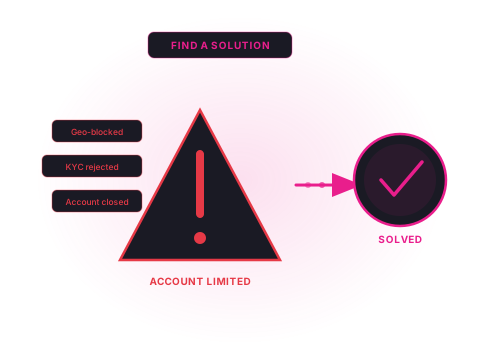
What Bookmakers Mean by Bonus Abuse
When a bookmaker says you've "abused" a bonus, they mean you've used a promotion in a way that ensures profit or near-guaranteed return, rather than using it as entertainment with expected loss built in. From the bookmaker's perspective, the promotional system is designed to generate losses with occasional wins. When a bettor systematically extracts the mathematical value from promotions, that breaks the model.
The accusation is almost always applied to practices that are not illegal, and are often not prohibited under the literal wording of the T&Cs either. Most bonus abuse clauses are written broadly enough to cover nearly anything the bookmaker decides in retrospect to disallow. Common language includes: "we reserve the right to void winnings where we determine promotional activity was undertaken in an abusive manner."
That kind of language hands bookmakers enormous discretion, and it leaves genuine ambiguity for bettors who acted in good faith under a reasonable reading of the terms. Nobody defines, clearly, where "smart use of a promotion" ends and "abuse" begins. That's sort of the point.
The Most Common Triggers
Certain betting patterns reliably trigger bonus abuse investigations, even when the bettor believes they are acting within the rules:
| Behaviour | Why It Triggers Review | Typical Outcome |
|---|---|---|
| Matched betting (free bet hedging) | Free bets are hedged on exchange, eliminating risk, guaranteed profit regardless of outcome | Bonus voided; account restricted or closed |
| Arbitrage during enhanced prices | Enhanced odds bet on one platform, opposite bet at normal odds elsewhere, locking in profit | Arb position voided; enhanced bet settled at normal odds or stakes capped |
| Multiple accounts / household sharing | Two people at the same address claiming separate welcome bonuses | One or both accounts closed; promotional winnings voided |
| Low-staking on high-RTP games to clear wagering | Casino bonus wagering requirements met by beting on games with 99%+ RTP (e.g. certain slots, roulette bets) | Bonus voided; wagering contribution rules invoked |
| Consistent single-selection value betting | Profitable single bets at sharp early prices, looks like "arbing" to the bookmaker's algorithms | Stake restrictions applied; may be miscategorised as bonus abuse |
The last row is important: value betting (which is entirely legitimate and involves no exploitation of promotions) is sometimes labelled "bonus abuse" or "arbitrage" by automated bookmaker systems that identify any profitable account pattern as suspicious. If you've been accused of bonus abuse but haven't been using promotions systematically, request a specific explanation of which bet or activity triggered the accusation.
What a Bookmaker Can and Cannot Do
Understanding your rights requires distinguishing between promotional balances and real-money balances:
What They Can Do
- Void promotional winnings if a T&Cs violation is identified
- Restrict your ability to claim future promotions
- Reduce the maximum stake on specific markets
- Close your account (in most jurisdictions with notice and return of real-money balance)
- Apply enhanced wagering requirements to future bonuses
What They Cannot Do
- Confiscate your deposited real-money balance without legal cause
- Withhold genuine real-money winnings from non-promotional bets
- Refuse to process a withdrawal of your real-money funds
- Retrospectively apply T&Cs that didn't exist when the bets were placed
- Ignore escalation to the ADR service they're contracted to
The critical practical point: a bookmaker can refuse to pay promotional winnings. They cannot, under IRGB or UKGC licensing rules, simply hold onto your deposited funds or genuine non-promotional winnings without cause. If a withdrawal is refused and the funds are not promotional, that is a serious regulatory matter.
How to Respond to the Accusation
A structured response gives you the best chance of recovering withheld funds or having restrictions reversed:
-
Get the accusation in writing
If you received only a suspension email or a pop-up message, contact support and request a written explanation of: (a) which specific T&Cs were violated, (b) which bets triggered the accusation, and (c) exactly what action the bookmaker is taking (void, restriction, closure).
-
Review the specific T&Cs cited
Read the precise clause they're invoking. Check whether your activity clearly falls within it, clearly outside it, or in an ambiguous zone. If the clause is ambiguous, that ambiguity is an argument in your favour; in regulated markets, T&Cs ambiguities are interpreted against the party who drafted them.
-
Gather your evidence
If you believe the accusation is incorrect, collect screenshots of the promotion terms as they existed when you took the bet, your betting history showing the disputed bets, and any communications confirming you understood the offer.
-
Submit a formal complaint
Write a formal complaint (not just a live chat message) stating clearly: the accusation is incorrect, why it's incorrect, the specific evidence, and the remedy you're requesting (restoration of winnings, removal of restriction, or explanation). Ask for a complaint reference number.
-
Wait for the formal complaint process
Licensed bookmakers must respond to formal complaints within defined timeframes (typically 8 weeks in the UK). Do not keep sending messages; this delays the formal process without adding value.
-
Escalate to ADR if unsatisfied
Every UKGC- and IRGB-licensed bookmaker must offer an Alternative Dispute Resolution service. Once the bookmaker's internal process is exhausted, you can take the dispute to the ADR at no cost. ADR decisions are binding on the bookmaker.
Escalation and Your Rights
Most bettors don't pursue formal complaints because they assume the bookmaker always wins. In practice, the regulated complaints system does provide genuine recourse, particularly when funds beyond promotional winnings are involved.
| Country | Regulator | ADR Route | Escalation Timeframe |
|---|---|---|---|
| Ireland | IRGB (Interim) | Bookmaker's listed ADR service | After 8 weeks or deadlock letter |
| UK | UKGC | IBAS or similar UKAS-accredited ADR | After 8 weeks or deadlock letter |
| Malta (MGA) | Malta Gaming Authority | MGA Player Support Unit | After internal complaint resolution |
If the disputed amount is material (£200+) and involves genuine real-money funds, the ADR route is worth pursuing. If the dispute concerns only the voiding of a free bet or promotional bonus, the outcome is less certain; bookmakers have more discretion over promotional funds, and ADRs typically apply a higher threshold for overturning these decisions.
The Bigger Picture: Soft Books vs Sharp Books
Bonus abuse accusations, account restrictions, and stake limits are structural features of soft bookmakers, not accidents or oversights. Soft bookmakers are built around the premise that promotional bettors eventually become losing bettors; when they don't, the model breaks and restrictions follow.
Professional bettors who have been through this cycle (matched betting into value betting, restrictions, closure, onto the next platform) typically arrive at the same conclusion: the promotional book model is a short-term strategy, not a long-term one. The platforms where serious long-term betting happens are structurally different:
Pinnacle (via Broker)
No welcome bonuses. No promotional structure. 1–2% margin on football markets. Winning bettors are not restricted; they're welcomed because they provide price information. Irish bettors access Pinnacle through licensed brokers (AsianConnect, BetInAsia). The shift from soft book promotions to Pinnacle real-money betting is the most significant structural upgrade a serious bettor can make.
Betfair Exchange
Peer-to-peer betting, no bookmaker on the other side. Commission of 5% on net winnings per market, with no stake restrictions and no account restrictions for winning. The Premium Charge affects highly profitable long-term traders (lifetime net winnings threshold), but doesn't affect casual-to-moderate bettors. Accessible directly from Ireland.
If you've just received an accusation, sort out the immediate dispute first, that's the priority. But worth saying honestly: the account you're fighting to save was probably always going to restrict you eventually, whether for the bonus use or simply for winning too much. The energy spent defending a soft book account is, more often than not, better spent building the infrastructure serious bettors actually rely on.
Professional Betting Platforms With No Restrictions
These brokers provide access to Pinnacle and Asian books, platforms that welcome winners and have no promotional structure to "abuse."
Frequently Asked Questions
What does "bonus abuse" mean to a bookmaker?
Bonus abuse, in bookmaker terms, refers to any systematic use of promotional offers in a way the bookmaker did not intend, even when the bettor is technically following the stated terms and conditions. This includes matched betting (hedging free bets on exchanges), arbitrage during enhanced-price offers, exploiting reload bonuses across multiple accounts or household members, and low-staking to meet wagering requirements on games with near-100% return-to-player rates. The term is applied broadly and subjectively: a bookmaker can label almost any efficient use of promotions as "abuse."
Is bonus abuse illegal?
No. Bonus abuse is not illegal in any jurisdiction where online betting is regulated. It is a violation of a bookmaker's Terms and Conditions, a contractual matter, not a legal one. However, the consequences are commercial: bookmakers can withhold promotional winnings, restrict accounts, or close accounts if they determine Terms and Conditions have been violated. The T&Cs of most major bookmakers include broad "bonus abuse" clauses that give them significant discretion to void promotional winnings. The legality of the practice is not the same as its enforceability.
Can a bookmaker keep my winnings if they accuse me of bonus abuse?
Potentially, yes, but only in specific circumstances. If the bookmaker can demonstrate a T&Cs violation (e.g. multiple accounts, coordinated abuse across a household, circumventing verification), they can withhold promotional winnings. They cannot, in most regulated jurisdictions, withhold genuine winnings from non-promotional real-money bets. If a bookmaker withholds winnings you believe are legitimately yours, you can escalate to the relevant regulator: IRGB in Ireland, UKGC in the UK. Regulated bookmakers cannot simply confiscate real-money balances without cause.
Will a bonus abuse accusation affect my other bookmaker accounts?
Not directly; bookmakers do not share account restriction information with each other. However, some use third-party fraud detection services that aggregate betting patterns across operators. If you've been flagged at one bookmaker for systematic promotional use, it may appear in shared screening databases. In practice, the larger risk from bonus abuse accusations is the account itself: restrictions, void winnings, or closure. The downstream effect on other accounts is a secondary concern and varies by the specific services used.
How do I respond if a bookmaker accuses me of bonus abuse?
First, read the specific accusation carefully: bookmakers are required to state what T&Cs they believe you violated. Request a written explanation if you haven't received one. If you believe the accusation is incorrect or the withheld funds are not promotional, write a formal complaint requesting restoration with your evidence. If this fails, escalate to the ADR (Alternative Dispute Resolution) service listed in the bookmaker's T&Cs; all UK and Irish licensed bookmakers are required to offer one. If the ADR finds in your favour, the bookmaker must comply.
What do professional bettors do instead of chasing bonuses?
Professional bettors move away from soft bookmaker promotions once accounts are restricted (which happens quickly for winning bettors and bonus-focused bettors alike). The alternative infrastructure is: Pinnacle and Asian books for tight-margin real-money betting with no restrictions, accessed via broker from Ireland; and Betfair Exchange for peer-to-peer markets. None of these platforms have welcome bonuses or promotional structures; they compete on price and access rather than short-term offers. The long-term value of tight margins without restrictions exceeds the short-term value of soft book promotions for any bettor with edge.