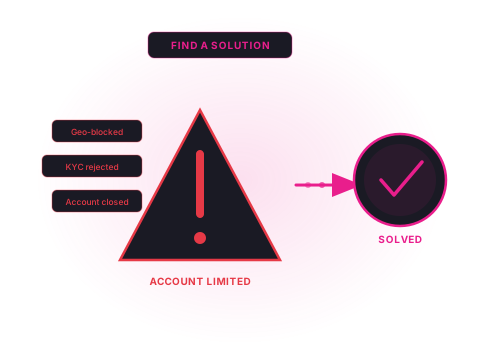
Common Bettor Problem

Bookmaker Geo-Blocking: What It Is, How It Works, and the Legitimate Alternatives

Geo-blocking is the technical system bookmakers use to enforce country restrictions. Understanding how it actually works — and why VPN workarounds tend to backfire — is the first step to finding a solution that doesn't put your account and funds at risk.

Jump to Solutions →
Bookmaker geo-blocking explained

You try to access a bookmaker — maybe via a link you've seen recommended, or after researching a sharp book with better odds than what's available to you locally. The site loads, but then you're redirected or shown a message saying your country is not supported. Or you get further into the registration process before a system check blocks you.

This is geo-blocking: the technical enforcement of country-based access restrictions. It's a standard part of how regulated online gambling platforms operate, and understanding how it works helps explain why some workarounds fail and what approaches actually lead to a sustainable solution.

How Bookmaker Geo-Blocking Actually Works

The IP address is the most visible enforcement mechanism. When you connect to a website, your IP address reveals your approximate location — this is how bookmakers identify that a visitor is connecting from a restricted country and redirect them or block registration.

But IP addresses are only the starting point. Modern bookmakers layer their detection: your payment method carries geographic information (your bank is based in your country, your card's BIN code identifies its country of issue), your billing address is entered at registration, your browser may expose locale settings, and during identity verification your proof of address document confirms your actual location. The geo-block at the connection level is the first filter — KYC is the definitive one.

Some bookmakers also use device fingerprinting — identifying a device not just by its IP but by a combination of browser version, installed fonts, screen resolution, and other factors. A device that was previously associated with a restricted location can be flagged even when connecting through a different IP.

The practical consequence is layered: even if you change your IP, you are likely to face a mismatch when you attempt to verify your identity. And for a regulated bookmaker, identity verification is not optional — they are legally required to complete it, which means they will receive your actual address regardless of how you initially connected.

Why VPNs Create More Problems Than They Solve

A VPN (Virtual Private Network) changes your visible IP address by routing your connection through a server in another location. It is the most commonly attempted workaround for geo-blocking. For bookmaker access, it has a set of specific problems that make it unreliable.

The risk profile of using a VPN to access a restricted bookmaker is: potential account closure, potential fund withholding, and no recourse through any regulator (since you've violated the terms). The expected value is negative even before calculating the effort involved.

The Pattern Most Bettors Go Through

The typical sequence: bettor discovers a bookmaker they want to use, finds it's restricted, looks up how to get around it, finds VPN guidance, connects via a VPN, completes registration, deposits, starts betting. Then one of two things happens: either the account is immediately flagged and closed after KYC, or the account runs for a while before a routine review surfaces the IP inconsistency and closes it. Either way, the window is temporary — and in the second scenario, there are often significant pending bets or a balance that's caught up in the closure process.

Beyond the individual account risk, there's a broader point: the bookmakers that are most commonly geo-blocked are the ones most worth accessing legitimately. Pinnacle, for example, is the gold standard for serious bettors — a sharp book with no limit policy. The path to Pinnacle for bettors in restricted countries isn't circumvention; it's the professional route that brokers provide. For more on why Pinnacle is worth accessing, see Pinnacle's restricted country situation explained.

The Legitimate Routes to Geo-Blocked Bookmakers

The solution to geo-blocking isn't to work around it technically — it's to use routes that aren't subject to the restriction in the first place.

Licensed Betting Brokers

A licensed betting broker is the professional-grade solution to geographic restrictions on bookmakers. Brokers hold institutional accounts at Pinnacle, SBO, and other major sharp books — accounts that operate under the broker's licence rather than individual consumer access agreements. The country restrictions that apply to direct retail accounts don't apply to the broker's corporate relationships.

A bettor in Ireland cannot open a direct Pinnacle account. But they can open an account with AsianConnect, which is a licensed broker that provides access to Pinnacle through its institutional setup. The KYC process is with the broker, using genuine documents, with no misrepresentation required. This is the professional route — it's how serious bettors in restricted markets access sharp odds without the account risk that comes with VPN circumvention.

Betting Exchanges

Betfair operates under an Irish gaming licence and accepts customers from Ireland and most European markets. If the primary goal is market efficiency and no account restriction risk, Betfair and other exchanges are a direct solution for many bettors who are looking for a way around soft bookmaker limitations. Betfair's geo-blocking is different in scope — it covers fewer countries than Pinnacle or the Asian books. See our country restrictions overview for a broader picture of which platforms are available where.

Bookmakers Available in Your Country

Depending on your location, some sharp-leaning bookmakers accept your country that you may not yet have accounts at. The available options vary by country and change as operator licensing policies evolve. It's worth systematically reviewing which operators accept your jurisdiction before concluding that the broker route is the only one.

What to Do Next

  1. Confirm the restriction is actually in place — Some bookmakers allow registration but restrict betting or withdrawals. Check whether the platform actually refuses accounts from your country, or just displays a warning.
  2. Don't use a VPN — The risk-reward calculation is negative. The potential for account closure and fund withholding outweighs the convenience of accessing a restricted platform temporarily.
  3. Research licensed brokers that accept your country — AsianConnect and BetInAsia both accept Irish clients and provide Pinnacle access. Verify current accepted countries directly with each broker.
  4. Open and verify a broker account using genuine documents — The KYC process at a regulated broker is straightforward and uses the same documents you'd use at any regulated bookmaker.
  5. Use the broker as your primary access point — Once active, a broker account provides access to the sharp markets that are geo-blocked for direct retail accounts — without the risk of account closure that VPN use creates.

Access Geo-Blocked Bookmakers Through a Licensed Broker

These regulated betting brokers provide legitimate access to Pinnacle and Asian markets for bettors in countries where those bookmakers are geo-blocked.

  1. #2
    BetInAsia

    Sharp odds, fast execution, low commission

  2. #3
    MadMarket

    Exchanges & Asian books via one account

  3. #4
    SportMarket

    European-regulated broker with wide market access

Frequently Asked Questions — Bookmaker Geo-Blocking

How do bookmakers detect my location?

Bookmakers use multiple signals to establish location: your IP address (the primary method at the point of access), billing address and bank details from payment methods, the address provided at registration, geolocation data from your browser if permissions allow, and device identifiers. The combination of these signals means that changing one factor (like your IP via a VPN) while the others remain consistent with your actual location creates a detectable inconsistency that triggers manual review.

Can a bookmaker geo-block me after I've already opened an account?

Yes. If you registered when the bookmaker did not yet restrict your country, and that policy later changed, existing accounts may be closed with a period of notice (typically 30 days) and your balance returned. Some operators impose a withdrawal-only period rather than immediate closure. If you believe you are in a country the bookmaker previously accepted, check whether their terms have been updated — some operators communicate this via email before enforcement.

Is it legal to access a geo-blocked bookmaker?

The legal position varies by jurisdiction, but using technical means to circumvent a geographic restriction typically violates the bookmaker's terms and conditions regardless of its technical legality. The more practical concern is that it creates grounds for the bookmaker to withhold winnings and close your account. The legal risk to the individual bettor is typically low, but the financial risk of having an account closed mid-activity is real.

What is the difference between a geo-block and a country restriction?

A country restriction is the policy decision — the bookmaker decides not to serve customers from a given country. Geo-blocking is the technical implementation — the mechanism used to enforce that policy. The two are related but not identical. A bookmaker may have a policy restricting your country but have imperfect geo-blocking that allows access. However, the policy applies regardless of the technical enforcement. If you access the platform and your real location is established during KYC, the account will be closed regardless of how you initially got through.

Are there bookmakers with no geo-blocking at all?

Regulated bookmakers are generally required to implement geographic controls as part of their licensing conditions. Completely unregulated offshore bookmakers may have no geo-blocking, but they also have no regulatory oversight, no fund protection, and no dispute resolution mechanism. Accessing unregulated operators to bypass country restrictions creates far greater risks than the access problem it appears to solve.