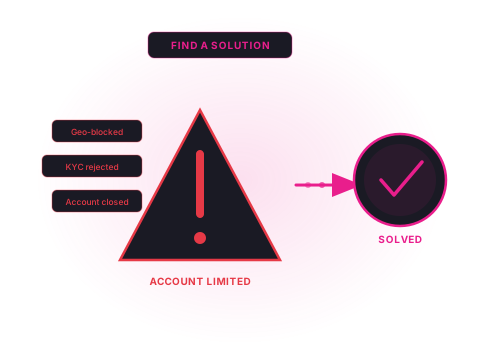
You logged in, tried to place a bet, or tried to withdraw, and found your account locked or suspended with a message about "suspicious activity" or "account review." The balance is sitting right there, you just can't touch it. Customer support gives vague answers. And as far as you're concerned, you haven't done anything wrong.
More bettors go through this than most people realise. Understanding what's actually happening, and what the most effective response looks like, means setting the instinctive reaction aside for a minute and looking at the mechanism objectively instead.
Why This Happens: The Real Reason Accounts Get Flagged
Soft bookmakers operate risk systems that flag accounts deviating from expected recreational betting patterns. The systems are automated; no human reviewed your account and decided you were suspicious. An algorithm identified statistical signals that triggered a flag.
The most common triggers fall into three categories:
| Trigger Category | What the Algorithm Sees | What It Means in Practice |
|---|---|---|
| Profitability Signal | Win rate above threshold over sufficient sample | You're betting with edge; bookmaker classifies you as unprofitable customer |
| Sharp Betting Patterns | Bets correlate with early price moves or sharp bookmaker lines | Your bets are positioned like those of professional bettors |
| KYC / AML Trigger | Deposit or withdrawal volume exceeds regulatory threshold | Mandatory regulatory review, not a judgement, just a compliance step |
| Multiple Account Signals | Device ID, IP, or payment method matches a flagged account | Association with a restricted account, can be innocent (shared device) |
| Bonus Pattern | Systematic bonus extraction across multiple offers | Matched betting or bonus abuse detection, different trigger from value betting |
| Unusual Deposit/Withdrawal Pattern | Frequent large deposits and rapid withdrawals without equivalent betting | AML concern, regulatory requirement to investigate funds flow |
Worth remembering: "suspicious" is the bookmaker's own internal term, not a legal concept, and it doesn't mean you've done anything illegal. For most flagged accounts the underlying cause is really quite mundane, the bettor just bets too well for the bookmaker's business model to tolerate.
What Happens After the Flag: The Review Process
The review process depends on which trigger fired. Most reviews follow a predictable sequence:
Document Request (KYC)
The bookmaker requests identity documents, proof of address, or both. This is standard regulatory compliance and applies to all customers at various thresholds. Submit clearly photographed or scanned documents promptly. Delays in submission extend the account suspension period.
Source of Funds Request
For larger deposit or withdrawal amounts, bookmakers may request evidence of source of funds: bank statements, payslips, or tax returns. This is an AML regulatory obligation, not an accusation. Provide accurate documentation that corresponds to the actual source of your funds.
Account Restriction
If the review is profitability-driven, the outcome is often a stake restriction rather than full closure; the account continues to function but your maximum stake is significantly reduced, sometimes to amounts that make betting impractical.
Account Closure
The most severe outcome. The bookmaker closes the account, returns the balance, and may issue a notice citing suspicious activity or terms of service. This is a commercial decision. The balance must be returned regardless of the closure reason.
What Most Bettors Do Wrong
The most common responses to a suspicious activity flag are exactly the wrong ones. Understanding why they don't work saves time and prevents unnecessary escalation.
Wrong approach
Sending repeated emails or making daily support calls. The review is handled by a compliance team operating on their own timeline. Escalations do not speed up the process and are noted in the account record. Excessive contact can trigger a more thorough review or be interpreted as pressure behaviour.
Wrong approach
Cancelling the withdrawal and withdrawing via a different method. Attempting to circumvent a suspended withdrawal by cancelling and re-requesting via a different payment method will trigger a more serious fraud review. If a withdrawal is suspended for review, leave it in place until the review resolves.
Wrong approach
Opening a second account at the same bookmaker. If your account is under review or restricted, opening a second account at the same bookmaker (even under a different email or device) constitutes a terms of service violation and can result in voided winnings. The bookmakers' device and payment matching systems are effective at identifying this.
Wrong approach
Threatening regulatory complaints before exhausting the internal process. Filing a complaint with the regulator before completing the bookmaker's internal dispute resolution process may be required procedurally; many regulators won't accept external complaints until the internal process is exhausted. Follow the process: submit documents, wait for the stated timeline, then escalate formally if unresolved.
What Professional Bettors Do Differently
Professional bettors don't experience suspicious activity flags as a crisis, mostly because they never depended on soft bookmaker accounts for the bulk of their volume in the first place. By the time a soft bookmaker account gets flagged and restricted, the professional bettor has already moved most of their action to platforms that don't restrict winning customers to begin with.
The professional infrastructure has three elements that eliminate the soft bookmaker dependency:
- Sharp bookmakers via broker: Pinnacle and Asian books accessed through a licensed betting broker provide tight-margin markets with no account restrictions. Profitable betting is not a liability; it's expected and accommodated. From Ireland, this requires a broker account (AsianConnect, BetInAsia).
- Betting exchanges: Betfair and Orbit Exchange don't restrict accounts based on profitability. The exchange model means there's no house to beat; you're betting against other market participants.
- Soft bookmakers used tactically: for welcome offers, specific markets not available elsewhere, or early prices before sharp books update. Not for sustained volume.
The fundamental problem: A suspicious activity flag at a soft bookmaker is a signal that the bookmaker considers you commercially unprofitable. Resolving the immediate review doesn't change that underlying assessment. The pattern will recur. The professional response is to build an infrastructure that doesn't depend on the commercial goodwill of operators who don't want profitable customers.
Practical Steps to Take Now
- Do not panic or take hasty action. Your balance is protected by regulation and must be returned regardless of the review outcome.
- Contact support once to ask clearly what documents are required and what the expected review timeline is. Note the response.
- Submit whatever is requested promptly and accurately. Identity documents, proof of address, or source of funds: provide the cleanest possible documentation without embellishment.
- Leave your withdrawal in place. Do not cancel and re-request via a different payment method during an active review.
- Follow up once after the stated timeline has passed. If no resolution after the expected timeframe, send one follow-up email referencing your case number and the original timeline provided.
- If unresolved after 8 weeks, file a formal complaint using the bookmaker's complaints process, then escalate to the relevant ADR or regulator if that process fails to resolve it within the required period.
- Restructure your betting operations regardless of this account's outcome. The infrastructure that eliminates dependency on soft bookmakers is available now: see our broker comparison.
Recommended Betting Brokers: No Account Restrictions
These brokers provide access to Pinnacle and major Asian bookmakers. Unlike soft bookmakers, they do not restrict accounts based on profitability.
Frequently Asked Questions
What does "suspicious activity" mean on a betting account?
A suspicious activity flag is a bookmaker's internal classification applied to an account that has exhibited patterns outside normal recreational betting behaviour. The threshold is determined by proprietary risk algorithms that assess factors including win rate, bet timing, market selection, stake patterns, and device/network data. "Suspicious" is the bookmaker's term (not a legal designation) and typically triggers an enhanced review rather than immediate account closure.
Can a bookmaker accuse me of fraud for suspicious activity?
A suspicious activity review is not a fraud accusation. The term is used internally by bookmakers to describe accounts that deviate from expected recreational patterns, primarily profitable bettors who bet sharp prices early. If the review is AML (anti-money laundering) related, it is a regulatory compliance process, not a fraud allegation. The practical outcome ranges from document requests to account closure, but the process itself is a commercial risk assessment, not a criminal investigation.
Why has my account been flagged if I bet normally?
Betting algorithms don't interpret "normal" the way a human would. A bettor who consistently backs early lines, selects markets with the tightest margins, or places bets that correlate with sharp money movements will be flagged regardless of how they perceive their own behaviour. Winning is itself a trigger. Bookmakers run flagging systems designed to identify profitable bettors and manage them commercially; the label "suspicious" is their internal terminology for this process.
How long does a suspicious activity review take?
Timeline depends on the review type. KYC-triggered reviews typically resolve within 24–72 hours if documents are submitted promptly and are in order. Source of funds reviews (more invasive and often triggered by large deposits or consistent profitability) can take 1–4 weeks. Full account investigations are open-ended and may result in account closure before resolution. During any review, withdrawals are typically suspended until the review concludes.
Should I contact customer support when my account is flagged?
Contact support only to request clarification on what documents are required and what the expected timeline is. Do not repeatedly escalate, threaten complaints, or request manager callbacks; none of these actions influence the review timeline and can complicate the process. Submit exactly what is requested, provide a brief factual explanation if asked, and wait. Excessive contact is noted and can affect how the review is handled.
What happens if my account is closed after a suspicious activity review?
If the account is closed, any balance must be returned to you. Bookmakers are obligated to return player funds; withholding a balance after account closure (unless there is a void bet dispute or fraud finding) is a regulatory breach that can be reported to the licensing authority. If your balance is withheld, file a formal complaint with the bookmaker first, then escalate to the relevant regulator (e.g., UK Gambling Commission, Irish Revenue Commissioners/AGSI) or Alternative Dispute Resolution service if unresolved.