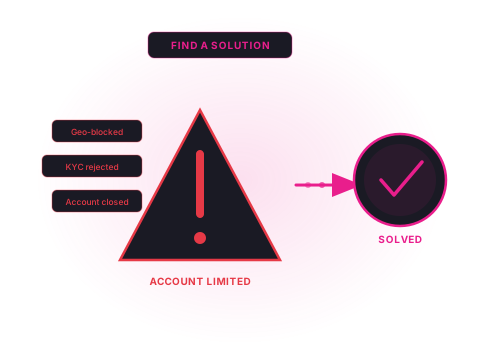
Your account has been suspended or closed, and you still have a balance sitting inside it. Access to the platform is gone, your bets may have been voided, and customer support is either not responding or giving you a circular answer about "review timelines". Alarming, yes. But usually resolvable, and the law is largely on your side here.
The critical thing to understand is that an account closure and a funds forfeiture are two entirely different things. Bookmakers confuse this regularly, either through poor communication or, in some cases, deliberate opacity (and it's worth saying plainly: sometimes it's deliberate). Your balance is your money. The bookmaker's right to close your account does not include the right to keep what's in it.
Why This Happens: The Common Scenarios
Understanding why your account was closed determines how to approach the recovery. The scenarios that result in funds being temporarily locked are different in nature, even if they produce the same surface experience.
Profitability-Triggered Closure
The bookmaker has decided your account is commercially unviable; you've been winning consistently enough to trigger a closure decision. This is common with soft bookmakers who manage their exposure to sharp bettors. Your funds should be returned without complication. The bookmaker has no legal basis to retain your balance for this reason.
Terms Violation Claimed
The bookmaker claims a rule was broken: bonus abuse, suspected multiple accounts, irregular betting patterns, take your pick. They may attempt to void bets and retain a portion of the balance. You're entitled to a specific, written explanation of which terms were violated and precisely which bets are being voided. A general claim isn't enough.
AML or Source of Funds Investigation
A compliance investigation is underway. Your funds are legally frozen (not stolen) during the investigation period. This is the most serious scenario and can take weeks to resolve. You have rights to communicate with the compliance team, but the regulator has given the bookmaker authority to hold funds during an active investigation.
Account Suspended Pending Verification
KYC documents are outstanding and a suspension has been triggered by a withdrawal request or activity threshold. This is the most straightforward scenario. Submit the required documents and the suspension typically resolves within a few days. Your funds are safe; the account is suspended, not closed.
Your Legal Position as a Bettor
In regulated markets (including Ireland and the UK), gambling operators hold a licence that comes with consumer protection obligations. One of those obligations is the return of client funds upon account closure, subject to the resolution of any legitimate compliance investigation. Client funds are supposed to be held in a manner that keeps them protected even if the operator runs into financial difficulty.
If a bookmaker closes your account and refuses to return your balance without a credible legal basis, they are in breach of their licensing conditions. This gives you a clear escalation path: formal complaint to the bookmaker, then the gambling regulator, then an ADR provider if the complaint is unresolved. Court action is a last resort but is rarely necessary once you reach the regulator stage; regulated operators respond to regulatory pressure.
Where bettors lose ground is in poorly documented disputes. If you've sent dozens of support messages but have no written record of what was actually said, your position becomes harder to present to a regulator. Everything from this point should be by email. No exceptions.
When the Bookmaker Claims a Terms Violation
This is the scenario where bettors most commonly get confused about their rights. A bookmaker can legitimately void specific bets where a genuine rule violation occurred, but the calculation must be transparent. They should be able to tell you exactly which bets are being voided, which rule was broken, and what the adjusted balance is after the voided bets are removed.
What they cannot do is use a generalised claim of "terms violation" to retain your entire balance with no further explanation. If this happens, your first step is a formal, written request for itemised detail. In many cases, this request alone is enough to prompt a proper response; the claim was an automated template rather than a considered decision.
If the bookmaker provides a detailed breakdown and you believe the voided bets are not justified, that is the basis for an ADR complaint. Keep the scope narrow and specific; the more clearly you can identify exactly which decision you are disputing, the more likely an ADR outcome is in your favour.