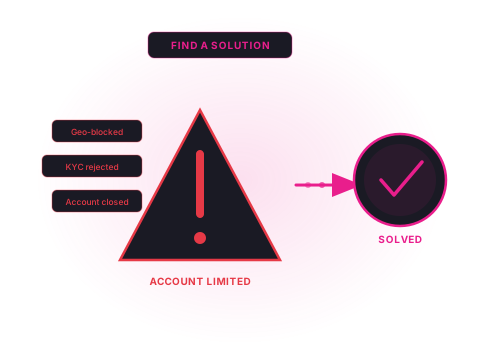
Common Bettor Problem

How to Avoid Bookmaker Limits: The Professional Approach

Limits don't appear without warning — there's a pattern of signals before any restriction is imposed. Understanding what triggers them, and how serious bettors structure their activity, is the difference between an extended betting career and a cycle of account restrictions.

Jump to Solutions →
How to avoid bookmaker limits

The question most bettors ask too late is: how do I avoid getting limited? By the time the restriction arrives, the answer becomes academic — but understanding the mechanics behind it is genuinely useful, both for extending the life of existing accounts and for structuring activity on accounts you haven't opened yet.

The honest answer is that limits are not fully avoidable at soft bookmakers if you bet with consistent edge. What is avoidable is the cycle itself — the pattern of opening accounts, building stakes, getting restricted, and starting again. Professional bettors exit that cycle structurally, not tactically.

Why Bookmakers Impose Limits in the First Place

Soft bookmakers operate on a recreational bettor model. Their margins are built around customers who bet on instinct, back popular teams, and lose more than they win over time. A bettor who consistently wins at a rate that exceeds the bookmaker's margin is commercially unprofitable — and modern bookmaking software identifies these accounts quickly.

The profiling systems used by major soft bookmakers monitor several variables simultaneously: your win rate across a rolling window, the markets you bet on (sharp markets like Asian handicap, first goalscorer, or niche leagues signal a different profile than prematch favourite backing), how close to the off you place your bets, whether your bet timing correlates with line movement elsewhere, and whether you regularly take value when odds are available.

None of these individual signals is definitive — it's the combination and consistency that triggers a flag. A bettor who wins at 55% on a high volume of carefully timed bets in efficient markets is going to be restricted. The question is when, not if.

This is worth understanding clearly: being limited is not a punishment or a personal decision. It is a commercial risk management response. Knowing this helps frame the right approach — the solution is structural, not confrontational.

The Warning Signs Bettors Miss

Before a formal stake limit appears, there are usually earlier signals that an account has been internally flagged. Recognising these gives you time to adjust activity on that account and prioritise opening alternatives.

What Most Bettors Try That Doesn't Work

Once restrictions start appearing, most bettors' instinct is to work around them. Some common approaches: rounding stakes to look less precise, switching to accumulator bets to obscure single-market exposure, reducing bet frequency to appear more recreational. These tactics exist on a spectrum from marginally useful to actively counterproductive.

The core problem with behavioural camouflage is that it doesn't change the underlying profitability signal — it just slows the rate at which that signal accumulates. If you're genuinely betting with edge, you will be profitable, and a profitable account will eventually be flagged regardless of how it looks superficially.

There's also a more direct cost to these tactics: they compromise your betting performance. Rounding stakes away from optimal sizes, adding legs to accumulate when you wouldn't otherwise, or timing bets suboptimally to look more casual — all of these reduce your edge. You're sacrificing real returns for a delay.

The more productive frame is to separate accounts that you use for value betting from accounts you use for recreational or lower-stakes activity, and to pursue structural access to the bookmakers and platforms where the limit dynamic doesn't apply.

How Professional Bettors Avoid the Limits Cycle

The bettors who sustain a profitable operation long-term don't beat the limits system at soft bookmakers — they exit it entirely by moving their activity to platforms where the commercial incentives are different.

1. Bet at Sharp Books That Don't Limit Winners

Pinnacle is the clearest example. Its business model depends on sharp action — it uses line movement from winning bettors to improve its own odds, which in turn attracts more efficient betting. An account that wins at Pinnacle is not commercially harmful; it is operationally useful. Pinnacle does not restrict accounts for profitability. The challenge is that Pinnacle does not accept accounts from Ireland and several other countries. See Pinnacle's restricted countries for the full picture.

2. Use Betting Exchanges

Exchanges like Betfair operate on commission from matched bets. They have no position against the bettor — winning customers pay more commission, which is commercially welcome. Exchanges do not impose stake limits on winning accounts. The limitation is market depth: exchanges can be thin for lower-league events, specials, and in-play on certain markets where soft bookmakers have volume.

3. Access Sharp Books Through a Licensed Broker

A licensed betting broker places bets on behalf of the client through professional corporate accounts at Pinnacle, Asian books, and exchanges. The individual bettor is not subject to the profiling systems that drive restrictions at retail bookmakers. This is structurally different from retail betting — the broker's accounts are high-volume professional accounts, not individual consumer accounts subject to recreational bettor screening.

Brokers like AsianConnect and BetInAsia provide access to Pinnacle and the major Asian markets. The commission model is transparent, and there is no restriction risk based on profitability.

Practical Steps to Extend Account Life and Build a Sustainable Setup

  1. Diversify across multiple bookmakers from the start — Distributing your betting volume slows profiling at any single operator and gives you more options when one account is restricted.
  2. Open exchange accounts early — Betfair, Orbit Exchange, and Smarkets accounts provide a permanent base that isn't subject to restriction risk. Establish these before you need them.
  3. Prioritise Pinnacle access — If you're in a country where Pinnacle is restricted, the broker route is the practical path. Look into the requirements for opening a broker account while your existing accounts are still active.
  4. Don't fight restrictions — Attempting to work around restrictions on a flagged account typically accelerates the timeline to closure. Accept the restriction and focus resources on accounts where the dynamic is different.
  5. Treat soft bookmakers as secondary — If your primary volume is through accounts that don't limit winners (exchanges, Pinnacle via broker), restrictions at soft books become less critical. They're a bonus source of edge, not your main betting infrastructure.

Professional Solutions — Access Sharp Books Without Limits

These licensed betting brokers provide access to Pinnacle, SBO, and Asian bookmakers through corporate accounts that are not subject to individual stake restrictions.

  1. #2
    BetInAsia

    Sharp odds, fast execution, low commission

  2. #3
    MadMarket

    Exchanges & Asian books via one account

  3. #4
    SportMarket

    European-regulated broker with wide market access

Frequently Asked Questions — Avoiding Bookmaker Limits

Can you bet at a soft bookmaker long-term without getting limited?

Rarely, if you are consistently profitable. Soft bookmakers profile accounts based on win rate, market selection, bet timing, and stake patterns. A bettor who wins consistently enough to be identifiable as a sharp bettor will eventually be restricted, regardless of how carefully they bet. The delay can be reduced, but not eliminated at soft books. The sustainable solution is to move activity to bookmakers and platforms that don't limit winners — Pinnacle, betting exchanges, and licensed brokers.

Does rounding stakes to round numbers actually help avoid limits?

It is sometimes suggested as a behavioural camouflage tactic, alongside betting on lower-volume markets or using accumulators to disguise single-market exposure. There may be marginal short-term benefit, but these tactics don't address the underlying profitability signal. A consistently profitable account will be identified and restricted eventually. These approaches delay, not prevent, the outcome.

Will using multiple bookmakers help me avoid limits?

It extends your runway, not indefinitely but practically. Spreading activity across multiple accounts slows the profiling process at each book and reduces your exposure at any single operator. Most serious bettors use five or more accounts. The problem is that this approach is resource-intensive to manage and still ends with the same outcome over time — each account eventually gets restricted. The long-term professional solution is the same: move activity to sharp books and brokers.

How quickly does a bookmaker impose limits after they flag an account?

It varies by bookmaker and by how sharply the profiling metrics are triggered. Some accounts are restricted within days if the betting pattern is strongly flagged. Others are monitored for weeks or months before action is taken. The process typically follows a sequence: internal flag → manual review → stake restriction on certain markets → broader restriction → full limit. Most bettors first notice a restriction when a bet is accepted at a lower stake than expected.

Are there bookmakers that genuinely don't limit winners?

Yes. Pinnacle does not limit accounts for winning — it is a core part of their business model. Asian bookmakers accessed through brokers operate similarly. Betting exchanges (Betfair, Orbit Exchange, Smarkets) do not close accounts for profitability. The challenge with Pinnacle is direct access — it is restricted in Ireland and several other countries. This is where licensed betting brokers become the practical route in.