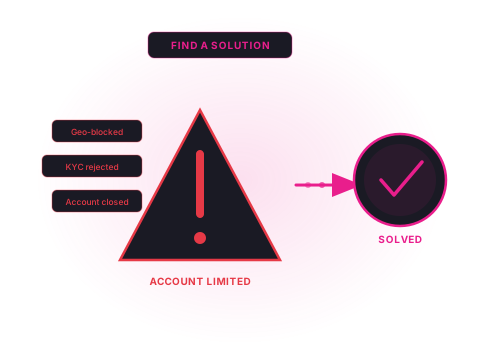
Common Bettor Problem

KYC Document Rejected: What's Really Happening and How to Fix It

A document rejection doesn't always mean your documents are wrong. KYC failures have multiple causes — some technical, some deliberate. Understanding which type you're dealing with determines whether there's a fix, or whether you need a different approach entirely.

Jump to Solutions →
KYC document rejected by bookmaker

You've deposited, placed a few bets, and then the email arrives: your verification documents have been rejected. The account is frozen pending re-submission, or — worse — the account has been closed pending documentation you've been told doesn't meet their requirements. For bettors who've gone through the registration process in good faith, this is both frustrating and confusing.

KYC (Know Your Customer) verification is a legal requirement for regulated bookmakers — not an optional process. But the way individual operators implement it varies significantly, and the gap between a legal requirement and an operator's internal policy creates situations where perfectly valid documents get rejected for reasons that have nothing to do with legality.

The Real Reasons KYC Documents Get Rejected

Not all KYC rejections are the same, and identifying the category matters because each requires a different response.

Technical rejections (fixable)

The most common category and the most straightforward to resolve. These occur when the document itself is acceptable, but the submission has a quality or formatting problem. Common causes include: scan resolution too low (most systems require at least 300 DPI), image too dark or backlit, edges of the document cut off in the photo, glare obscuring part of the document, or a mobile photo taken at an angle that distorts the text. In these cases, re-submitting with a better quality image typically resolves the issue.

Document type not accepted

Bookmakers specify which document types they accept for each verification category. A national ID card may be accepted by one operator but not another. A bank statement more than 90 days old will typically be refused as proof of address. Provisional driving licences are rejected by some operators. The fix is to check the bookmaker's specific accepted document list and resubmit with a qualifying document type.

Source of funds documentation issues

Higher-stakes accounts or accounts that trigger a certain deposit threshold are often required to provide evidence of where the funds originated — pay slips, bank statements showing salary deposits, or investment account statements. This is a more intensive process, and rejections here can be harder to resolve if the operator's internal risk team has decided the account is not one they want to maintain. Source of funds reviews are sometimes the precursor to an account closure decision rather than a genuine verification request.

Eligibility-based rejections (not fixable with documents)

Some KYC rejections are not really about the documents at all. If you are resident in a country where the bookmaker does not offer services, the verification rejection is a policy decision communicated through the KYC process. No document will change the outcome, because the underlying issue is geographical eligibility. This is the most important category to identify — it means the path forward is not re-submission but an alternative platform or access method.

Common Mistakes During KYC Disputes

The most common mistake is spending significant time and energy pursuing re-submission and escalation at a bookmaker that has no intention of completing verification. If the rejection is policy-based — related to your country or to a commercial decision about your account — additional documents won't change the outcome. Recognising this early saves time.

Another common issue is sending documents via multiple channels simultaneously (email, live chat, the account portal) which creates confusion in the operator's verification queue and can actually slow down the process. Submit through the official channel specified in the account verification section, once, and allow the stated processing time.

Attempting to re-register with slightly different personal details after a KYC rejection is a terms of service violation. If the original account was rejected for a policy reason, the new account will face the same outcome, and operating multiple accounts is a more serious breach. See our guide on bookmaker verification failures for more detail on the escalation process.

What to Do When KYC Verification Is Blocked or Refused

For technical KYC issues, the path forward is usually document re-submission following the specific guidance above. For policy-based rejections, the approach is different.

For technical rejections: What actually works

Use a dedicated document scanning app (rather than a phone camera) to produce a consistently flat, high-resolution image. Ensure the document is fully visible with a small border around all edges. Photograph in neutral natural light, avoiding direct sunlight or overhead artificial light that creates glare. For proof of address, ensure the document is less than 90 days old and shows your full name and current address. A bank statement downloaded directly from your online banking as a PDF typically produces cleaner results than a photographed paper statement.

For eligibility-based rejections: The alternative route

If the KYC rejection is driven by your country of residence rather than your documents, the bookmaker is telling you that your account isn't eligible — not that your documents need improvement. The viable paths are:

Step-by-Step: Resolving a KYC Rejection

  1. Identify the rejection type — Read the rejection email or message carefully. Is it about document quality (technical), document type (wrong format), or does it reference your country or eligibility? This determines your path forward.
  2. For technical rejections: re-submit once with improved quality — Use a scanning app, ensure good lighting, include all edges. Submit once via the bookmaker's official document portal, not via email or chat simultaneously.
  3. Allow the stated processing time — Most bookmakers state a processing window. Allow that time before following up. Contact support once by email if the window expires without response, and keep a written record.
  4. If re-submission is refused: request a clear reason — Ask in writing why re-submission was rejected. A regulated bookmaker should be able to tell you what specific requirement was not met.
  5. If it's an eligibility issue: don't waste time on re-submission — Research alternatives that accept your country. A licensed betting broker may be the most direct solution.
  6. Escalate if funds are held — If your account balance is frozen during a verification dispute, contact the relevant gambling regulatory authority if the bookmaker doesn't respond within the regulated timeframe.

Alternatives When Direct Access Is Blocked

If KYC has been refused due to country restrictions, these licensed betting brokers operate their own independent verification process and can provide access to Pinnacle and Asian markets.

  1. #2
    BetInAsia

    Sharp odds, fast execution, low commission

  2. #3
    MadMarket

    Exchanges & Asian books via one account

  3. #4
    SportMarket

    European-regulated broker with wide market access

Frequently Asked Questions — KYC Document Rejections

Why do bookmakers reject documents that are officially valid?

Bookmakers apply their own verification standards, which can be stricter than what official identity documents legally require. A passport accepted for international travel may still fail a bookmaker's KYC if the scan quality is below their threshold, the image is too dark or too light, or the document has physical wear that obscures machine-readable data. Additionally, some bookmakers use automated document scanning software that produces false rejections on genuine documents. The legal validity of the document is separate from whether it meets a specific operator's internal requirements.

How long should KYC verification take?

Regulated bookmakers are typically required to complete KYC verification within a set period — usually 30 days, though many process it much faster (48–72 hours for clean submissions). If verification has been pending beyond a week without communication, contact support in writing to request a status update and keep a record. If the bookmaker is regulated, delays beyond the regulated timeframe should be escalated to the relevant gambling authority.

Can I bet while my KYC is under review?

It depends on the bookmaker. Some allow limited activity while KYC is pending and restrict withdrawals until it is complete. Others freeze all activity pending verification. Check the bookmaker's terms — if activity is permitted while under review, the account should function normally. If restricted, the restriction typically lifts once verification is completed. Avoid depositing additional funds while your account is under review.

If my KYC is rejected permanently, can I open a new account?

If a bookmaker has rejected your verification permanently — typically due to a country restriction, a policy decision rather than a document issue — opening a new account with the same personal details will produce the same outcome. The rejection is not about the document quality; it is about eligibility. In this case, the relevant solutions are alternative operators that accept your country of residence, or a licensed betting broker who can provide access to the underlying markets you want to reach.

Do all bookmakers require KYC?

All regulated bookmakers are required to perform Know Your Customer checks under anti-money laundering legislation. The specifics vary by jurisdiction and operator, but identity verification (government-issued photo ID), proof of address (utility bill or bank statement), and sometimes source of funds documentation are standard requirements. No regulated bookmaker can legally exempt customers from this process.