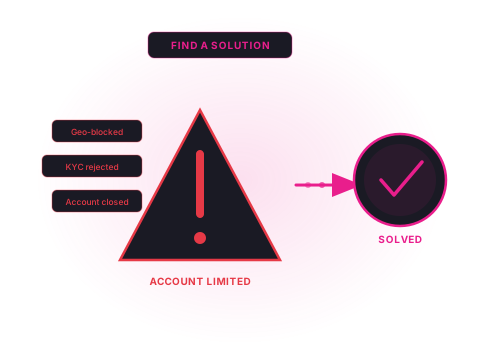
If you've tried to register with Pinnacle and your application was refused, or if you live in Ireland or another restricted country and never got past the registration screen, you're not alone. Pinnacle has one of the more restrictive country lists in the industry, for reasons that have nothing to do with your individual betting history.
Here's the good news, and it's genuinely good: this is one of the most reliably solved access problems in the entire betting world. Professional bettors across restricted countries have been getting into Pinnacle through legitimate channels for years now. The mechanism is straightforward, legal, and stable. Which is more than can be said for the workarounds (VPNs, third-party accounts) that tend to create far more problems than they solve.
Why Pinnacle Refuses Account Applications
Pinnacle is licensed under Curaçao's eGaming framework, not under any European national licence. This means it cannot legally offer services to customers in jurisdictions where a local licence would be required. Ireland, the UK, Germany, France, and several other European countries are on this restricted list. It also restricts accounts from the United States, most of Asia-Pacific, and various other markets.
The refusal mechanism works like this: when you attempt to register, Pinnacle checks your IP address against its country block list. If your detected IP is from a restricted country, the registration process is blocked at the point of country selection or account creation, often without a specific error message, or with a generic "not available in your region" notice. This happens regardless of your personal betting history, your professional status, or the quality of your documentation.
There are secondary causes for account refusals that apply even to users in non-restricted countries:
- IP/document mismatch: if your detected IP suggests a different country than your stated address, Pinnacle's verification system may flag the discrepancy and decline the application.
- Incomplete KYC: Pinnacle requires full identity verification before an account can be activated. Documents submitted that don't meet their standards (unclear, expired, or mismatched) will result in a declined application.
- Previous account history: if you have a prior Pinnacle account that was closed or suspended, re-registration is typically blocked.
- Business address or corporate identity: Pinnacle only accepts individual personal accounts, not business accounts or bets placed on behalf of others (this is why the broker model works through Pinnacle-facing corporate accounts at the broker level).
Why Pinnacle Is Worth the Effort to Access
Most bettors who discover Pinnacle after years of betting with soft bookmakers describe it as a significant shift. Pinnacle is built around volume from sharp bettors; its margins are thin because its model depends on high turnover, not on recreational bettors losing. This has several practical implications.
Pinnacle does not limit accounts. A bettor who wins consistently will not be restricted, gubbed, or closed. The account structure is permanent as long as you comply with the platform's terms. Pinnacle also has some of the highest maximum stakes in the industry on major football, tennis, and basketball markets, typically in the tens of thousands per match.
The odds are tight. Pinnacle's overround on a standard two-way market is typically 2–3%, compared to 5–10% at soft bookmakers. Over a large volume of bets, this difference compounds significantly. Professional bettors use Pinnacle's odds as a reference line; if you can consistently bet at Pinnacle prices or better, you are operating at the professional tier of the market.
What Most Bettors Try That Doesn't Work
The first attempt for most bettors is to use a VPN to access Pinnacle from a restricted country. This appears to work initially; you can get past the registration screen if your VPN IP is from an accepted country. However, the identity verification process is where this approach consistently fails. Pinnacle requires documents that match your actual address, and if that address is in a restricted country, the verification will not pass. Accounts verified with mismatched details risk closure and forfeiture of any deposited funds.
The second attempt is to ask a friend or family member in an accepted country to register on your behalf. This creates a more serious problem: operating or having someone operate a betting account under a different identity is fraud under most regulatory frameworks, and any funds in such an account have no regulatory protection.
Both approaches create legal and financial risk without providing a stable solution. The professional approach, which has been used reliably by sharp bettors for many years, is the broker model.