Betting Explained

Bookmaker Gubbing: A Plain-Language Explanation of What It Is and How It Works

"Gubbing" is one of those betting terms that gets used a lot without always being explained clearly. This page breaks down what gubbing actually is, the mechanism behind it, and — most importantly — what it means for how you should structure your betting.

Jump to Solutions →
What is bookmaker gubbing — explained

If you've been betting for any length of time and doing it seriously, you've probably heard the term "gubbing". You may have even been gubbed without fully understanding what happened. It's an informal term for something the betting industry does systematically, and it affects hundreds of thousands of bettors across the UK and Ireland every year.

The core of it is simple: a bookmaker has decided your account is unprofitable, and they're restricting what you can do with it. But understanding the mechanics in more detail — why the system works this way, what the algorithm is actually detecting, and what the practical consequences are — helps you make much better decisions about where to bet and how to build a sustainable approach.

Gubbing: What It Actually Means

In the strictest sense, gubbing refers to being excluded from a bookmaker's promotional offers — free bets, enhanced odds, sign-up bonuses, reload offers, and loyalty rewards. The term comes from UK betting communities and has been in common use since the mid-2010s when matched betting and advantage betting became widely discussed online.

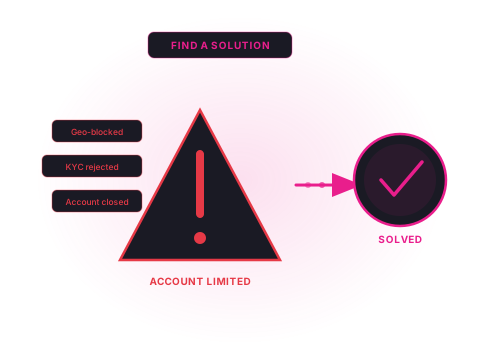
Over time, the term has broadened in common usage to cover any significant account restriction — stake limits, market bans, or price restrictions. Most bettors use "gubbed" to mean any situation where the bookmaker has restricted the account to the point where it's no longer useful. In that broader sense, being gubbed and being staked-limited are effectively the same outcome: the account can no longer be used at meaningful volumes.

The key thing to understand is what gubbing is NOT. It is not a punishment for breaking rules. It's not a result of doing anything illegal. It is a commercial decision by the bookmaker about which customers are worth keeping — and the answer, for a consistently winning bettor, is: not worth keeping on standard terms.

The Mechanism: How Bookmakers Decide to Gub an Account

Bookmakers do not gub accounts manually in most cases. The decision is driven by automated profiling systems that run continuously in the background, analysing account activity against a set of risk indicators.

The primary indicator is your account's P&L against the bookmaker's theoretical margin. Every bet has a built-in edge for the bookmaker — the difference between the true probability of an outcome and the price offered. Over a large enough sample of bets, a recreational bettor's results should fall in line with that edge. An account that consistently performs better than the theoretical margin is displaying one of two things: extraordinary luck (which regresses to the mean) or genuine edge. The algorithm is designed to distinguish between the two.

Secondary indicators include: the selectivity of your betting (do you only bet on markets where you have a view, or do you bet broadly?), whether your bets correlate with sharp market movements (do prices move in your direction after you bet?), how quickly you bet after prices are published, and your bonus extraction ratio (are you consistently claiming and profiting from every available promotion?).

None of these individual factors necessarily triggers a gubbing decision. It's the combination — and the persistence over time — that moves an account into restriction territory. A bettor who occasionally has a profitable week is not in danger. A bettor who has been profitable over 6 months across a specific set of markets with consistent timing patterns is going to be flagged.

The Stages of Gubbing

Account restrictions rarely appear all at once. There is typically a sequence that follows a recognisable pattern:

See our related guides on bookmaker gubbing in practice and bookmaker stake restrictions for more detail on each stage.

Why This Is a Feature, Not a Bug

From the bookmaker's perspective, gubbing makes complete commercial sense. Soft bookmakers operate on margins that require a certain ratio of losing to winning customers. Promotional budgets are specifically designed to attract and retain recreational bettors — free bets are loss leaders that work economically because most of the people receiving them lose the free bet stakes and continue betting recreationally.

A bettor who extracts full promotional value, then consistently beats the margin on standard bets, is drawing on the promotional budget without providing the expected return. The bookmaker's response — restricting access to promotions and reducing staking capacity — is rational from their commercial standpoint. Understanding this removes any sense that there is an injustice to be appealed. The bookmaker is not making an error; they are doing exactly what their business model requires.

The deeper insight for serious bettors is that the gubbing cycle at soft bookmakers is structurally inevitable. Any bettor who bets with enough edge, for long enough, at a soft bookmaker, will eventually be gubbed. The question is not how to avoid it — it's how to build a betting operation that doesn't depend on soft bookmaker accounts in the first place.

Platforms That Don't Gub — The Professional Alternatives

The permanent solution to the gubbing cycle is not better profile management at soft bookmakers. It's using platforms that don't operate on the soft bookmaker model.

Sharp Bookmakers: Built for Winning Bettors

Pinnacle is the most important example. With margins of 1–3% on major markets and a business model based on high volume and efficient pricing, Pinnacle has no commercial reason to gub winning accounts. Sharp money improves their market quality rather than threatening it. The challenge for Irish bettors is direct access — Pinnacle doesn't accept Irish accounts — but this is solved via the betting broker route. See Pinnacle's restricted countries for the current situation.

Betting Exchanges: No Individual Restrictions

Exchanges earn commission on matched volume. There is no incentive to restrict winning bettors — they are the source of the liquidity that makes markets work. Betfair and Orbit Exchange don't have a gubbing mechanism. Exchange betting has its own considerations — thinner markets on lower-tier events, commission costs — but for bettors who have been gubbed at soft books, exchanges provide immediate unrestricted alternatives.

Licensed Betting Brokers: Corporate Access Without Individual Profiling

A licensed betting broker places your bets through corporate accounts at Pinnacle and Asian bookmakers. Your individual betting activity is not exposed to the underlying bookmaker's profiling systems. There is no individual account flag, no individual restriction, and no gubbing mechanism. Services like AsianConnect and BetInAsia are designed specifically for this use case — professional bettors who need reliable access to sharp markets without the restriction cycle.

The broker model has a cost structure (typically a percentage commission on winnings) that doesn't exist with direct bookmaker accounts. But for bettors who have reached the end of the road with soft bookmaker accounts, the comparison is not broker fees versus zero fees — it's broker fees versus betting at £2 maximum stake per bet.

Next Steps for a Gubbed Bettor

  1. Accept the situation — The account is done. Don't spend time or money trying to reverse it. Direct your energy toward the alternatives.
  2. Open exchange accounts if you haven't already — Betfair is the largest and most liquid. Orbit Exchange is worth considering for lower commission if you're willing to move to a smaller platform.
  3. Understand the broker model — Compare the leading betting brokers. Commission rates, minimum deposits, available markets, and platform quality vary significantly.
  4. Don't replicate the soft bookmaker cycle — Opening new soft bookmaker accounts to repeat the same process is not a strategy. The gubbing cycle will replay faster on subsequent accounts as profiling systems share learning across the platform.

Professional Solutions — Recommended Betting Brokers

These brokers provide access to Pinnacle and Asian sharp markets without the soft bookmaker gubbing cycle.

  1. #2
    BetInAsia

    Sharp odds, fast execution, low commission

  2. #3
    MadMarket

    Exchanges & Asian books via one account

  3. #4
    SportMarket

    European-regulated broker with wide market access

Frequently Asked Questions — Bookmaker Gubbing

What does "gubbed" mean in betting?

Being "gubbed" means your bookmaker account has been restricted — most commonly by being excluded from promotional offers such as free bets and enhanced odds, or by having your maximum permitted stake significantly reduced. The term is widely used in UK and Irish betting communities. At its core, gubbing means the bookmaker has identified your account as commercially undesirable and is reducing your ability to extract value from their platform.

Is gubbing the same as being limited?

The terms are often used interchangeably but have slightly different origins. Technically, "gubbing" refers specifically to the exclusion from bonuses and promotions. "Being limited" typically refers to stake restrictions. In practice, both arise from the same underlying process — the bookmaker's risk system flagging your account as sharp or unprofitable — and they frequently occur together. An account that has been gubbed is almost always also subject to stake restrictions, and vice versa.

How does a bookmaker decide to gub someone?

Gubbing is driven by automated profiling. Bookmakers use algorithms that analyse your betting history across multiple dimensions: your overall win rate, the ratio of winnings from promotional offers versus standard bets, your market selection patterns, the timing of your bets relative to price movements, and the correlation between your stakes and subsequent line movements. Accounts that show consistent indicators of sharp or advantage-betting behaviour are flagged and restrictions are applied, often without any human review.

Can you un-gub yourself?

Rarely, and not in any reliable way. Some bettors attempt to rehabilitate their account profile by placing recreational-looking bets — small accumulators, novelty markets, low-stakes wagers on popular events. This occasionally delays further restrictions or marginally restores some promotional eligibility at bookmakers whose algorithms weight recent activity heavily. But the underlying profitability flag is rarely cleared, and the strategy costs money in negative expected value bets. Most experienced bettors conclude that the time and money cost of trying to un-gub an account is better spent elsewhere.

Do all bookmakers gub accounts?

Soft bookmakers — those whose model depends on recreational bettor losses — gub accounts systematically. Sharp bookmakers do not operate this way. Pinnacle does not gub accounts because its business model doesn't require it — the margins are low enough that sharp money improves the market rather than threatening it. Betting exchanges also have no gubbing mechanism because they earn commission on matched bets regardless of outcome. The gubbing problem is specific to the soft bookmaker model.

What is the difference between a soft bookmaker and a sharp bookmaker?

A soft bookmaker (examples: Bet365, Paddy Power, William Hill) offers relatively high margins, bonuses, and accumulator promotions. Their model depends on recreational bettor losses. They restrict winning accounts because those accounts threaten their margin. A sharp bookmaker (primary example: Pinnacle) offers low margins, accepts large stakes, and does not restrict winning accounts. Sharp bookmakers attract professional bettors and use their activity to make markets more efficient. The two models serve different markets and have different attitudes to winning customers.