There is a moment most serious bettors recognise: the email from a bookmaker explaining that your account "no longer fits their customer profile," accompanied by a maximum stake that is a fraction of what it was. At that point, the question of where to bet next becomes urgent, and it usually arrives at the worst possible time.
Betting brokers are the professional answer to that question, but they work differently enough from bookmakers that it's worth understanding the full picture before switching. The differences aren't just about restrictions. They affect how you bet, what you pay, and which markets are even available to you in the first place.
The Fundamental Difference: Who Is on the Other Side of Your Bet?
When you bet with a bookmaker, the bookmaker is the counterparty. They set the odds, hold your stake if you lose, and pay out your winnings if you win. Their profit comes from the margin in the odds: the bookmaker wins when the average bettor loses over time.
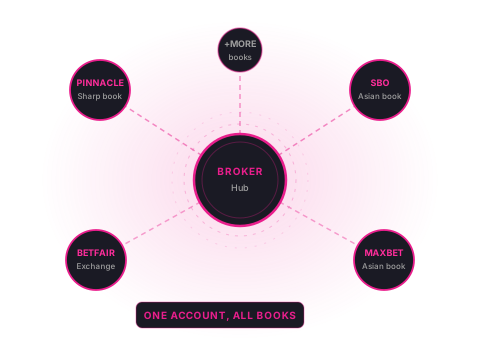
When you bet through a broker, the broker is not the counterparty. The underlying bookmaker is, but accessed through the broker's institutional account. The broker's income is a declared commission on the bet. They make the same commission whether you win or lose. There is no financial incentive for the broker to restrict you, because your winning does not cost them money.
This is the structural reason why account limitations exist at bookmakers but not at brokers. It's not primarily a policy difference. It's a business model difference, full stop, and no amount of "responsible gambling" language from a soft bookmaker changes that underlying incentive.
Betting Broker vs Bookmaker : Full Comparison
| Feature | Traditional Bookmaker | Betting Broker |
|---|---|---|
| Account limits | Common: winning bettors are restricted | None (bets placed through institutional account) |
| Gubbing risk | High for profitable bettors | None (individual profiling doesn't apply) |
| Odds quality | Variable: soft books carry 6–10% margin | Sharp: access to Pinnacle, SBO at 1–3% margin |
| Cost model | Hidden margin in odds | Declared commission on stakes (0.5–2%) |
| Market access (Ireland) | Restricted: Pinnacle unavailable directly | Full: Pinnacle, Asian books, exchanges all accessible |
| Account longevity | Limited for profitable bettors | Indefinite (no profit-based restrictions) |
| Setup complexity | Instant (online registration) | Moderate: KYC, bank transfer required |
| Minimum deposit | Low or none | Higher (varies by broker) |
| Funding method | Card, e-wallet, bank transfer | Bank transfer (typically) |
| Suitable for recreational bettors | Yes | No: commission structure suits volume betting |
The Real Cost Comparison: Margin vs Commission
The most common objection to brokers is the commission. It is a visible cost that does not exist at a bookmaker, at least not visibly. But bookmaker margins are not zero. They are simply embedded in the odds rather than declared separately.
Consider a bettor placing €10,000 in stakes per month across football markets. At a soft bookmaker running 7% overround, the expected theoretical cost of that activity (before any skill) is €700 per month in margin. At a broker charging 1% commission to access Pinnacle at 1.5% overround, the total expected cost is around €250 per month. The declared commission is lower in absolute terms, not just proportionally.
For a bettor with a positive edge, the difference is even more significant. Accessing sharper prices through a broker increases the practical value of every edge point. A 2% edge at Pinnacle odds produces more return than a 2% edge at soft book odds, because the base odds are tighter and the margin is lower.
Market Access: What Brokers Open Up That Bookmakers Block
For bettors in Ireland specifically, the market access difference is substantial. Pinnacle (the world's most respected sharp bookmaker) does not accept direct registrations from Ireland. SBOBet, ISN, and most major Asian bookmakers are effectively inaccessible without a broker account. European bettors have historically been locked out of the markets that professional bettors use as price benchmarks.
A broker account unlocks this entire ecosystem. The same markets that Asian-based professional syndicates use for price discovery become accessible through a single broker account. For bettors who use Pinnacle's odds as a reference price, or who want to bet into markets that follow Asian prices rather than setting them, this access changes the fundamental options available.
See the bookmaker country restrictions guide for more on why specific operators are unavailable directly, and how the broker model resolves this.
When a Betting Broker Makes More Sense Than a Bookmaker
The broker model suits a specific bettor profile, and it becomes the right choice when a few things line up at once: your bookmaker accounts are being limited or gubbed and the pattern is clearly tied to profitability, you need access to Pinnacle or Asian markets that Ireland simply doesn't get directly, you bet at a volume where the gap between sharp and soft margins actually adds up over a year, you want betting infrastructure that doesn't quietly degrade as you get better at this, and you're willing to sit through KYC and use bank transfers as your main funding method rather than a card.
Brokers are not the right choice for occasional recreational bettors, people betting small stakes for fun, or anyone who hasn't been restricted yet and is still betting purely for entertainment. For that group, honestly, the setup requirements and commission structure just don't pay off.
For a practical next step, see our complete guide to how betting brokers work, or compare the leading options in our broker rankings for 2026.
Frequently Asked Questions : Broker vs Bookmaker
What is the main difference between a betting broker and a bookmaker?
A bookmaker sets odds and holds risk against the bettor, making money when bettors lose. A betting broker is a neutral intermediary that places bets on your behalf at existing market prices, earning commission regardless of whether you win or lose. The practical consequence: bookmakers restrict profitable bettors; brokers do not. Your individual record is not visible to the underlying operator when you bet through a broker.
Is it more expensive to bet through a broker than a bookmaker?
Not necessarily, and for serious bettors, it is often cheaper in real terms. Soft bookmakers embed a 6–10% margin in their odds. A broker charging 1% commission to access Pinnacle (which operates at a 1–2% margin) produces a total effective cost of around 2–3%. For bettors who have an edge, the broker route is significantly cheaper than paying soft bookmaker margins on every bet.
Can bookmakers close or limit my account if I use a broker?
No. When you bet through a broker, the bookmaker cannot see your individual account or betting history. Bets arrive through the broker's institutional account. The profiling mechanism bookmakers use to identify and restrict winning individuals does not apply. This is the core protection the broker model provides for profitable bettors.
Which bookmakers are available through brokers that aren't available directly?
The most important example for Irish bettors is Pinnacle, a sharp bookmaker with a no-limit policy that does not accept direct registrations from Ireland. Pinnacle is accessible through brokers such as AsianConnect, BetInAsia, SportMarket, and MadMarket. Many Asian bookmakers (SBOBet, ISN, and others) are also practically inaccessible to European bettors without a broker account.
Should I close my bookmaker accounts when I open a broker account?
Not necessarily. Some bettors maintain soft bookmaker accounts alongside a broker account, using bookmakers for recreational betting or specific markets, and the broker for volume and sharp prices. The practical reality is that most accounts at soft bookmakers eventually get restricted if you win consistently, which makes the broker account progressively more important over time.