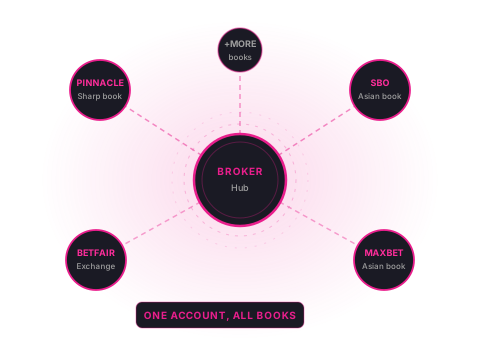
The first question most bettors ask when they encounter the broker model is simple: what does it actually cost? The commission is visible. It's declared upfront, applied at settlement, deducted from your account, right there in black and white. That visibility, ironically, is what makes it look more expensive than betting direct. But here's the thing worth pushing back on: direct bookmakers charge you too. They just do it invisibly, through the margin baked into every set of odds you're ever shown.
Understanding both costs, declared broker commission on one hand and invisible bookmaker margin on the other, is really the only way to make an accurate comparison. And for most serious bettors who actually sit down and do the maths, the broker route comes out significantly cheaper.
How Betting Broker Commission Works
Most betting brokers charge commission as a percentage of stakes. If you place a €500 bet and the broker's commission rate is 1%, you pay €5 commission on that bet, regardless of whether it wins or loses.
Some brokers use an alternative structure: a percentage of net winnings rather than stakes. Under this model, you pay nothing on losing bets and a commission (say, 5%) on what you win. The total cost over a period depends on your win rate: stake-based commission is more predictable; winnings-based commission is lower when you are on a losing run and higher during winning periods.
Commission rates typically range from around 0.5% to 2% for established brokers. Rates can vary by market type: some brokers charge differently for Asian handicap markets, exchange bets, or European football compared to other sports. Volume discounts are available at some brokers for high-turnover accounts.
Broker Commission vs Bookmaker Margin: The Real Comparison
The reason broker commission looks costly in isolation is that it is explicit. Bookmaker margin is implicit: it is embedded in the odds and invisible unless you know where to look.
A bookmaker offering 1.90/1.90 on a 50/50 market is charging 5.26% overround. That is the total margin: the difference between the implied probability in the odds (105.26%) and the true probability (100%). Every bettor who bets into those odds is paying 5.26% on every bet whether they are aware of it or not.
Pinnacle (the benchmark for sharp odds) typically operates at around 1–2% overround. A broker charging 1% commission to access Pinnacle produces a total effective cost of around 2–3%. Compare that to a soft bookmaker at 7% and the broker model costs less than half, even with commission on top.
| Bet type | Effective margin | Cost on €1,000 stake |
|---|---|---|
| Soft bookmaker (Paddy Power, Betfair Sportsbook) | ~7% overround | ~€70 expected cost |
| Sharp bookmaker direct (where available) | ~1.5% overround | ~€15 expected cost |
| Broker 1% commission + Pinnacle 1.5% overround | ~2.5% total | ~€25 expected cost |
| Betfair Exchange (5% commission on net wins) | ~2.5% effective at 50% win rate | ~€25 expected cost |
The comparison shows that broker commission, when paired with sharp bookmaker access, is broadly comparable to or cheaper than exchange commission, and materially cheaper than soft bookmaker margins. The key insight is that the margin you are paying at a soft bookmaker is not zero just because it is not labelled "commission".
Other Fees to Check When Comparing Brokers
Commission is the primary ongoing cost, but it's not the only line item worth checking before you open an account. Withdrawal fees are the first one to look at: some brokers charge a flat fee per withdrawal, others don't, and either way your own bank may add a transfer fee on top that's entirely outside the broker's control. Inactivity fees are worth a mention too, they get charged on accounts with no betting activity for a defined period, typically somewhere between 3 and 12 months, so check the terms if you're planning to leave funds sitting on account during a quiet spell. If you bet in a currency other than your account's base currency, a conversion spread can apply, so confirm which currencies are accepted and what that spread actually costs. Some brokers also impose a minimum stake per bet, which matters if you want the account for smaller test bets or lower-stakes markets, and it's worth asking. Account funding itself is usually straightforward, bank transfer is the standard method, and while most brokers charge no fee for deposits, a few charge for specific methods, so it's a five-minute question worth asking at registration rather than discovering it later.
How to Compare Brokers on Fees Accurately
The most accurate way to compare brokers is to model the total cost against your own betting profile: your average stake size, win rate, and primary markets. Generic commission rate comparisons are a starting point, but the practical cost depends on how you actually bet.
For a stake-based commission comparison, the calculation is straightforward: multiply your expected monthly stakes by the commission rate. €50,000 in monthly stakes at 1% commission = €500 per month in commission cost, regardless of results.
For a winnings-based commission, you need to factor in your expected win rate and average return on winning bets. A 5% commission on net winnings at a 55% win rate on even-money bets produces a different effective cost than the same commission on a 60% win rate with higher odds.
The other factor, and honestly the one people underweight, is the quality of access being bought. A broker with slightly higher commission that gives you better execution speed, wider market access, or more reliable Pinnacle pricing can easily produce better results net of commission than a cheaper broker with thinner market access. Commission rate is one data point. Not the only one.
For a full side-by-side on the leading brokers, see our best betting brokers comparison for 2026. For context on how the broker model works in practice, see how betting brokers work.
Frequently Asked Questions: Broker Fees
How much commission do betting brokers charge?
Most established brokers charge between 0.5% and 2% of stakes per bet. The exact rate varies by broker, market type, and sometimes betting volume: higher-volume bettors may negotiate reduced rates. Some brokers structure commission differently for bookmaker bets versus exchange bets. Always confirm the current commission structure directly with the broker at the time you open your account.
Is it cheaper to use a broker or to bet directly with a bookmaker?
For serious bettors, brokers are almost always cheaper in real terms. Soft bookmakers embed a 6–10% overround (margin) in their odds, which is an invisible but constant cost on every bet. A broker charging 1% commission to access Pinnacle (which operates at 1–2% margin) produces a total effective cost of around 2–3%. The declared broker commission is typically far less than the hidden margin at soft bookmakers.
What is the difference between stake-based and winnings-based commission?
Stake-based commission (the most common broker model) charges a percentage of your stake on every bet, regardless of outcome. If you stake €1,000 at 1% commission, you pay €10 win or lose. Winnings-based commission charges a percentage of your net winnings only: if your bet loses, you pay nothing; if it wins, you pay commission on the profit. The total cost over time depends on your win rate and the commission rate.
Are there any other fees beyond commission at a betting broker?
Some brokers charge withdrawal fees, inactivity fees for dormant accounts, or currency conversion fees for bets placed in currencies other than your account currency. These are typically minor compared to the commission cost but worth confirming at registration. Bank transfer fees from your own bank for deposits and withdrawals are an additional external cost outside the broker's control.
Do broker commissions make it unprofitable to bet through a broker?
Not for bettors with a genuine edge. The commission is a known, predictable cost that reduces expected profit, but the access to sharper prices through Pinnacle and Asian books often more than compensates. A bettor finding value at soft bookmaker prices who switches to Pinnacle often improves their long-term return materially, even after broker commission. The commission becomes a problem primarily if you are betting without a real edge.