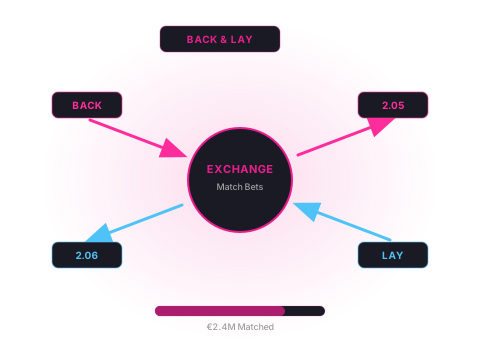
If you've only ever bet with traditional bookmakers, the exchange model takes a moment to fully click. But once it does, it genuinely changes how you think about every bet you've placed before. The fundamental shift is this: the person on the other side of your bet isn't a corporation with a built-in profit margin. It's another bettor who simply disagrees with your read on the outcome.
Orbit Exchange runs entirely on this peer-to-peer model. Its job is to match buyers and sellers of bets, settle the markets, and charge 2% on net winnings. That's it, really, that's the whole picture. No proprietary trading desk quietly adjusting prices against you. No algorithm profiling your account behind the scenes. No mechanism for restricting how much you can bet beyond whatever liquidity actually exists.
The Core Mechanism: Back and Lay
Every bet placed on Orbit Exchange involves two sides: a backer and a layer.
Backing is what most bettors are already familiar with: you select an outcome and stake money on it happening. If you back Manchester City to win at odds of 2.0, you stake €100 and receive €200 if they win (€100 profit plus your stake returned).
Laying is the other side: you are betting that something will not happen. If you lay Manchester City at 2.0, you are taking the role of the bookmaker for that selection. Your liability (the maximum you stand to lose) is calculated as (odds – 1) × stake. At odds of 2.0, laying €100 means you risk €100 if City win, but collect €100 from the backer if they do not.
The exchange matches backers and layers at agreed odds, settles the market on the official result, and charges 2% commission on the net winning side of each market. Neither party ever interacts with the other directly. The exchange just handles all of it, quietly, in the background.
How the Order Book Works
When you open any market on Orbit Exchange, you will see an order book for each selection: a column of available back prices (in blue) and available lay prices (in pink), with the amount available to match at each price point shown alongside.
Best available back price is the highest odds a layer is currently willing to offer: this is the price you take if you back immediately. Best available lay price is the lowest odds a backer is willing to accept: this is what you take if you lay immediately.
The spread between the best back and best lay price is the effective market margin. In highly liquid markets, major football, top cricket, this spread gets razor tight, sometimes as little as 0.01 in odds terms. In thinner markets it widens out, and that matters a lot if you're planning to trade positions in and out.
You can also request a better price than what's currently available. Your bet just enters the order book and waits there until another customer matches it or it expires. This, in a nutshell, is how prices form on an exchange: customers set the market themselves by offering whatever they're actually willing to accept.
Orbit's 2% Commission: What It Means in Practice
Commission on Orbit Exchange is charged on net market winnings, not on gross turnover, and not on every bet individually. If you place multiple bets in the same market (including trading a position), the commission applies to the net outcome across all transactions in that market.
At 2%, the cost advantage over Betfair's standard 5% is meaningful, though not dramatic, on a per-bet basis. It's the volume where the difference really compounds. An account generating €10,000 in net winnings per month pays €200 in commission on Orbit versus €500 on Betfair at standard rates: a €300 monthly difference, or €3,600 a year, and that's before accounting for any Premium Charge a profitable Betfair account might attract.
For accounts that have crossed Betfair's Premium Charge threshold, the comparison gets even more favourable. Orbit has no equivalent tiered penalty at all; the 2% rate applies uniformly no matter how profitable the account becomes. Which is exactly why professional traders squeezed by Betfair's profitability surcharge actively use it.
Liquidity: Where Orbit Exchange Performs and Where It Doesn't
Worth being honest about liquidity before you start routing activity to Orbit. In the markets where it's built genuine depth (cricket especially, international and IPL, and top-tier European football Match Odds pre-match) it's a genuinely credible venue. Prices are competitive, matching is fast at reasonable stakes, and the 2% rate makes it the better-value pick wherever liquidity roughly matches Betfair's.
In horse racing though, Orbit's liquidity is materially thinner than Betfair, across almost all markets. UK and Irish racing punters relying on large-stake execution or deep in-play books will find Betfair a lot more usable, and that's not really a criticism of Orbit. It just reflects that Betfair's had a 20-year head start in UK/Irish racing, and that kind of liquidity advantage is structural, not something a challenger closes quickly.
For professional bettors who want access to sharp pre-match odds on football and other sports at scale, neither Orbit nor Betfair replaces access to Pinnacle or the major Asian books. Those markets are best reached through a licensed betting broker; exchanges serve a different purpose in the overall professional setup.
In-Play Betting on Orbit Exchange
Orbit Exchange offers in-play betting on major sports, with markets remaining open after events start. The mechanics are identical to pre-match: you can back or lay at live prices, trade positions to lock in profits regardless of outcome, or let your bet run to settlement.
In-play liquidity is generally lower than Betfair's across the board. For football, cricket, and tennis the in-play books are usable at moderate stakes. For niche sports or lower-tier competitions, though, in-play volume may simply not be there for meaningful position sizes. Execution speed (the gap between clicking and actually getting matched) is worth testing yourself before committing to any strategy that needs fast reactions. Orbit's delay structure isn't necessarily the same as Betfair's, and that difference matters more than people expect for in-play trading.
Frequently Asked Questions
- What is Orbit Exchange and how is it different from a bookmaker?
- Orbit Exchange is a peer-to-peer betting platform. Unlike a traditional bookmaker (which sets its own prices and takes the other side of every bet) Orbit matches bettors against each other. One customer backs a selection; another lays it. The exchange facilitates the match and charges 2% commission on net winnings. Because there is no house bookmaker building in a margin against you, the prices available on an exchange are almost always sharper than those at a traditional bookmaker for the same market.
- How does Orbit Exchange's 2% commission work in practice?
- Orbit charges 2% on your net market winnings, meaning if you win a back bet, 2% of the profit is taken as commission. If you lose the bet, no commission is charged on that transaction. If you trade a position (back and lay to lock in a profit), 2% applies to the net gain from the combined position. Over a large volume of activity, this is significantly cheaper than Betfair's standard 5% rate, and, crucially, Orbit has no Premium Charge mechanism that would increase this rate for consistently profitable accounts.
- Can you lay bets on Orbit Exchange?
- Yes. Laying bets is one of the core functions of Orbit Exchange. As a layer, you are effectively taking the position of the bookmaker for a specific selection: you are betting that the selection will not win. If the selection loses, you collect the backer's stake. If it wins, you pay out at the lay odds. Lay liability is displayed clearly in the bet slip before confirmation, so you know exactly what you stand to lose if the selection wins.
- What sports and markets does Orbit Exchange cover?
- Orbit Exchange covers football, cricket, tennis, horse racing, and a range of other sports. Its liquidity is strongest in cricket and top-tier football. Horse racing markets exist but carry significantly less volume than Betfair, making them impractical for larger stakes or fast in-play trading. Cricket is where Orbit has built its strongest market depth relative to competitors, with some international formats rivalling Betfair on liquidity for certain match types.
- Is Orbit Exchange regulated and safe to use?
- Orbit Exchange operates under a gambling licence and follows standard regulatory requirements including KYC (Know Your Customer) identity verification, responsible gambling tools, and customer fund protections. As with any licensed operator, customer funds are held separately from company operating funds. Always verify that the exchange is currently licensed in your jurisdiction before depositing.
- What happens if a bet cannot be matched on Orbit Exchange?
- Unmatched bets sit in the order book until a counter-party accepts them or until the market closes. If a bet is still unmatched at event start (for pre-match markets), it will typically remain open if in-play betting is available, or be cancelled if the market closes unmatched. You can manually cancel unmatched portions of a bet at any time before it is matched. For deep liquidity markets, most bets at competitive prices will match quickly; in thinner markets, acceptance may require pricing closer to the current market.