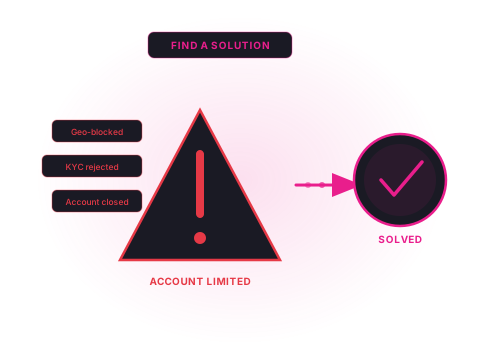
If you've been betting seriously in Ireland for any length of time, you've probably tried to register at a bookmaker — Pinnacle, most likely, or one of the Asian books — and hit the wall. Account not accepted. Country not supported. The sites work, the odds are visible, but an Irish address means no account.
This is one of the more frustrating structural features of the Irish betting market. Ireland is a regulated, legally clear market for online gambling — but the bookmakers that matter most to sharp bettors have chosen not to operate retail accounts there. Understanding why, and what the workable alternatives are, changes what you do next.
Which Bookmakers Block Irish Accounts — and Why
The bookmakers available in Ireland break down clearly once you look at their licensing structure and commercial positioning.
Available to Irish bettors (direct account)
Bet365, Paddy Power, Betfair (sportsbook and exchange), William Hill, BoyleSports, SportPesa, and most mainstream UK-facing operators accept Irish accounts. These are primarily soft bookmakers with recreational bettor models — they limit winning accounts, gub profitable players, and operate the conventional model where bettors with consistent edge are managed out.
Betfair Exchange is an important exception — it's available in Ireland, operates on peer-to-peer commission rather than a position against the bettor, and doesn't restrict winning accounts. It's the best directly accessible sharp market for Irish bettors.
Not available to Irish bettors (direct account)
Pinnacle is the most significant omission. It is the gold standard for sharp fixed-odds betting — best-in-class margins, published limits rather than hidden restrictions, and no account closure for winning. Irish accounts are not accepted. This is a commercial licensing decision, not a legal prohibition on Irish access.
Asian bookmakers — SBOBet, MaxBet, Singbet, BetISN, and others — are not available for direct registration from Ireland. These operators service the Asian market ecosystem and are primarily accessible through licensed brokers for European bettors. See our overview of Asian bookmakers for context on what these platforms offer.
Some Curacao-licensed operators nominally accept Irish accounts but have no regulated dispute resolution, no fund protection, and no accountability structure. Accessing these as a workaround to the restriction on regulated sharp books trades one problem for a significantly worse set.
Why Pinnacle Doesn't Accept Ireland
The common assumption is that Pinnacle is legally prohibited in Ireland. This is not accurate. Pinnacle's restriction on Irish accounts is a commercial decision — they don't hold the Irish gaming licence required to directly service retail customers in the market, and they've chosen not to pursue it.
Pinnacle's business model involves careful market selection. They operate in markets where they can manage their licensing cost relative to their market volume. Ireland, as a small English-speaking market surrounded by larger English-speaking regulated markets, has apparently not made that calculation work for them. The restriction may also relate to their model of accepting sharp money — some markets present challenges for that model that Pinnacle has decided to avoid via geographic selection.
What this means in practice: the restriction is at the retail account level. Pinnacle has institutional relationships with licensed brokers who serve European markets — these brokers operate under their own licences and serve as intermediaries. The restriction on Irish retail accounts doesn't apply to those institutional relationships. This is the route in for Irish bettors who want Pinnacle odds.
What Irish Bettors Try — and Why It Usually Fails
The standard sequence: search for how to access Pinnacle from Ireland, find VPN guides, try a VPN registration. The problem surfaces at verification: Pinnacle's KYC process requires proof of address documents. An Irish address document directly contradicts the registration country claimed via VPN. The account either fails verification or is flagged for review and closed with funds returned — at best, an inconvenience. At worst, funds are under extended review.
The other common attempt is to try multiple smaller-known operators assuming one will have missed the restriction. Most of the legitimate ones haven't. The ones that appear to accept without restriction are typically unregulated operators with no account security, no fund protection, and no pathway for dispute resolution.
See our full page on how bookmaker geo-blocking works for the technical detail on why VPN workarounds are unreliable and what risks they create.