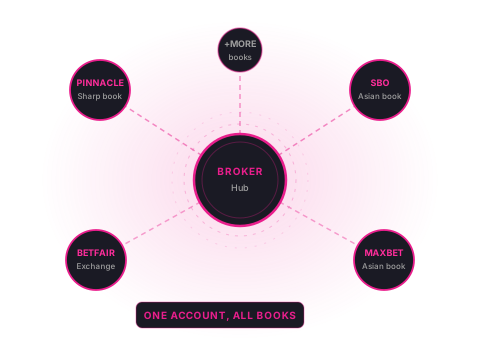
When serious bettors start looking beyond traditional bookmakers, two options come up most often: betting exchanges and betting brokers. Both are legitimate alternatives to the soft bookmaker model. Both offer better odds quality than mainstream operators. But they work in fundamentally different ways, and the right choice depends on how you bet.
The confusion between them is understandable, honestly: both involve a middleman, both charge commission, and both get used by professional bettors. But the underlying mechanics, the costs, and the use cases are distinct enough that choosing between them (or combining them, which a lot of people end up doing) is worth understanding clearly.
How Betting Exchanges Work
A betting exchange is a marketplace where bettors trade against each other rather than against a bookmaker. When you back a selection on Betfair, another bettor lays it, and vice versa. The exchange provides the matching platform, manages settlement, and earns commission on net winnings rather than setting odds itself.
The practical implications of the peer-to-peer model are significant. Odds on a liquid exchange market are set by the collective view of bettors, not by a bookmaker's margin-influenced pricing. For heavily traded markets, this often produces tighter prices than even the sharpest bookmakers. The back/lay model also allows position trading: backing at one price and laying at a better price to lock in profit regardless of outcome.
The limitation of exchanges is liquidity, plain and simple. Less popular markets often have thin order books, meaning your bets cannot be matched at the price you want, or at all. For markets outside the major leagues and highest-volume events, exchange access is less useful than it is for mainstream football, horse racing, or tennis.
How Betting Brokers Work
A betting broker places bets on your behalf at bookmakers and, in some cases, exchanges, through their institutional corporate accounts. Rather than creating a marketplace, the broker gives you access to existing markets at sharp prices, while insulating your individual account from the profiling that traditional bookmakers use to restrict winners.
The broker earns commission on stakes or winnings, a declared cost rather than the hidden margin embedded in bookmaker odds. In exchange for that commission, you get access to bookmakers that are otherwise unavailable (Pinnacle from Ireland, Asian operators inaccessible directly), and you operate without the risk of individual account restriction.
For more detail on the broker mechanics, see our full guide to how betting brokers work.
Broker vs Exchange : Direct Comparison
| Feature | Betting Broker | Betting Exchange |
|---|---|---|
| Counterparty | Bookmaker (via broker's institutional account) | Other bettors (peer-to-peer matching) |
| Commission model | On stakes (typically 0.5–2%) | On net winnings (typically 2–5%) |
| Account restrictions | None (individual profiling removed) | Rare, but Premium Charge applies to big winners on Betfair |
| Back/lay ability | Back only (at bookmaker prices) | Back and lay: full position trading |
| Market depth | Wide: bookmaker markets across all sports | Deep on major markets, thin on niche events |
| Pinnacle access (Ireland) | Yes (via broker) | No (Pinnacle is a bookmaker, not an exchange) |
| Asian handicap markets | Yes (core offering) | Limited: some exchanges offer AH, but not all |
| In-play betting | Yes (via bookmaker markets) | Yes (typically faster execution on exchanges) |
| Setup requirements | KYC, bank transfer funding | Standard registration (more accessible initially) |
| Best suited to | Volume bettors, restricted bettors, Asian market access | Traders, lay bettors, matched bettors, in-play specialists |
The Real Cost Comparison: Which Model Is Cheaper?
Commission structures look similar on the surface: both brokers and exchanges charge somewhere in the 1 to 5% range. The basis is different, though, and that's where the comparison actually needs some care.
Betfair charges commission on net winnings, typically 2–5% depending on market and loyalty tier. On a winning bet of €1,000, at 5% commission, you pay €50 in commission. On a losing bet, you pay nothing. The effective cost varies with your win rate.
A broker typically charges a percentage of stakes, say 1%. On the same €1,000 stake, you pay €10 regardless of outcome. The total cost is more predictable but applies win or lose.
For a bettor with a 55% win rate backing at even money (2.0), the Betfair model at 5% commission and the broker model at 1% stake commission produce roughly comparable costs over volume. The tipping point shifts with commission rates, win rates, and whether the broker is accessing sharper odds than the exchange is offering for the same market.
The Betfair Premium Charge (which applies to consistently profitable customers and can reach 60% of gross winnings) changes this calculation significantly for high-volume winners. Accessing exchanges through a broker's institutional account can avoid or reduce exposure to this charge. For bettors approaching that threshold, it is a material consideration.
Broker or Exchange? When to Use Each
The choice is not binary for most serious bettors: both tools serve different parts of a professional betting operation.
Use a broker when: You need Pinnacle or Asian bookmaker access from Ireland. Your bookmaker accounts have been restricted. You primarily place win bets rather than trading positions. You want access to wide pre-event markets across all sports without liquidity constraints.
Use an exchange when: You trade positions, backing at one price and laying at another. You use back/lay strategies or matched betting approaches. You want in-play execution on liquid markets. You are looking for better odds on major events where the exchange price is sharper than available bookmaker prices.
Use both when: You have a multi-strategy approach that combines outright win betting (broker for Pinnacle/Asian access) with position trading or lay betting (exchange). Many professional bettors maintain a broker account alongside a direct exchange account, or use a broker like MadMarket that provides both through a single account.
For more on the exchange model, see our guide to how betting exchanges work. For a comparison of the leading brokers, see best betting brokers in 2026.
Frequently Asked Questions : Broker vs Exchange
What is the difference between a betting broker and a betting exchange?
A betting exchange is a peer-to-peer platform where bettors match against each other: one side backs a selection, another lays it. The exchange earns commission on net winnings. A betting broker is an intermediary that places bets on your behalf at bookmakers and exchanges, earning a commission on stakes or winnings. Brokers give you access to bookmakers; exchanges replace the bookmaker with another bettor as your counterparty.
Can you use a broker to bet on an exchange?
Some brokers provide exchange access as part of their offering (MadMarket and AsianConnect, for example, include Betfair access alongside bookmaker markets). In this case, you use the broker as an intermediary to access the exchange, rather than opening a direct exchange account. The broker adds a commission layer on top of the exchange's own commission structure, which is worth factoring into the cost comparison.
Do betting exchanges restrict accounts like bookmakers do?
Traditional betting exchanges (like Betfair) do not restrict accounts for being profitable in the same way bookmakers do, because your winnings come from other bettors, not from the exchange. However, Betfair does have a Premium Charge that applies to consistently profitable customers, which can significantly reduce effective returns for high-volume winners. Brokers avoid this by accessing exchange markets through institutional accounts exempt from or differently structured around premium charges.
Are odds better at an exchange or through a broker?
It depends on the market and timing. Exchanges often offer better odds on heavily traded markets because prices are set by bettors rather than a bookmaker's margin. Brokers accessing sharp bookmakers like Pinnacle offer tight margins on a wider range of markets, including pre-event markets where exchange liquidity is thin. For many professional bettors, both are useful: exchanges for specific back/lay strategies, brokers for accessing Pinnacle and Asian sharp prices.
Should serious bettors use a broker or an exchange?
Many serious bettors use both, as they are complementary rather than competing tools. Exchanges suit bettors who trade positions, use back/lay strategies, or want the liquidity of Betfair's markets. Brokers suit bettors who need Pinnacle or Asian book access, want to avoid individual profiling, or are primarily placing win bets rather than trading positions. The broker model adds particular value when direct bookmaker access is unavailable or when accounts have been restricted.