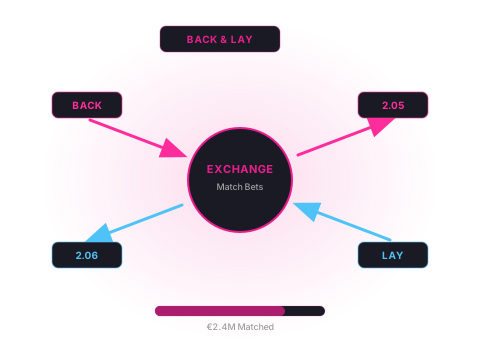
A meaningful chunk of what gets matched on Betfair every day is placed by automated systems. Trading bots, algorithmic strategies, API-connected software: none of that is some unusual fringe activity. It's a core part of how the market actually functions, providing liquidity, tightening spreads, reacting to events faster than any human clicking through the interface ever could.
Betfair has supported this intentionally since the early 2000s, and the logic is simple once you see it. Unlike bookmakers who watch for patterns and shut down winning accounts, Betfair profits from every matched bet regardless of outcome. An algorithmic system that wins consistently generates more commission, not less. That alignment between the Exchange's business model and sophisticated traders is a big part of why Betfair is the dominant platform for serious automated betting worldwide.
How Betfair API Trading Works
At its most basic, API trading swaps out manual browser-based clicking for a direct programmatic connection to Betfair's markets. Instead of logging in, navigating to a market, and clicking back or lay, a trading system authenticates with Betfair's servers, pulls live market data, checks that data against a set of rules or a model, and places orders automatically when its conditions are met.
There are really two interfaces that matter here. The Sports API handles market listings, catalogue queries, order placement, and account management, the bookkeeping side of things, essentially. The Streaming API is the more interesting one: it keeps a persistent connection open and pushes real-time market updates rather than making the client poll over and over, which is exactly what you need for in-play and anything time-sensitive.
A typical trading bot subscribes to a set of markets via the Streaming API, takes in continuous price updates, runs its logic, and fires order placement calls through the Sports API the moment its conditions trigger.
Common API Trading Strategies
| Strategy type | How it works | Markets typically used |
|---|---|---|
| Pre-match model-driven | Bot compares model price to Exchange price; places bet when edge exceeds threshold | Football, tennis, horse racing pre-race |
| In-play event response | System detects live event (goal scored, set won) and places position before price fully adjusts | Football in-play, tennis, cricket |
| Market making / scalping | Places back and lay orders close to current price; profits from spread when both sides fill | Horse racing, top football pre-match |
| Greening up automation | Automatically closes a position by laying off a winning back position as price shortens | Horse racing, football |
| Cross-platform arbitrage | Monitors price gaps between Betfair and other books; executes arb when gap exceeds threshold | Football, tennis, major events |
Tools and Software for Betfair API Trading
Not all API trading means writing code, which surprises people. Several well-established third-party apps handle the GUI-based automation and just connect to the Betfair API quietly underneath.
Bet Angel
A long-established Windows application providing ladder trading, automated rules ("Guardian" automation), and spreadsheet-based strategy development via Excel integration. Widely used by horse racing and football traders. Has an API connection feature for custom bot integration.
Geeks Toy
A low-latency trading application built around speed of execution, popular among horse racing in-play specialists. Ladder interface, automated bots, and an API connection for custom extensions.
Python + betfairlightweight
For traders who want to build something of their own, this is the common starting point. The library wraps Betfair API calls, handles authentication, and gives you streaming support. You need to actually know how to code, but the flexibility is total.
BetTrader / Fairbot
Browser-based and desktop tools with enhanced ladder interfaces, triggered bets, and automated position management. Lower learning curve than writing your own code, used mostly by recreational-to-semi-professional traders.
API Trading in the Context of a Professional Betting Operation
Most serious operations running Betfair API trading don't rely on Betfair alone; it's usually one component of something bigger. In-play execution, racing, certain pre-match markets: that's naturally Betfair territory. But for pre-match Asian Handicap and fixed-odds football specifically, the real volume sits with Asian bookmakers.
Operators who want both sides typically go through a licensed betting broker for the Asian book piece. Brokers like AsianConnect and BetInAsia give you a single regulated account with access to Pinnacle, SBO, and other sharp books, sidestepping the country restrictions that would otherwise block direct access from Ireland. Some brokers throw in their own API connections or programmatic interfaces for high-volume clients, too.
Put it all together and the full picture for anyone taking this seriously looks something like: Betfair API for Exchange execution, Asian books via broker for pre-match, and maybe other exchanges like Orbit Exchange thrown in for price comparison and Premium Charge diversification. No single platform does everything well. But Betfair's API infrastructure is still, by some distance, the best-developed Exchange automation environment an independent operator can get their hands on.
Frequently Asked Questions
- Is API trading on Betfair legal?
- Yes, fully legal, and Betfair actually encourages it. The official API is built for exactly this: automated trading, bot development, programmatic market access. Using it doesn't violate Betfair's terms, and Betfair provides full documentation, developer support, and a dedicated API community for people building trading systems. There's no difference in how Betfair treats API bets versus manual ones when it comes to commission or account standing.
- Do I need to be a programmer to do API trading on Betfair?
- Direct API trading needs programming ability, or at least a collaborator who has it. But several well-established third-party apps (Bet Angel, Geeks Toy, BetTrader among others) give you GUI-based automation without requiring any code. They connect to the Betfair API under the hood and let you set automated rules, trigger-based bet placement, and ladder trading through a desktop interface. Plenty of professional traders never write a single API call themselves.
- What programming languages work with the Betfair API?
- It's a REST/JSON interface, so honestly, any language that can make HTTP requests works. Python is by far the most widely used in the Betfair developer community; libraries like betfairlightweight and the official Betfair Python library simplify things a lot. Java, C#, and Node.js all get used too, but Python's mix of simplicity, data libraries (pandas, numpy), and an active community makes it the practical default for most independent developers.
- What is the advantage of API trading over manual trading?
- Speed and consistency, mainly. API trading reacts to market movements in milliseconds, which matters a lot for in-play strategies where prices move faster than any human can keep up with. Consistency is the other side of it: automated systems execute rules without hesitation, emotion, or fatigue. A well-designed bot won't second-guess a trigger, won't miss a window, and won't over-stake after a bad run. The discipline humans struggle to hold onto is just built into the code.
- Can API bots make money on Betfair?
- Some do, sure. But let's be honest about the caveat: building a genuinely profitable automated system is hard, harder than most people building their first bot expect. Strategies that look great in backtesting tend to perform worse live, thanks to execution slippage, shifting market conditions, and the simple fact that Betfair's ecosystem is crowded with other automated systems all trying the same thing. Profitable API trading takes real statistical reasoning, disciplined backtesting, and constant iteration. It is not, despite what some forums will tell you, a passive income system.
- Is there latency involved in Betfair API execution?
- Yes, there always is. API bet placement involves network latency between your system and Betfair's servers, plus Betfair's own processing time. For most trading applications that's manageable: a few hundred milliseconds worst case. But for strategies that depend on reacting to in-play events near-instantly (horse racing in-play, tennis point-by-point) latency management becomes genuinely critical, which is why the most performance-sensitive operators pay for co-location services that put their systems physically closer to Betfair's servers.