Most bettors approach Betfair the same way they'd approach any bookmaker: pick a winner, back it, wait. That works fine, and Betfair is a genuinely better environment than most bookmakers for straightforward value betting. But there's a lot more depth here than that surface-level approach uses.
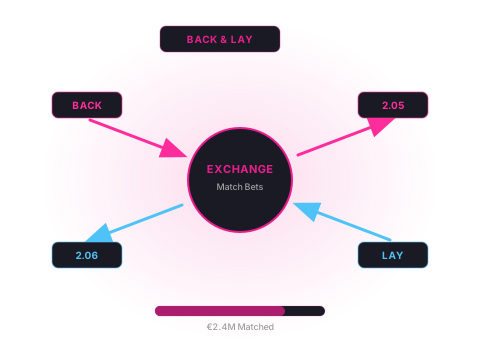
The difference is structural, right down at the root. When you bet on Betfair, you're matched against another bettor holding the opposite position, not a bookmaker's trading desk. Betfair doesn't care whether you win; it profits from commission on matched bets regardless of the result. Sharp bettors are genuinely welcome here. Accounts can't be gubbed for winning. And the prices reflect market supply and demand, not a risk team quietly deciding how much you're allowed to make.
That one structural change unlocks approaches that simply don't exist at a conventional bookmaker.
Core Betfair Exchange Strategies
There isn't just one way to work the Exchange, and which approach suits you depends a lot on what skills you're bringing to the table. Back betting for value is the most familiar one: finding outcomes priced higher than their true probability, which rewards bettors with strong selection models or genuine market knowledge. Lay betting flips that around entirely, you're taking the bookmaker's position, effectively betting that something won't happen, and it suits people who can spot overpriced favourites.
Then there's the trading side of things. Back-to-lay trading means backing before an event and laying in-play, or as the price shortens, to lock in a profit either way; it takes someone who can actually read market movement as it's happening. Lay-to-back trading works the opposite direction: lay first at a price, back later if it drifts, and green up. That one tends to suit in-play specialists and horse racing traders in particular.
For the more statistically minded, the closing line value approach means betting pre-match and tracking your performance against the closing price over time, a long game rather than a quick one. And multi-platform arbitrage, laying on the Exchange while backing at a sharp bookmaker or broker at a different price, is really the domain of high-volume players running accounts across several platforms at once.
Value Betting on the Exchange
Value betting on Betfair follows the same logic as value betting anywhere: you're looking for a price that exceeds the true probability of an outcome. What the Exchange gives you is prices driven by market forces instead of a bookmaker's margin, so genuine mispricings do turn up, particularly in lower-profile markets, in the early stages of price formation, or when some bit of news hasn't fully worked its way into the price yet.
A key concept here is closing line value. If your pre-match bets consistently beat the final market price before an event kicks off, that's a real, statistically meaningful signal that your selections have genuine edge (not just luck). The closing price is essentially the market's best guess at true probability once everything is priced in, so beating it consistently across a large sample is about as clear a signal of a real edge as you'll find.
Plenty of serious value bettors actually use Betfair's prices as a reference point for finding value elsewhere, at softer bookmakers, rather than betting on the Exchange itself. A selection at 3.0 on Betfair but available at 3.30 at a recreational bookmaker is a straightforward opportunity, even though the actual bet gets placed at the bookmaker. The Exchange is doing the job of a benchmark there, nothing more.
Lay Betting: The Exchange's Most Distinctive Feature
Lay betting is the thing that makes Betfair genuinely different from any bookmaker, full stop. You're not predicting what will happen, you're predicting what won't. Lay a selection and you take the bookmaker's role: it loses, you collect the backer's stake; it wins, you pay out at the lay odds.
That asymmetry opens up opportunities you just can't get anywhere else. Think a short-priced favourite is overvalued, that the market's leaned too hard into it, and you can lay it at those short odds with fairly limited payout exposure. A favourite at 1.50 (67% implied probability) that you reckon is more fairly priced at 1.65 (61%) is a lay edge, even though the favourite still wins more often than not.
The discipline that matters here is managing liability properly. Lay at 1.50 and your potential payout is 0.50 units per unit the backer staked. Lay at 5.0 and it's 4.0 units. High-odds lay positions carry real liability, which is exactly why most Exchange traders cap their lay positions somewhere around 5.0 or 6.0 until they've got real experience handling the variance.
How Professional Bettors Use Betfair Alongside Other Platforms
The most effective professional setups never rely on one platform alone. Betfair's Exchange is genuinely exceptional for in-play markets, horse racing, and certain pre-match football and tennis markets. But there are real gaps in what it offers, and pretending otherwise doesn't help anyone.
Asian Handicap markets are the clearest example, actually, of where Betfair's depth is weakest relative to how dominant it is elsewhere. That specialist volume lives at Asian bookmakers (Pinnacle, SBO, MaxBet), and those books consistently offer sharper pre-match prices across a much wider range of leagues than the Exchange can match. Bettors in Ireland who want access typically go through a licensed betting broker, a single regulated account covering multiple Asian books at once.
So the practical structure most serious bettors land on looks something like this: Betfair Exchange for in-play, trading, and racing; an Asian book broker for pre-match fixed-odds and Asian Handicap; and, sometimes, another exchange like Orbit Exchange thrown in for price comparison. Each platform earns its place where it actually has an advantage. None of them is being asked to do everything.
Frequently Asked Questions
- What makes Betfair different from a bookmaker for strategy?
- On Betfair you are betting against other bettors, not a bookmaker holding a fixed position. Prices get set by market supply and demand, not a trading team trying to cap your winnings. A sharp bettor is genuinely welcome here because they supply liquidity for the other side of the market. The practical upshot: you can back at better prices when the market gets it wrong, lay when a favourite is overpriced, and trade positions before settlement, none of which a soft bookmaker will ever let you do.
- Is value betting viable on Betfair?
- Yes, definitely. Value betting works on the Exchange the same fundamental way it works anywhere: you are looking for prices that exceed the true probability of an outcome. The difference is you are competing with other bettors rather than a bookmaker margin. Liquid Betfair markets tend to reflect sharp collective wisdom pretty fast, but in less liquid markets, or at specific moments during price formation, edges do show up. Plenty of professional bettors use Betfair prices as a benchmark for finding value in softer markets elsewhere.
- Can I get limited on Betfair for winning?
- Not on the Exchange, no, and that is a fundamental break from the bookmaker model. Betfair profits from commission on matched bets, so a winning account actually helps Betfair by generating more activity. That said, Betfair's Sportsbook (the fixed-odds product) behaves more like a conventional bookmaker and can restrict accounts there. It is the Exchange specifically that is the real advantage for serious bettors.
- How do professional bettors use Betfair alongside bookmakers?
- As one piece of a wider setup, mostly. Laying overpriced favourites, trading positions before events, and accessing in-play markets where bookmakers suspend pricing are the typical uses. For pre-match fixed-odds value, particularly Asian Handicap markets, they turn to sharp Asian bookmakers like Pinnacle through a licensed broker instead, since Betfair's Exchange often lacks the depth and spread of markets that Asian books specialise in.
- What are the most reliable strategies for a new Exchange bettor?
- Start simple, honestly. Straightforward back betting in liquid markets before you touch lay betting or trading. Get your head around Betfair's commission and how it eats into net returns before you decide a price is genuinely good value after charges. Pre-match value betting in top football markets is a sensible place to begin, since those markets have high liquidity and reasonably transparent price formation.
- What is the closing line value approach on Betfair?
- The idea, essentially, is that a sharp bet is one that beats the final market price before an event starts. The price at kick-off (or race start) is the market's most accurate collective read on probabilities, so getting a meaningfully better price earlier is one of the clearest long-term signals that you actually have an edge, rather than just being lucky. Professional bettors track CLV closely for exactly this reason.