A delayed or blocked withdrawal is one of the most stressful betting problems, but the right response depends on which type of problem you actually have. This guide explains the four main causes and the specific steps that work for each.
Diagnose Your Problem →"Your withdrawal is being processed" is the message most bettors receive. What it means (and how long the process takes) varies enormously depending on why the withdrawal is being held. Some delays are standard KYC administration. Others are account reviews that won't resolve without the right documentation. A smaller number involve bookmakers making claims that have a legal dimension.
The single most important thing is to correctly identify which situation you're in. A Source of Funds check requires a completely different response than a standard ID verification delay. Using the wrong approach wastes time and can inadvertently complicate the process.
This guide covers the four main types of bookmaker withdrawal problem, your legal position in each case, and the specific steps that actually move things forward.
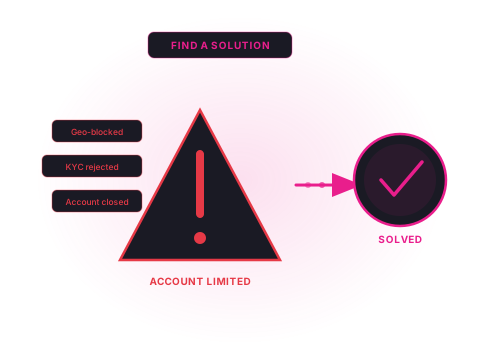
Bookmaker withdrawal problems divide into four distinct categories, each with different causes, timelines, and resolutions.
What it is: Your KYC documents haven't been reviewed yet, or a task in your account's verification section is incomplete.
How long it takes: 24–72 hours for automated checks; 3–7 business days for manual review.
What to do: Log into your account and check the verification or KYC section. Complete any pending task. If documents have been submitted and no action has been taken after 5 business days, contact the KYC team directly by email, not live chat.
What it is: The bookmaker has flagged your account for an activity review, often triggered by a large win, unusual betting patterns, or a withdrawal amount significantly above your deposit history.
How long it takes: 7–30 days depending on the type of review.
What to do: Request clarification from the compliance team in writing. Ask specifically what the review entails and what documents are needed to complete it. Do not submit unsolicited documents; wait for their specific request.
What it is: A formal Anti-Money Laundering (AML) procedure requiring you to demonstrate the legitimate origin of the funds in your account. Typically triggered by cumulative deposits above a certain threshold or a large single withdrawal.
How long it takes: 14–45 days in some cases; depends on responsiveness and document quality.
What to do: Submit a comprehensive SOF package proactively: payslips, bank statements covering the relevant period, and a cover letter explaining the origin of funds. Partial submissions extend the timeline significantly.
What it is: The bookmaker has closed your account and is withholding your balance, either as part of a terms violation claim or while an investigation is ongoing.
How long it takes: Highly variable; from days to months in contested cases.
What to do: Request the specific terms alleged to have been violated, in writing, with evidence. Under regulated gambling law, your balance belongs to you. If the bookmaker cannot provide documented, specific justification, you have grounds for a formal complaint and regulator escalation.
Understanding the expected timeline for each type of problem prevents unnecessary escalation and helps you know when action is genuinely warranted.
| Problem Type | Normal Timeline | When to Escalate | Escalation Route |
|---|---|---|---|
| Standard KYC delay | 24h–7 days | After 7 business days with no update | Email KYC team directly |
| Account activity review | 7–30 days | After 30 days with no outcome or communication | Written complaint to compliance manager |
| Source of Funds check | 14–45 days | After 45 days with documents submitted | Written complaint + regulator notification |
| Balance withheld post-closure | Varies | Immediately; request written justification | ADR service + licensing regulator |
The most common mistake bettors make when facing a withdrawal problem is using live chat for a process that requires email correspondence. Live chat agents have no authority over compliance decisions and cannot move a review forward. Every interaction should be in writing.
A regulated bookmaker operating under a UK, Irish, or Malta licence has legal obligations that protect your balance. The key points:
For more on specific withdrawal scenarios, see our pages on bookmaker withdrawal delayed, withdrawal under review, and withdrawal from locked accounts.
Withdrawal friction is one of the most cited reasons professional bettors move to the broker model. Brokers handle withdrawals differently in two important ways:
First, brokers operate on a commission model; they earn money from your activity, not your losses. A profitable bettor placing high volume is a valued client. There is no commercial incentive to delay or obstruct a withdrawal from a winning account, because there is no profitability review cycle.
Second, KYC at a broker is typically a one-time process. Once you're verified, withdrawals proceed via bank transfer without repeated document requests or Source of Funds checks triggered by every large win. The compliance framework is still present (brokers are regulated), but the operational experience is materially different from the bookmaker environment.
For bettors who have experienced persistent withdrawal delays across multiple bookmakers, the structural shift to a broker account removes the underlying cause. See our guide on broker advantages for the full picture.
A licensed bookmaker cannot refuse to pay a legitimate balance without legal justification. If they allege a terms violation, they must specify exactly which terms were breached and provide evidence. Generic references to "suspicious activity" are not sufficient. If a regulated bookmaker refuses to pay without specific, documented justification, you have the right to escalate to their licensor (CRU, MGA, or UKGC depending on their licence) and to the relevant ADR service.
Common causes include incomplete KYC (the most frequent), a Source of Funds check triggered by withdrawal amount or account history, an account activity review, or simply the bookmaker's standard processing time combined with bank processing. Check the KYC section of your account first; there is often a pending task you're not aware of. If KYC is complete and no pending requests exist, contact the compliance team directly by email.
Under gambling law in most regulated jurisdictions, your balance is yours regardless of account status. Account closure or restriction does not allow the bookmaker to retain your funds. They may delay payment while conducting a review, but ultimately must release the balance. Document everything in writing, request specific reasons for any hold, and use the formal complaints process if the bookmaker does not respond within a reasonable timeframe.
Standard KYC for a withdrawal typically requires a government-issued photo ID (passport or driving licence) and proof of address (utility bill or bank statement less than 90 days old) in the same name as the account. For larger withdrawals, a Source of Funds declaration may also be required; this can include payslips, a bank statement showing regular income, or other documentation establishing the legitimate origin of the funds.
Yes. If the bookmaker's internal complaints process does not resolve the issue, you can escalate to the relevant licensing authority (CRU for Irish-regulated operators, UKGC for UK licences, MGA for Malta licences) and to an Alternative Dispute Resolution (ADR) provider. Most regulated bookmakers are required to participate in ADR. The process can take weeks, but for material amounts it is worth pursuing.
Betting brokers operate a different business model; they earn commission regardless of your win/loss record, so they have no commercial incentive to delay or block withdrawals. Withdrawals are typically processed via bank transfer within 2–5 business days, and there is no pattern of holding profitable accounts' funds as part of a profitability review. For bettors who have experienced bookmaker withdrawal issues, the broker model removes this friction entirely.