Why Horse Racing Suits the Exchange Model
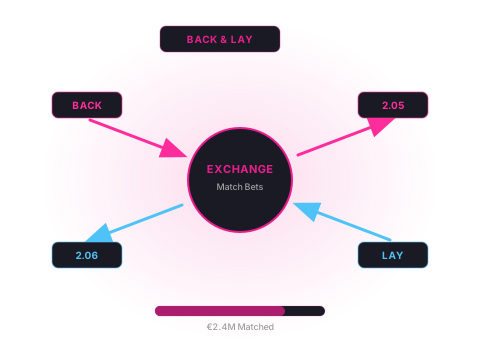
The betting exchange model, where users bet against each other rather than against a bookmaker, is particularly well-suited to horse racing for a few structural reasons. Some of this is obvious once you say it out loud; some of it took the market years to actually exploit.
First, horse racing naturally generates both backing and laying interest. For every bettor who wants to back a horse, there is another with a view that the horse is overpriced. The exchange simply matches the two positions. In football, this matching is less natural because the result is more binary in terms of betting interest; in horse racing, traders, casual bettors, and professional layers all participate in the same market at the same time, often on the same horse, for completely different reasons.
Second, the in-running dimension of horse racing creates a richer trading environment than most sports. A horse's price changes dramatically during a race as its position and running style become apparent. This creates opportunities for traders who want to take positions during a race and exit them at a profit before the finish. A strategy that, worth saying plainly, requires an exchange and simply does not exist with a bookmaker.
Third (and this is the one that gets overlooked), horse racing is an area where traditional bookmakers consistently run less efficient markets than the exchange. Betfair's horse racing prices, particularly closer to the off, reflect the aggregated view of a large and informed crowd. Bookmakers often price individual horses in isolation rather than running a genuinely balanced book, which means overrounds can be higher and smart money tends to move prices on the exchange first.
Betfair Horse Racing Market Structure
Each horse racing meeting on Betfair typically offers several distinct markets. Understanding which ones generate meaningful liquidity, and which don't, is really the starting point for any trading or betting approach. Skip this step and you'll waste time trying to trade a market nobody else is in.
| Market type | Description | Typical liquidity | Best for |
|---|---|---|---|
| Win market | Back or lay a horse to win the race | High (major UK/Irish meetings), moderate (others) | Pre-race trading, value backing, in-running |
| Place market | Horse finishes in the places (top 2, 3, or 4 depending on field size) | Moderate | Each-way arb, place speculation |
| Each-Way market | Combined win and place bet in a single market | Lower than win/place separately | Convenience (less used by traders) |
| Antepost markets | Ante-post betting on big races (Cheltenham, Grand National) weeks in advance | Lower; grows as race approaches | Early price speculation; non-runner risk |
| Without a named horse | Race outcome with a specific horse removed from the book | Low (niche) | Specialists only |
The Win market is the primary market for most purposes, honestly for almost every purpose. Liquidity in UK and Irish racing on the Win market at major meetings is typically £500,000 to £2m+ matched, with significantly more available at key festivals.
In-Running Betting on Betfair Horse Racing
Betfair's in-running horse racing markets are the most liquid in-play betting markets in existence, full stop. Prices move in real time as the race unfolds. A horse leading at the second last hurdle in a novice chase may be trading at 1.10, only to fall at the last and be matched at 1000 moments later. The exchange accommodates this fluidity because it simply matches buyers and sellers at whatever the current price happens to be.
The 5-second delay is the critical infrastructure point for in-running betting via the standard Betfair interface, and it trips people up constantly. Any unmatched bet submitted during the in-running period is held for 5 seconds before being submitted to the exchange. If the price has moved during those 5 seconds (and in a fast-developing race, it often has), the bet may not get matched at the price you asked for.
Why the 5-second delay exists
Horse racing is broadcast on television with a delay of several seconds relative to what is actually happening on the track. Without a delay on in-running betting, someone watching live at the track, or working off a faster data feed, could bet with near-certainty on outcomes that are already decided (backing a horse that has just cleared the last hurdle to win, say, before most viewers at home have even seen it). The delay partially levels the playing field. It doesn't eliminate in-running betting, and it isn't meant to.
Pre-Race Trading Strategies
The majority of Betfair horse racing trading volume happens in the 20 to 30 minutes before the race starts. Pre-race markets see price movements driven by bookmaker activity, stable money, market-maker positioning, and speculative trading. Out of all that noise, a handful of patterns keep showing up among experienced traders:
Steam trading
Backing a horse early in the pre-race window when its price begins shortening (falling), then laying at the lower price once the market confirms the move is real and not just noise. Requires fast execution and a decent read on whether a move is genuine stable money or temporary froth. Software is essentially required for this at any meaningful scale.
Drift trading
The mirror image of steam: laying a horse whose price is lengthening (rising), then backing at the higher price. More common when a heavily-backed horse begins to drift in the final minutes, which usually suggests the early support wasn't as informed as it looked.
Position scalping
Repeatedly entering and exiting small positions for a tick or two of profit. Requires a ladder interface and real volume to be worthwhile, plus tight discipline on entry and exit points. Works far better in liquid markets (favourites in major races) than on longer-priced horses, where the spreads are wide enough to eat your edge.
In-running position carry
Taking a pre-race position and managing it into the in-running period. A back position at 4.0 may be worth greening up early in a race if the horse jumps well; a lay position may need to be cut quickly if the horse leads from the start. Not for the faint of heart: requires real comfort with in-running volatility and the 5-second delay constraint.
Liquidity by Meeting: Where Volume Is
Not all Betfair horse racing markets are equal, not even close. Liquidity concentrates on UK and Irish racing, and within that, on Grade 1 and Group 1 level racing. The following meetings consistently generate the highest liquidity on Betfair:
Cheltenham Festival
March: four days of Grade 1 National Hunt racing. The most liquid horse racing markets on the exchange. Championship Day (day 4) races like the Gold Cup see millions matched per race.
Grand National: Aintree
April: the most bet-on horse race in the UK by individual bettors, by some distance. The Grand National itself generates exceptional Betfair volume, and the entire Aintree Festival gets heavily traded around it.
Royal Ascot
June: five days of Flat Group racing. Highest Flat racing liquidity of the year. International runner interest (especially from Ireland and France) increases market participation.
Punchestown Festival
April/May: major Irish National Hunt festival. Significant liquidity for Irish racing standards. Many of the same horses that ran at Cheltenham compete here.
Galway Festival
August: Ireland's biggest Flat/NH summer festival. High recreational betting volume drives exchange liquidity unusually high for a domestic Irish meeting.
Everyday UK racing
UK racing runs most days year-round. Saturday racing from major tracks (Newmarket, Sandown, Ascot, Haydock) generates moderate-to-high liquidity. Midweek provincial meetings have much lower volume.
Tools for Betfair Horse Racing Trading
The standard Betfair website simply does not provide the tools that serious horse racing traders use, and it never really has. The key limitation is the absence of a ladder interface, which is the primary display format for pre-race and in-running trading and shows all available prices and liquidity at once, stacked vertically, so you can react to the market instead of hunting for it.
| Tool | What it provides | Best for |
|---|---|---|
| Bet Angel | Ladder interface, automation, pre-race tools, Guardian multi-market view | Active traders; automation users; multi-market monitoring |
| Gruss Betting Assistant | Ladder interface, simpler automation, reliable execution | Traders who want execution speed without complexity |
| MarketFeeder Pro | Advanced automation; triggers based on price/volume conditions | Rule-based and systematic traders |
| Betfair API | Programmatic market access; no interface delay | Developers building automated systems |
Frequently Asked Questions
- Is there a delay on Betfair horse racing in-running betting?
- Yes. Betfair applies a 5-second delay to in-running bets submitted via the standard website and mobile app. This delay exists to protect against bettors using faster data sources (such as trackside data or broadcaster feeds) to bet after the outcome of a race segment is effectively known. The 5-second delay applies to unmatched bets: any bet submitted via standard interface during in-running will have a 5-second window before it is submitted to the exchange. Bets placed via the Betfair API do not have this delay imposed by Betfair, but race operators can apply their own delay rules.
- Which UK and Irish horse racing festivals have the most Betfair liquidity?
- Cheltenham Festival (March), Royal Ascot (June), and the Grand National meeting at Aintree (April) generate the highest liquidity volumes on Betfair horse racing markets. Epsom Derby, Goodwood Festival, and the Breeders Cup also attract large markets. For Irish racing specifically, the Dublin Racing Festival, Galway Festival, and the Irish Classics generate significant volume. Day-of trading on these meetings sees liquidity levels many times higher than equivalent days at smaller meetings.
- Can I place each-way bets on Betfair horse racing?
- Betfair offers a separate Place market on most horse racing events, which functions as the place component of an each-way bet. You bet on a horse to finish in the places (typically top 3 or top 4 depending on field size), at exchange odds. This is distinct from each-way betting at bookmakers, where the place portion is a fixed fraction of the win odds. The Place market on Betfair is often more efficient than bookmaker each-way terms, particularly for each-way arbitrage opportunities.
- Is trading horse racing on Betfair profitable?
- Horse racing is one of the primary markets for Betfair traders, particularly for pre-race steam trading and in-running position management. Profitability depends heavily on having an edge in reading market movement, access to good tools (Bet Angel, Gruss, or similar), and disciplined position management. Like all trading, the majority of casual participants do not generate consistent profit, and the market includes professional traders with real experience and infrastructure behind them. That said, horse racing is genuinely one of the few sports where exchange trading can be systematic rather than just guesswork with extra steps.
- What software is best for Betfair horse racing trading?
- Bet Angel and Gruss Betting Assistant are the most widely used dedicated platforms for horse racing exchange trading. Both provide ladder interface display, automation capabilities, and pre-race market tools. Bet Angel has the more feature-rich automation suite; Gruss is simpler and tends to be preferred by bettors who just want reliable execution without a lot of extra complexity getting in the way. MarketFeeder Pro is used by more automation-focused traders. The standard Betfair website and app, worth repeating, do not provide the ladder interface or automation that serious horse racing traders actually need.
- Can I bet Betfair horse racing from Ireland?
- Yes. Betfair holds an Irish licence and horse racing markets are fully available to Irish residents. You can bet pre-race and in-running on UK, Irish, and many international racing markets. The 5-second delay applies to in-running bets via the standard interface. Irish racing markets (particularly at Cheltenham, Punchestown, and Galway) have strong liquidity given the size of the Irish betting market relative to population.