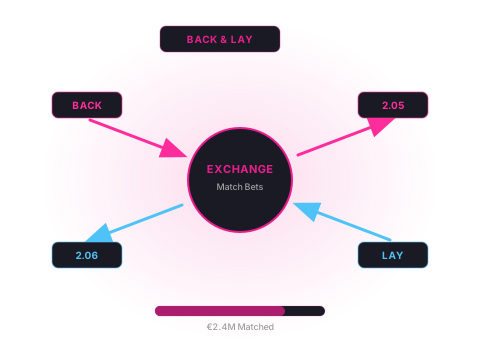
If you've spent any real time betting with bookmakers and getting limited for the crime of winning, a betting exchange feels like a different world. Exchanges genuinely don't restrict profitable accounts. High-volume winners are, if anything, commercially useful to them. That freedom, stacked on top of better prices than most bookmakers offer, is why exchanges have become the primary platform for serious bettors in almost every market.
The strategies that actually work here lean into that structure. They chase long-run edge rather than temporary promotional offers, use the ability to lay selectively as a risk management tool, and treat closing line value as a measure of process quality rather than getting swayed by a hot streak or a bad month. This guide walks through the core strategies and how they fit together.
Exchange Betting Strategies: Overview
| Strategy | How It Works | Skill Level | Best On |
|---|---|---|---|
| Value backing | Back selections where implied probability underestimates true chance | Intermediate | All markets |
| Closing line value (CLV) | Target prices that will be worse by market close: a signal of edge | Advanced | Football, horse racing |
| Lay betting | Bet against overpriced favourites or poorly-assessed selections | Intermediate | Horse racing, football |
| Back-to-lay trading | Back early at high price, lay later at lower price to lock in profit | Advanced | Horse racing pre-race |
| Lay-to-back trading | Lay early at short price, back later at longer price as favourite drifts | Advanced | Horse racing, in-play |
| Cross-platform arbitrage | Back at bookmaker/Asian book, lay on exchange to guarantee profit | Intermediate | All markets |
Value Backing: The Foundation of Exchange Profitability
Value betting on an exchange runs on the same principle as any other platform: you're hunting for prices where the implied probability sits below your estimate of the true probability. At odds of 4.0 (25% implied), if you genuinely believe the true probability is 30%, that's a value bet. Do that enough times at positive expected value and profit follows, eventually, with the usual noise along the way.
Two things make value backing more sustainable on an exchange than on a bookmaker. First, the prices are simply better; there's less overround standing between you and profitability. Second, and this is the bigger one, consistent winners don't get limited. Someone with genuine edge can operate indefinitely here, without the account restrictions that quietly kill value betting strategies on most bookmaker platforms.
The real-world constraint is liquidity. Your bet still has to be matched. In deep markets like Betfair horse racing or the major football leagues, matching large orders at your requested price is usually fine. In thinner markets, size gets constrained, and that caps how much of any given edge you can actually monetise.
Closing Line Value: Measuring Your Edge Independent of Results
Closing line value is, frankly, the single most important concept for anyone who wants to know whether their process has genuine edge, as opposed to just having a good few weeks.
Here's the logic. As a market approaches its start time, more and more informed money gets placed, compressing the odds toward their true probability. The closing price is effectively the market's best collective estimate. So if you consistently got prices before the close that were better than that closing price, your assessments were ahead of the market. That's edge, by definition.
Tracking CLV isn't complicated: record the price you bet at and the price available at match start. If your average price ends up 3% better than close over time, you're beating the market. This predicts long-term profitability far more reliably than recent win/loss results do, especially over shorter samples where variance just drowns everything out.
For bettors who use Pinnacle as a benchmark, and Pinnacle's closing lines are widely regarded as about as efficient as markets get, the same principle applies. Understanding how Pinnacle's odds work alongside exchange prices gives you the fullest picture of where your prices actually sit relative to the true market.
Lay Betting: Betting Against Overpriced Selections
Laying only exists on betting exchanges, and it's a real strategic tool, not just a novelty feature. Most bettors who actually analyse markets spot both value backing opportunities and selections they think are overestimated. Traditional betting only lets you act on the first kind. An exchange lets you act on both.
The discipline lay betting demands is liability management, full stop. Lay at 5.0 for a €50 backer stake and you win €50 if the selection loses, but lose €200 if it wins. That asymmetry means you'd better be genuinely confident in your read, and that you're tracking full liability across every active position, not just the one in front of you. Laying short-priced selections keeps liability lower while giving you more frequent wins, which is why plenty of systematic layers just focus on favourites in markets where they believe the crowd consistently overrates the favourite's chances.
The detailed lay betting guide covers liability calculation, common errors, and how professional layers structure their approach across a full racing or football card.
Exchanges in a Multi-Platform Setup
Experienced bettors rarely stick to exchanges alone. The full picture uses exchanges for what they're good at and other platforms for what they're good at:
Exchanges for horse racing and trading
Betfair is still the dominant venue for horse racing, in-play betting, and anything requiring laying. Betdaq and Smarkets work well as lower-commission alternatives for horse racing wherever the liquidity holds up.
Asian books for football and AH markets
Pinnacle, SBO, and similar Asian bookmakers offer the best fixed-odds football prices, and nothing on an exchange really replaces their Asian Handicap markets. From Ireland, that usually means going through a licensed broker such as AsianConnect or BetInAsia.
Betfair as a CLV benchmark
Even betting elsewhere, checking Betfair's pre-close price gives you context on whether you actually got value. Pinnacle plays the same benchmark role for fixed-odds markets.
Cross-platform arbitrage
When a bookmaker or sharp book prices something well above Betfair's lay price for the same outcome, there's a guaranteed profit sitting there. The exchange is what converts that bookmaker value into a genuinely risk-free return.
For bettors looking to widen access to sharp platforms, understanding how betting brokers work is the natural next step. Brokers give you multiple Asian books through a single account, sidestepping the direct registration barriers that exist across Ireland and much of Western Europe.
Frequently Asked Questions
- What is closing line value and why does it matter?
- Closing line value (CLV) measures whether the price you obtained is better or worse than the price available at kick-off or race time, when all available information is reflected in the market. Research consistently shows that bettors who beat the closing line at scale are profitable long-term, even before results. CLV is a process metric rather than a results metric: it tells you whether your price assessment is accurate, independent of short-term variance.
- Is value betting on exchanges different from betting on bookmakers?
- The principle is identical: find prices where the implied probability is below your estimated true probability. The mechanics differ: on an exchange, you are competing against other bettors for prices rather than taking a bookmaker's quoted price. This means opportunities can close faster in liquid markets as informed money compresses odds. However, accounts do not get limited for winning, which removes the primary constraint that makes bookmaker value betting unsustainable at scale.
- What is the difference between backing for value and trading?
- Value backing is placing a bet and leaving it to settle; you win if your selection comes through. Trading involves placing a back bet and a lay bet in the same market to lock in a profit regardless of outcome, or to reduce exposure. Trading requires price movement to generate profit, while value backing requires accurate probability assessment. Both are valid approaches; experienced exchange users typically employ elements of both depending on the market.
- Can exchanges be used for arbitrage?
- Exchange prices are commonly used in arbitrage setups: backing at a bookmaker and laying on an exchange to guarantee a profit. This is legal and widely practised. The challenge is execution speed: arbitrage opportunities close quickly as both sides of the market adjust, and the commission cost on the exchange side reduces the net margin. For most individual bettors, arbitrage on exchanges is supplementary rather than a primary strategy.
- Do exchanges limit accounts for using these strategies?
- Exchanges do not limit accounts for winning or for using sophisticated strategies. This is structurally different from traditional bookmakers. The only significant constraint for persistent winners on Betfair is the Premium Charge, which raises the effective commission rate for profitable accounts. Betdaq, Smarkets, Matchbook, and Orbit Exchange have no equivalent mechanism.
- How does an exchange fit into a multi-platform strategy with Asian bookmakers?
- Most professional bettors use exchanges and Asian books for different functions. Betfair is the primary tool for horse racing, in-play betting, and trading. Pinnacle, SBO, and similar Asian books offer the best fixed-odds prices on football and provide Asian Handicap markets. From Ireland, accessing Asian books directly is often restricted; brokers such as AsianConnect and BetInAsia bridge that gap, giving single-account access to multiple sharp platforms.