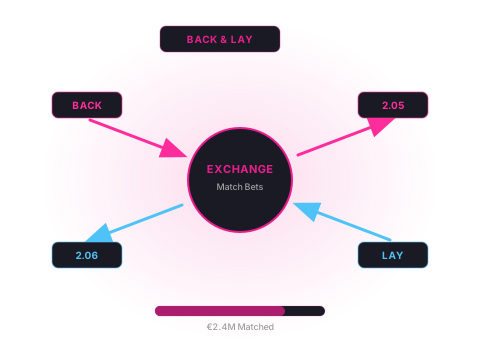
Most bettors think of a bet as binary: your selection wins, or it loses. Exchange trading runs on a completely different model. Place a back bet and a lay bet on the same selection in the same market, and you can build a position where the actual result of the event stops mattering. What matters instead is the gap between your back price and your lay price.
That's exchange trading, and it borrows heavily from financial market thinking, honestly more than most betting content admits. Spread, position management, locking in profit when it's on the table, these are as central here as they are in trading bonds or equities. The difference is the "assets" are sporting outcomes and the market closes at a fixed, known time.
It's not for everyone. It demands active attention, real discipline around position size, and a stomach for the constant back-and-forth of matching and unmatching orders. But for bettors who take it seriously, it opens up a dimension of exchange use you simply don't get anywhere else.
Core Exchange Trading Strategies
| Strategy | Direction | Typical Market | Skill Level |
|---|---|---|---|
| Back-to-lay (B2L) | Back high, lay lower after drift-in | Horse racing pre-race | Intermediate |
| Lay-to-back (L2B) | Lay low, back higher after drift-out | Horse racing, in-play | Intermediate |
| Scalping | Tick-by-tick: back and lay within one price increment | High-liquidity racing | Advanced |
| Swing trading | Larger price moves (position held for minutes or hours) | Football match odds, racing | Advanced |
| In-play trading | React to event developments: price moves on goals, cards, race pace | Football in-play, racing in-play | Advanced |
| Greening up | Spread existing trade profit across all outcomes | Any multi-selection market | Beginner–Intermediate |
Back-to-Lay Trading: The Entry Point for Most Exchange Traders
Back-to-lay is usually the first trading strategy people try, mainly because it matches an intuition most bettors already have: spot a selection you think is currently underestimated but likely to attract money as the market develops, and its price shortens accordingly.
In horse racing this plays out most naturally in the hour before a race. Form and market signals cause prices to compress as serious money comes in. A horse opening at 10.0, expected to attract punter support, might close at 7.0. A trader who backed at 10.0 and lays at 7.0 for the right stake has locked in profit no matter whether the horse wins or finishes last.
Example: Back a horse at 10.0 for €20. It shortens to 7.0. You lay at 7.0 for a stake that matches your exposure. At 10.0 backing, your potential profit is €180 (if it wins). At 7.0 laying, your liability is €120 per unit. Calculating the correct lay stake locks in approximately €40–50 profit regardless of result. The horse can win or lose; you win either way.
The risk, obviously, is the price drifting the wrong way. Horse drifts from 10.0 to 15.0 instead of shortening, and now you're underwater, deciding whether to cut the loss or just hold it as a straight back position and hope.
In-Play Trading: Higher Risk, Higher Opportunity
In-play trading happens while the event is live. Prices move fast in response to goals, red cards, injuries, or shifts in race pace, and your reaction window is measured in seconds, not minutes. For an experienced trader that volatility is opportunity. For someone unprepared, it's a fast way to lose real money.
Take a practical in-play football example: a goalless match where you expect the draw to shorten as the second half wears on without a goal. You back the draw at 4.0 at half-time and set a lay order at 3.0 to close the position automatically if the price compresses. If a goal goes in, though, the draw price collapses, so you need a plan for that already worked out: either a stop-loss lay or accepting the full back bet exposure.
Betfair has the deepest in-play markets by a distance and remains the standard platform here. For a detailed walkthrough of the mechanics, the in-play trading guide covers football and racing specifically.
Greening Up: Converting Trading Positions into Guaranteed Profit
Once a trade is in profit, meaning you backed at a higher price than the current lay price, greening up spreads that profit evenly across all possible outcomes so you genuinely cannot lose. Most exchange software has an automatic "cash out" or "green up" button for this, but it's worth understanding the manual calculation too.
In a horse racing market with multiple runners, your trade might have netted €60 profit on one horse. Greening up spreads it so you land roughly €10 to €15 regardless of which horse actually wins. The exact figures depend on current prices for each selection, and the interface does the maths for you.
Plenty of experienced traders green up only partially, banking some guaranteed profit while leaving a slice of the original position open, which keeps the locked-in gain but preserves some upside if the original selection comes in. It does require knowing your exact profit and liability across every selection in the market though, and dedicated trading software makes that considerably easier than the exchange's standard interface.
Tools and Software for Exchange Trading
The standard Betfair website works fine for basic trading, but it's just not built for speed or position management across complex markets. Most active traders reach for third-party software instead.
Bet Angel
One of the most widely used Betfair trading tools. Provides one-click betting, ladders, automated trigger betting, and full API access. Used by both recreational and professional traders. Subscription-based.
Geeks Toy
Popular among horse racing traders particularly. Very fast interface, excellent ladder display, low-latency order placement. Often cited as the preferred tool for scalping and pre-race trading.
Betfair API (direct)
For technically-oriented traders, Betfair's API provides programmatic access. Python's betfairlightweight library is a popular choice. This route enables fully automated strategies and custom analytics.
BetTrader / Fairbot
Alternative interfaces with different UI approaches. BetTrader is strong for football trading; Fairbot is simpler and popular with newer traders who want something faster than the main site without a steep learning curve.
For bettors interested in the technical side of exchange access, the Betfair API overview and the guide to Betfair API trading cover the architecture and practical setup in detail.
Risk Management for Exchange Traders
The single most common way exchange traders fail is bad risk management, plain and simple. Trading is seductive: small, frequent profits feel steady and reliable, right up until one bad position wipes out several sessions' worth of gains in one go. Discipline around position size and loss limits isn't optional, at any level, no matter how good you think your edge is.
Define maximum position size
Set a maximum back stake per trade as a fixed percentage of your trading bank, typically 5–10%. This prevents any single trade from causing damage that takes weeks to recover from.
Have a plan for every scenario
Before entering a trade, know what you will do if the price moves against you: at what point do you cut the loss? Will you let the bet run? Deciding this in advance removes emotional decision-making in the moment.
Respect in-play volatility
If you are not actively monitoring an in-play trade, set an automatic stop-loss or close the position. In-play prices can move 50–100% in seconds on major events. An unmonitored open position in-play is a risk that cannot be controlled.
For bettors who want to pair exchange trading with broader sharp-book access, betting brokers get you into Asian bookmakers and sharp fixed-odds lines that complement exchange functionality nicely. That matters especially for bettors in Ireland who can't reach Pinnacle, SBO, or similar platforms directly; a broker account opens up the full professional toolkit within one setup.
Frequently Asked Questions
- What is exchange trading and how is it different from backing a selection?
- Exchange trading involves placing both a back bet and a lay bet on the same selection in the same market to profit from price movement, similar in concept to trading financial markets. Unlike a straight back bet where you win or lose based on the outcome, a successful trade can produce a profit regardless of the result by locking in the difference between your back price and your lay price. The outcome of the event becomes irrelevant once a position is fully traded out.
- What is "greening up" on an exchange?
- Greening up is the process of distributing your trading profit across all outcomes in a market so that you are guaranteed to make a profit regardless of the result. The exchange's trading interface typically has an automatic "cash out" or "equalise" function that calculates the lay bet needed to spread your profit evenly. Manually, it involves calculating the lay stake needed so that your net return is the same whether your original selection wins or loses.
- How does back-to-lay trading work?
- Back-to-lay (B2L) involves backing a selection early at a high price, then laying the same selection later at a lower price after the odds have shortened. The profit comes from the difference between your back price and lay price, scaled by the stake. For example: back a horse at 10.0 for €20, then lay it at 5.0 for the correct stake to lock in profit regardless of result. The risk is that the price rises rather than falls, leaving you with an unmatched position or a loss.
- What is lay-to-back trading?
- Lay-to-back (L2B) is the opposite: you lay a selection early when the price is short, expecting the price to drift longer. If a favourite opens at 2.0 but you expect it to drift to 3.0, you lay at 2.0 and back at 3.0. The profit comes from the difference between your lay price and back price. The risk is that the selection shortens further, increasing your liability before you can back to close.
- Can exchange trading be automated?
- Yes. Betfair provides an API that supports automated bet placement, and a range of third-party tools (Bet Angel, Geeks Toy, BetTrader) allow traders to automate strategies without writing code. For more technically-oriented traders, Python libraries such as betfairlightweight provide programmatic access to the exchange. Automated trading is fully permitted by Betfair and accounts are not restricted for using it.
- What are the main risks of exchange trading?
- The primary risks are: unmatched orders (your bet never fills, leaving you with one side of a trade); in-play volatility (prices move faster in-play than pre-event, reducing time to react); and overbetting (using stakes that create liabilities beyond your buffer). Successful traders manage these through discipline: defined maximum position sizes, criteria for entering and exiting trades, and using the exchange's tools to set automatic stop-loss orders.