Most bettors spend years placing bets with bookmakers before they even find out exchanges exist. And when they finally do, the reaction is almost always the same: why wasn't I using this sooner? The prices are better, accounts don't get limited, and the whole structure makes a lot more sense for anyone who bets seriously. There's a learning curve, sure, but it's short. Give it an hour on an exchange and the mechanics click.
This guide covers the core concepts from scratch. What an exchange actually is, how back and lay betting works, how commission gets calculated, and which platform to start with depending on what you bet on.
What Is a Betting Exchange?
A traditional bookmaker sets its own odds, accepts your bets, and profits from the margin baked into those odds. In practice this means the bookmaker's implied probabilities always add up to more than 100%, and that excess is the bookmaker's edge. Over time it gets extracted from every bettor on the platform, no matter how clever their selections are.
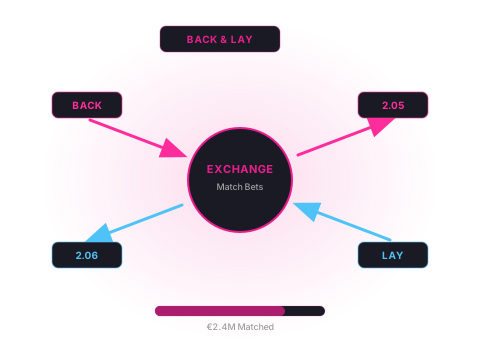
A betting exchange removes the bookmaker from the middle entirely. You're betting against another bettor instead. One person wants to back Manchester City to win; someone else wants to bet against them winning. The exchange matches the two, takes a small commission from whoever ends up winning, and that's the whole business model, honestly. Because there's no bookmaker margin baked into the odds, the prices you'll find on an exchange are usually noticeably better.
The two sides of every exchange bet are called backing (betting on something to happen) and laying (betting against it). Every bookmaker bet you've ever placed had someone sitting in that "lay" position. That someone was the bookmaker. On an exchange, that position is open to you too.
| Feature | Traditional Bookmaker | Betting Exchange |
|---|---|---|
| Who you bet against | The bookmaker | Other bettors |
| Odds margin | 5–15% built in | Near zero (commission on winnings only) |
| Account restrictions | Very common for winners | Rare / not applicable |
| Lay betting | No | Yes |
| In-play | Limited | Extensive |
| Revenue model | Margin on all bets | Commission on winning bets only |
Backing and Laying: How They Work in Practice
Backing a Selection
Backing on an exchange looks identical in outcome to placing a bet with a bookmaker. Pick a horse, a football team, whatever, choose your stake, and if it wins, you collect. The difference is under the hood: your bet is matched against another exchange user taking the opposite side, not against "the house."
Example: You back a horse at decimal odds of 6.0 for €25. If it wins, you receive €125 (€25 × 6.0), a profit of €100. Commission of 2% on that €100 profit is €2, so net profit is €98. On a traditional bookmaker at equivalent odds there'd be no commission, but the odds would likely be meaningfully worse, say 5.5, netting you just €112.50 on the same €25 stake. Worse price wins over the long run, even without a fee attached.
Laying a Selection
Laying flips it. You're taking the bookmaker's side of the bet, betting that a selection will not win, and this is really where exchanges break from anything in traditional betting.
Example: You lay a horse at 6.0 for a backer's stake of €25. If the horse loses, or finishes anywhere except first, you win €25. If it wins, you pay out €125, a loss of €100 to you. That €100 is your "liability", the amount you need available in your account to cover the payout. This is the concept to actually get before you start laying: your potential loss is always bigger than your potential gain.
Key rule for new layers: Always check your liability before placing a lay bet. The exchange shows this automatically, but understanding why the number is what it is helps avoid surprises. Liability = (lay odds − 1) × backer's stake.
How Commission Works, and Why It Matters
Commission is charged on net market winnings, not on each individual bet. That matters if you place multiple bets within the same market, say, backing a selection in-play and then laying it to lock in a profit. What gets taxed is your final net position in the market, not each little transaction along the way.
Rates vary by exchange. Betfair charges 5% for most bettors, rising sharply for consistent winners through the Premium Charge. Betdaq, Smarkets, Matchbook, and Orbit Exchange all sit at a flat 2% with no equivalent mechanism. If you're winning consistently, that gap adds up to real money over a season.
| Exchange | Standard Commission | Premium Charge | Best For |
|---|---|---|---|
| Betfair | 5% | Yes (up to 60%) | Liquidity, in-play, all markets |
| Betdaq | 2% | No | Horse racing, cost-conscious bettors |
| Smarkets | 2% | No | Horse racing, football, politics |
| Matchbook | 2% | No | Football, football trading |
| Orbit Exchange | 2% | No | Cricket, football, multi-sport |
Understanding Liquidity: Why It Matters for Exchange Bettors
Liquidity is just the amount of money sitting there ready to be matched at a given price. On an exchange, your bet only actually goes through once it's matched against a counterparty. Want to back a selection at 5.0 for €500 but only €200 is available at that price? Only €200 gets matched. The rest sits as an unmatched order until someone else offers that price.
This is the real limiting factor with smaller exchanges. Betfair has, by a wide margin, the most liquidity across the board. Betdaq has genuine depth in UK and Irish horse racing. Smarkets holds its own in horse racing and politics. For a beginner, starting with Betfair just makes sense, you'll always find liquidity there. Once you've got a feel for where each exchange is actually strong, running multiple platforms starts to feel natural rather than complicated.
For Asian Handicap markets and sharp bookmaker lines, exchanges aren't really the tool for the job. The full explanation of how betting exchanges work gets into that distinction properly. Bettors chasing access to Asian books usually end up finding that licensed betting brokers are the more practical route in, giving you Pinnacle, SBO, and similar sharp platforms via one account, sidestepping the registration headaches those books create from Western Europe.
Where to Start as a Beginner Exchange Bettor
The practical starting point is to open a Betfair account, deposit a modest amount you are comfortable with, and place your first back bets as you would with any bookmaker. Once the interface is familiar, try your first lay bet on a market you know well, starting small so the liability mechanics are clear before you scale.
When you are comfortable with the basic mechanics and ready to reduce commission costs, Betdaq and Smarkets are the natural next step. Both charge 2% and both have accounts that Irish bettors can open directly. Holding accounts on two or three exchanges gives you the ability to compare prices and route each bet to where the combination of odds, liquidity, and commission is most favourable.
For a deeper understanding of the strategies experienced exchange bettors use, the guide to exchange betting strategies covers value backing, lay betting, in-play approaches, and how exchanges fit into a broader professional betting setup.
Frequently Asked Questions
- What is a betting exchange and how is it different from a bookmaker?
- A betting exchange is a marketplace where bettors bet against each other rather than against a bookmaker. You can back a selection (bet on it to win) or lay it (bet against it, taking the role of the bookmaker). The exchange earns money by taking a small commission on winning bets, typically 2–5%, rather than building a margin into the odds. This results in better prices for bettors compared to traditional bookmakers.
- What does "backing" mean on an exchange?
- Backing on an exchange means betting on a selection to win, just as you would with a traditional bookmaker. If you back a horse at 5.0 (decimal odds) for €20 and it wins, you receive €80 profit (€100 return minus your €20 stake). The difference on an exchange is that your bet is matched against another bettor who is "laying" the same selection, betting on it to lose.
- What does "laying" mean?
- Laying is betting against a selection, taking the bookmaker role. When you lay a horse at 5.0 for €20 (meaning the backer stakes €20), you are agreeing to pay out €80 in profit if that horse wins. If it loses, you keep the €20 stake. The risk with laying is that your potential loss (the "liability") is greater than the amount you stand to win, which is why understanding liability calculation matters before you start laying.
- How does commission work on a betting exchange?
- Commission is charged on your net winnings in a market, not on each individual bet. If you place multiple bets in a football match market and come out with a net profit of €50, you pay commission on that €50. At 2% that is €1. At Betfair's standard 5% that is €2.50. If you have a losing net result in a market, no commission is charged. Betfair also operates a Premium Charge system for consistent winners that can raise the effective rate to 40–60%.
- Which exchange should a beginner start with?
- Betfair is the natural starting point due to its liquidity: in most markets, your bets will match quickly at the price you request. For horse racing specifically, Betdaq and Smarkets also have meaningful depth and charge lower commission (2%) than Betfair's standard rate. Starting with Betfair to learn the mechanics, then expanding to lower-commission exchanges once you are comfortable, is a practical approach.
- Can exchanges limit or close winning accounts?
- Generally no. This is one of the fundamental differences between exchanges and traditional bookmakers. Because an exchange earns more commission the more you win, consistent winners are commercially desirable. Betfair's Premium Charge is the main exception: very profitable accounts see their effective commission rate rise significantly. But it is a commission mechanism, not an account restriction; you can still bet freely.