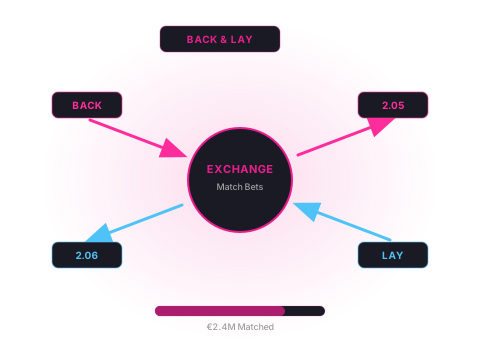
The first time most bettors look at a betting exchange, it looks more complicated than a bookmaker. Two prices for every selection instead of one, and "laying" is a concept that doesn't even exist in traditional betting. Give it a bit of time, though, and the logic clicks. Once it does, the advantages of exchange pricing over bookmaker pricing are hard to miss.
This guide walks through how exchange odds actually work, from the ground up: decimal odds, back and lay prices, implied probability, the spread, and how exchange prices stack up against sharp bookmakers like Pinnacle.
Why Exchange Odds Are Generally Better Than Bookmaker Odds
Every bookmaker builds a profit margin into its odds, the overround. In a two-outcome market, a bookmaker might price both sides at 1.90 rather than the mathematically fair 2.00. At 1.90, the implied probability of each outcome is 52.6%, which together adds up to 105.2%. That excess 5.2% is the bookmaker's edge, and over enough bets, it quietly transfers wealth from bettor to bookmaker no matter how skilled the bettor actually is.
An exchange has none of that built in. It earns only a commission on net winnings, typically 2 to 5%, and prices are set by bettors competing against each other, not by a firm trying to hit a margin target. In a liquid market this competition pulls prices toward fair value, so the implied probabilities of all outcomes sum to very close to 100%. No hidden tax baked in.
| Platform | Example Odds (Both Sides) | Total Implied Probability | Margin / Cost |
|---|---|---|---|
| Soft bookmaker | 1.80 / 1.80 | 111% | ~11% overround |
| Pinnacle (sharp) | 1.95 / 1.95 | 102.6% | ~2.6% overround |
| Betfair Exchange | 1.98 / 2.02 (back/lay) | ~100.5% | 5% commission on net wins |
| Betdaq / Smarkets | 1.99 / 2.01 (back/lay) | ~100.2% | 2% commission on net wins |
For a bettor placing 500 bets a year at a €50 average, the difference between 11% bookmaker overround and 2% exchange commission is basically the difference between structural losses and a fair contest. It's not that experienced bettors have some secret insight when they migrate to exchanges. The pricing structure is just fundamentally better, and eventually that's impossible to ignore.
Decimal Odds: How to Read and Calculate Exchange Prices
Betting exchanges use decimal odds exclusively. Decimal odds represent the total return per unit staked, including the stake itself. This makes calculation straightforward.
| Decimal Odds | €10 Stake Return | €10 Stake Profit | Implied Probability |
|---|---|---|---|
| 1.50 | €15.00 | €5.00 | 66.7% |
| 2.00 | €20.00 | €10.00 | 50.0% |
| 3.00 | €30.00 | €20.00 | 33.3% |
| 5.00 | €50.00 | €40.00 | 20.0% |
| 10.00 | €100.00 | €90.00 | 10.0% |
| 20.00 | €200.00 | €190.00 | 5.0% |
The implied probability formula is simple: 100 ÷ decimal odds. This gives you the percentage probability of the outcome as implied by the price. Comparing this to your own probability assessment is the core of value betting.
Back Odds and Lay Odds: What the Two Prices Mean
Every selection on an exchange shows two prices: back odds (what you can accept to bet on the selection) and lay odds (the price at which you take the bookmaker role and bet against it). Back odds sit slightly above lay odds for the same selection at the same moment, always.
The gap between the two is the spread. In a highly liquid market, Betfair horse racing close to race time is the classic example, the spread might be a single price increment (0.01 or 0.02 at most prices). In a thin market it widens, which quietly increases the cost of trading whether you notice it or not.
Reading the exchange interface: The blue column shows back odds (you bet on it). The pink/red column shows lay odds (you bet against it). The numbers beneath each price show how much money is available at that price. Your bet will only be matched up to that available amount.
Request a price that isn't immediately available and your order just sits in the queue, unmatched. Someone else might match it eventually, or you cancel and take whatever price is currently on offer. Different world entirely from a bookmaker, where your bet is accepted instantly at the quoted price, no waiting involved.
Exchange Odds vs Asian Bookmaker Odds: How They Compare
Sharp bookmakers like Pinnacle run on very low margins, typically 1 to 3% for football and horse racing, against 8 to 15% at soft European bookmakers. That makes Pinnacle a genuinely better deal than the typical bookmaker alternative. Still, exchanges in liquid markets can beat even Pinnacle, simply because there's no built-in margin at all on the exchange side.
In practice it depends on the specific market and its depth. Betfair's horse racing prices often edge past Pinnacle by a small margin, but Pinnacle offers Asian Handicap markets and fixed-odds certainty for football that exchanges just don't replicate in quite the same way. Most professional bettors operating at any real volume use both: exchanges for what exchanges do well, Asian books wherever a fixed-odds line is actually preferable.
For bettors in Ireland and Western Europe wanting access to Pinnacle and similar Asian books, direct registration is often blocked by country restrictions, which is annoying but not the end of the road. Licensed brokers such as AsianConnect or BetInAsia get you onto those platforms via a single account. Understanding how Pinnacle's odds work gives useful context on where each platform actually fits in a complete setup.
Practical Implications for Exchange Bettors
Understanding how the odds mechanics actually work shapes how you use exchanges day to day. A few things that matter in practice:
Check the available amount before ordering
Want to back at a specific price for €200 but only €50 is available there? Only €50 matches. The rest just sits unmatched. For time-sensitive bets, particularly in-play, that unmatched remainder can be a real risk.
Commission is on net market position
Back a selection and then lay it to trade out, and commission applies to your net gain in that market, not to each individual leg. That's part of what makes multi-bet trading strategies within a market more efficient than placing individual bookmaker bets.
Price movements matter more than with bookmakers
Exchange prices move in real time based on supply and demand, so getting your order in early, especially for popular events, often means better prices than you'd get at match time. Closing line value is a genuinely meaningful indicator of edge here.
Laying requires liability management
Every lay bet locks up liability in your account until the market settles. Knowing your total exposure across all active lay bets isn't optional if you use laying seriously; most exchange interfaces show it clearly enough, but it still needs your attention.
Frequently Asked Questions
- Why are exchange odds usually better than bookmaker odds?
- Bookmakers build a margin (overround) into their odds; the implied probabilities of all outcomes in a market add up to more than 100%, with the excess being the bookmaker's guaranteed edge. On an exchange, prices are set by bettors competing against each other. The exchange earns only a small commission on net winnings, so it has no incentive to suppress odds. This competition between bettors typically drives prices closer to the true probability, resulting in better available prices.
- What is the difference between back odds and lay odds?
- Back odds are the price at which you can bet on a selection to win. Lay odds are the price at which you can bet against a selection (take the bookmaker role). On an exchange, back odds are always slightly higher than lay odds for the same selection at the same moment; the difference between them is called the spread. A narrow spread indicates a liquid market where matching is easy.
- What are decimal odds and how do I calculate my return?
- Decimal odds represent the total return per unit staked, including your original stake. At odds of 4.0, a €10 bet returns €40 total (€30 profit + €10 stake). The formula is: return = stake × decimal odds. Profit = (stake × decimal odds) − stake. Exchanges exclusively use decimal odds, which makes comparison and calculation more straightforward than fractional odds.
- What does implied probability mean?
- Implied probability is the probability of an outcome as implied by the odds. For decimal odds, the formula is: implied probability (%) = 100 / decimal odds. At 2.0, implied probability is 50%. At 5.0, it is 20%. Comparing implied probability to your own assessment of the true probability is the fundamental basis of value betting: if you believe a selection has a 25% chance but the exchange offers 5.0 (implying 20%), that is a value bet.
- What is the spread on an exchange and does it matter?
- The spread is the difference between the best available back price and the best available lay price. In a liquid market, this spread is very narrow, often just one increment. In a thin market, the spread can be wider, meaning you accept a worse price if you want your bet matched immediately. For high-volume bettors, a wide spread is a meaningful cost. Checking the spread before placing large orders in less-traded markets is standard practice.
- How do exchange odds compare to Asian bookmaker odds like Pinnacle?
- Pinnacle and other sharp Asian bookmakers operate on margins of 1–3% depending on the market, better than European soft books but still a fixed margin applied to all bets. Exchange odds in liquid markets are competitive with or superior to Pinnacle on pre-match selections, but Pinnacle offers fixed-odds certainty that is sometimes preferable to exchange order matching. Many professional bettors use both: Betfair for exchange functionality, and Pinnacle (or similar) via a betting broker for fixed-odds sharp lines, especially on Asian Handicap markets.